Online Doctor Prescription UK: Your 2026 Guide
Need an online doctor prescription uk? Our 2026 guide explains how it works safely & legally. Choose a regulated online pharmacy for discreet treatment.
SEO brief
- Primary keyword: online doctor prescription UK
- Secondary keywords: online prescription UK, online doctor UK, private prescription online, repeat prescription online, online pharmacy UK
- Search intent: Informational. The reader wants to know if online prescriptions are legal, safe, and how the process works in the UK.
- Target reader: UK adults who want convenient treatment but feel cautious about safety and legitimacy
- Product/service mention: Neutral educational article with a brief Courier Pharmacy CTA at the end
- Internal links available: Assumed from the supplied brief and included where required
Yes, you can legally and safely get a prescription from a UK online doctor. The process involves a digital consultation reviewed by a registered clinician before a prescription is issued and sent to a pharmacy for delivery.
That matters because many people still worry an online prescription is just a quick form and a box of tablets in the post. In real practice, it shouldn't work like that at all. A safe service keeps a human in the loop, checks your identity, reviews your answers properly, and only prescribes when the medicine fits your symptoms and medical history.
If you're weighing up an online doctor prescription UK service, this guide will show you what happens behind the scenes, what can and can't be prescribed online, and how to spot a provider that takes safety seriously.
- Online prescriptions are legal in the UK when they meet the same legal rules as in-person prescriptions.
- A real clinician should review your case, not just a form or algorithm.
- Not every medicine suits online prescribing, especially when you need an examination or close monitoring.
- Good services ask more questions, not fewer. That's a safety sign, not a nuisance.
- You should check the provider before you order, including identity checks, prescriber details, and pharmacy regulation.
What an online doctor prescription is and how it works in the UK
An online prescription is not the same as buying medicine casually from a website. It means a clinician assesses your information remotely and, if appropriate, issues a prescription that must meet UK legal requirements just like one from a surgery or clinic [1].

A prescription is still a prescription
UK law doesn't give online services a shortcut. A legal prescription must be written or printed clearly, include a valid date, identify the patient and prescriber, and carry the prescriber's signature, with specific extra requirements for certain controlled drugs [1].
That sounds technical, but the practical point is simple. If key details are missing, the pharmacy may not be able to dispense it. Safe online systems build checks around that before anything reaches the dispensary.
Practical rule: If a website makes prescribing sound instant or automatic, be cautious. Safe prescribing needs review, judgement, and clear records.
The wider market has also moved well beyond a niche service. Patients in the UK choosing online pharmacies for NHS prescriptions nearly doubled from 999,498 in March 2020 to 1,950,497 in March 2022, and items dispensed by online pharmacies rose from 13.2 million in 2016 to 52.9 million in 2021 [2]. That doesn't prove every provider is good, but it does show online fulfilment is now a normal part of care.
For context on how a regulated digital pharmacy model works in practice, see this guide to an online pharmacy in the UK.
Why the human review matters
The bit patients often worry about is the questionnaire. They assume a short form means a robot decides everything. In a reputable service, the questionnaire is only the starting point.
A good clinician uses your answers to check three things:
- Is the diagnosis likely? Your symptoms need to fit the condition.
- Is the medicine safe for you? Allergies, pregnancy, current medicines, and past side effects matter.
- Is remote care appropriate? Some problems still need an examination, tests, or urgent face-to-face help.
Pharmacist's tip: If a service asks follow-up questions, that's usually reassuring. It means someone is reading what you've written rather than pushing every request through.
Your patient journey from consultation to delivery
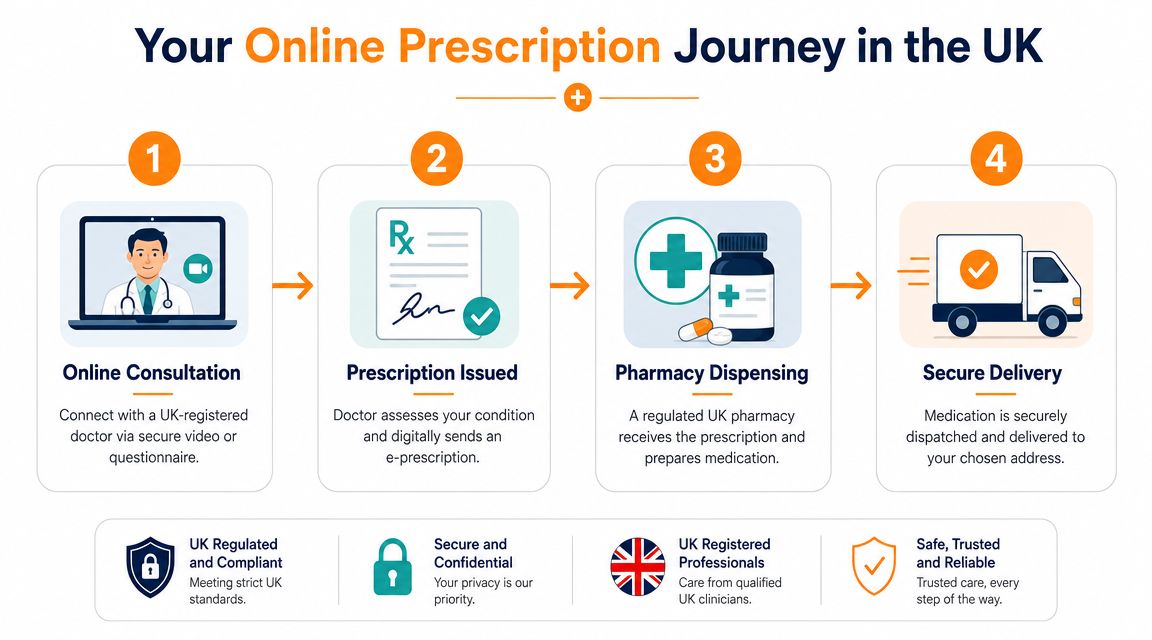
Most online prescribing follows a fairly clear path. Knowing that path makes the whole thing feel less mysterious.
Step 1 to step 2
Step 1. You complete a consultation
You answer questions about your symptoms, health conditions, allergies, pregnancy risk where relevant, and any medicines you already take. For some services, that may be a written questionnaire. For others, it may include video or phone contact.
Step 2. A real clinician reviews it
This is the heart of safe online prescribing. The clinician checks whether the requested medicine fits your answers, whether there are warning signs, and whether more information is needed.
A lot of patients are surprised by this stage. They expect either instant approval or a live call every time. In reality, asynchronous review often works well because the clinician can read carefully, compare answers, and pause when something doesn't add up.
The safest online prescribing doesn't remove clinical judgement. It gives that judgement better information and a clean record.
The growth in online dispensing shows many patients are comfortable with digital supply when the process is clear. The number of patients choosing online pharmacies for NHS prescriptions nearly doubled from just under 1 million in March 2020 to almost 2 million in March 2022, while item volume through online pharmacies grew fourfold between 2016 and 2021 [2].
If you want a plain-English example of why you might not always get a call, this explanation of how ordering treatment works and why you might not get a call reflects how many safe digital services operate.
Step 3 to step 4
Before the medicine is sent, it helps to remember what happens next.
Step 3. You get an outcome
There are usually three possibilities:
- Approved: The prescription is suitable and moves to dispensing.
- More information needed: The clinician needs clarification before deciding.
- Declined: The medicine isn't suitable, or you need another type of assessment.
Step 4. The pharmacy dispenses and sends it
Once approved, the prescription goes to a regulated pharmacy for a second layer of checks before supply. The medicine is then packed and delivered, often discreetly.
Featured snippet answer
Can an online doctor in the UK prescribe without speaking to me live?
Yes, if a registered clinician can assess your case safely from the information provided. If they can't, they should ask follow-up questions or direct you to in-person care.
Pharmacist's tip: Answer the consultation as if your safest treatment depends on it, because it does. Missing out a medicine, allergy, or symptom can change the decision.
What medicines can and cannot be prescribed online
Some medicines are a good fit for online care. Others aren't. The difference usually comes down to how certain the diagnosis is, how risky the medicine is, and whether you need an examination or monitoring.
Treatments that often suit online care
These are commonly suitable when the condition is straightforward and your answers support the diagnosis.
| Medicine Category | Commonly Prescribed Online? | Examples |
|---|---|---|
| Straightforward condition treatments | Often yes | Erectile dysfunction treatment, acne treatment, hair loss treatment, some migraine treatment |
| Stable repeat medicines | Sometimes yes | Repeat inhalers, some HRT, contraception renewals where clinically appropriate |
| Symptom-led short courses | Sometimes | Selected treatments where symptoms are clear and no red flags appear |
Treatments that usually need more than an online form
Some requests need more caution.
- Medicines needing close monitoring: These may require blood tests, physical checks, or regular review.
- Medicines for unclear symptoms: If the diagnosis isn't obvious, prescribing online becomes less safe.
- Certain high-risk or tightly controlled medicines: These often involve stricter legal or clinical rules.
A useful example is sleep treatment. People often assume anything that helps sleep should be easy to order online, but rules differ depending on the medicine and why you need it. This article on why melatonin is restricted in the UK shows how the legal side can shape what an online prescriber can offer.
Some medicines are easy to send. That doesn't make them easy to prescribe safely.
Featured snippet answer
Can I get repeat prescriptions online in the UK?
Often, yes. Repeat medicines are commonly suitable when your condition is stable and the prescriber has enough information to confirm ongoing safety.
Pharmacist's tip: If your symptoms are new, severe, or changing quickly, don't force them into an online treatment category just because it's convenient.
Choosing a safe and reputable online doctor service
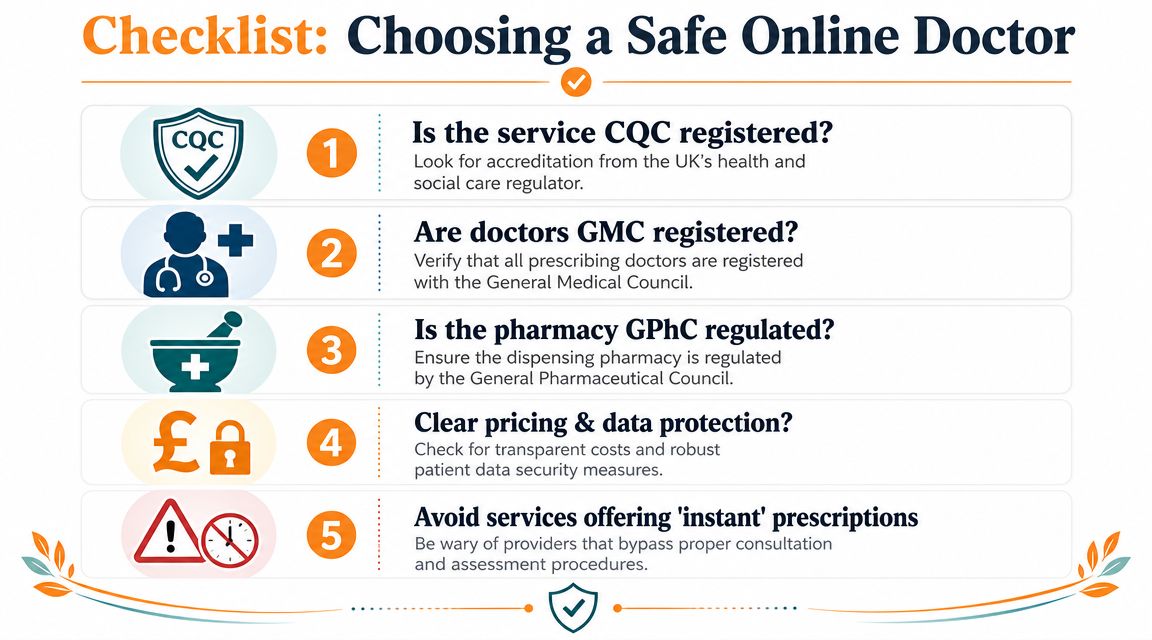
This is the part that protects you. A polished website means very little on its own. Safe online prescribing depends on regulation, identity checks, clinician oversight, and a pharmacy that follows UK rules.
Green flags worth looking for
Start with identity checks. The NHS online services model requires registration and strong identity verification, often using photo ID and a face scan, because that helps reduce fraud and wrong-patient prescribing [3]. Private services don't have to mirror every NHS step exactly, but reputable ones should take identity seriously.
Look for these signs:
- Named prescribers: The service should be open about who reviews consultations.
- A regulated pharmacy: Medicines should come from a UK-regulated dispensing pharmacy.
- Clear contact details: You should be able to find a real UK address and support route.
- A privacy policy that makes sense: Your medical data should be handled clearly and securely.
- Follow-up when needed: Good services don't disappear after checkout.
If you want to judge how a provider explains patient data handling, a UK privacy statement for online pharmacy services is worth reading for comparison.
Red flags that should make you stop
Some warning signs are hard to miss once you know them.
- “No questions asked” claims: Safe prescribing always needs questions.
- Instant approval language: A proper clinical review takes judgement.
- No mention of who prescribes: If you can't tell who is responsible, step away.
- No route for problems after supply: Medicines can cause side effects or need follow-up.
- Pressure selling: Healthcare shouldn't feel like buying trainers online.
There's also a trust issue to remember. A UK study published in 2021 found that the public placed high value on consultations at a local medical centre and low value on phone, video, or instant messaging formats. The paper concluded there was "little appetite" in mid-2018 for online providers or non-face-to-face GP appointments [4]. That doesn't mean online care isn't useful. It means providers need to earn trust through safe process, not slick marketing.
Featured snippet answer
How do I know an online doctor service is legit in the UK?
Check that real clinicians review consultations, the dispensing pharmacy is regulated, identity checks are in place, and the website clearly explains privacy, contact details, and follow-up.
Pharmacist's tip: If a service feels vague about safety, assume the safety is vague too.
Real-life examples of using an online prescription service
Online prescribing works best when it solves a practical problem without cutting corners. These are the kinds of situations where it can help.
Example 1 the busy parent
A parent notices their child's regular inhaler is running low and can't easily get to a daytime appointment. An online repeat request can be practical if the condition is already diagnosed, the medicine is established, and the clinician has enough information to check it's still appropriate.
The useful part isn't just speed. It's that the parent can complete the details after bedtime, in one sitting, with a written record of the child's medicines and symptoms.
Example 2 the shift worker
A warehouse worker with recurring migraines struggles to phone a surgery during normal office hours. An online consultation can work well when the migraine pattern is already understood and the answers don't suggest another urgent cause for the headache.
Asynchronous review often shines. The patient can describe triggers, past treatments, and warning signs clearly, and the clinician can assess that information without rushing.
Example 3 the privacy seeker
A man wants help for erectile dysfunction but feels uncomfortable discussing it face to face. Online care can make that first step easier, provided the service still asks the right questions about heart health, current medicines, and whether the symptoms could point to a wider health problem.
That privacy matters because many people still prefer traditional care for some issues. As noted earlier, UK public preference has historically leaned towards face-to-face appointments [4]. Good online services don't try to pretend that preference is wrong. They make remote care safe, discreet, and appropriate for the right cases.
Convenience helps people seek care. Safety decides whether they should get the medicine.
Your final checklist before getting an online prescription
A few checks before you order can save a lot of trouble later.
A quick pre-order check
Run through this list before you submit anything:
- Check the prescriber details: Make sure the site explains who reviews consultations.
- Check the pharmacy details: You should know which pharmacy dispenses the medicine.
- Read the pricing carefully: Look for consultation, medicine, and delivery costs.
- Provide accurate information: Include all medicines, allergies, and health conditions.
- Read the safety information: Make sure you understand side effects and when not to take it.
- Know what happens if declined: A safe service may say no.
- Know how your data is used: This matters for any health service handling sensitive information.
If you want to see the sort of information a provider may collect during assessment, this page on patient consultation data is a useful example.
When to seek urgent help instead
Online prescribing is not right for emergencies.
Seek urgent medical help now if you have symptoms such as:
- Chest pain
- Severe shortness of breath
- Signs of stroke
- Severe allergic reaction
- Sudden confusion
- Heavy bleeding
- A rapidly worsening infection with severe illness
Featured snippet answer
Is an online doctor prescription in the UK safe?
It can be, if a registered clinician reviews your case properly, identity checks are in place, and a regulated pharmacy dispenses the medicine. It isn't safe when services skip questions or promise instant prescriptions.
In summary, online prescribing can be a very sensible option when the condition is suitable, the service is regulated, and a real clinician reviews the case. The questionnaire isn't there to replace a doctor. It's there to give the doctor the facts needed to make a safe decision. For many common and repeat treatments, that works well. For severe, unclear, or high-risk problems, in-person care is still the safer route. The trick is knowing the difference, and choosing a provider that does too.
If you want a UK-regulated option that uses clinician-reviewed questionnaires and pharmacy checks rather than a “robot doctor” approach, Courier Pharmacy offers online treatment services with discreet delivery, follow-up support where appropriate, and a broad range of prescription options.
Summary
Yes, you can get a legal online prescription in the UK. The safe version always includes a real clinician review. A questionnaire is a tool, not a substitute for judgement. Many common and repeat treatments suit online care well. Some medicines and symptoms still need in-person assessment. Check the provider, answer truthfully, and don't ignore red flags. If you're ever unsure, ask before you order.
FAQs
Can an online doctor legally prescribe in the UK?
Yes. Online prescriptions must meet UK legal standards in the same way as prescriptions issued in person [1]. The format may be digital, but the clinical and legal responsibility still sits with the prescriber.
Is an online questionnaire enough for a prescription?
Sometimes, yes. If the condition is suitable and the clinician has enough information to assess safety, a questionnaire can support safe prescribing. If not, the service should ask for more information or direct you elsewhere.
Are online prescriptions just approved by a computer?
A safe service shouldn't work that way. The questionnaire may collect information efficiently, but a real clinician should review the answers and make the prescribing decision.
Can I get antibiotics from an online doctor?
Sometimes, but only when clinically appropriate. Infections can be tricky, and some need examination, testing, or closer review. Antibiotic prescribing also needs caution because of resistance concerns [4].
Can I get controlled drugs online?
Some medicines in tightly controlled categories have extra legal requirements, and some are not suitable for routine online prescribing [1]. If a website appears relaxed about those rules, that's a warning sign.
Why did the clinician refuse my request?
Refusal can be a sign the process worked properly. The medicine may not suit your symptoms, may interact with another treatment, or may need in-person assessment first.
Do I need ID for online prescriptions?
Often, yes. Strong identity checks help reduce fraud and wrong-patient prescribing, and the NHS uses photo ID and face-based checks for online services [3]. Private providers that take safety seriously often use similar checks.
Is online prescribing better than seeing my GP?
Not always. It can be more convenient and very effective for the right problems, but many people still value face-to-face care highly [4]. The best choice depends on the condition, the medicine, and how certain the diagnosis is.
Meta description
Online doctor prescription UK explained. Learn how online prescriptions work, what's safe, and how to choose a trusted UK service.
Internal links to consider
- Online pharmacy UK
- How ordering treatment works and why you might not get a call
- Why melatonin is restricted in the UK
- Privacy statement UK
- Patient consultation data
Visual ideas for the designer
Illustration idea 1
A patient at home completing a health questionnaire while a clinician reviews notes on another screen, with brass plaque labels showing “Questionnaire”, “Clinical review”, and “Dispensing”.
Alt text: Patient completing an online medical questionnaire while a UK clinician reviews the case remotely.Illustration idea 2
A safety checklist poster in pale yellow-green and lime with ornate brass borders, showing identity check, clinician review, regulated pharmacy, and follow-up.
Alt text: Checklist showing the safety steps involved in getting an online prescription in the UK.Illustration idea 3
A split-scene comparison of “safe online prescribing” versus “unsafe instant prescribing”, using light grey backgrounds and bright green approval marks.
Alt text: Comparison between a regulated online prescription process and an unsafe instant medicine website.
Byline
Author: Medical Mojo Editorial Team
Credentials: Health content writers with UK pharmacy and prescribing input
Clinical review: Clinically reviewed by a UK-registered pharmacist
How this content was created
This article was written using UK health service information and peer-reviewed research listed below, then structured for patient readability and reviewed for clinical sense, legal accuracy, and plain-English clarity. It is for information only and isn't a substitute for personal medical advice.
References
[1] Health Education England, n.d. Legal aspects of prescription writing. Available at: https://london.hee.nhs.uk/medicines-management-legal-aspects-prescription-writing [Accessed 22 May 2026].
[2] The Pharmaceutical Journal, 2022. Online pharmacy boom prompts concern over patient safety. Available at: https://pharmaceutical-journal.com/article/feature/online-pharmacy-boom-prompts-concern-over-patient-safety [Accessed 22 May 2026].
[3] NHS, n.d. Online health and prescription services. Available at: https://www.nhs.uk/nhs-services/gps/online-health-and-prescription-services/ [Accessed 22 May 2026].
[4] Victoor, A., Delnoij, D., Friele, R. and Rademakers, J., 2021. Why patients do not use online consultations in general practice in the Netherlands? Evidence from a discrete choice experiment. Available at: https://pmc.ncbi.nlm.nih.gov/articles/PMC7937442/ [Accessed 22 May 2026].


