Online Pharmacist Consultation: Your 2026 UK Guide
Considering an online pharmacist consultation? Our 2026 UK guide explains how it works, safety, costs, and treatable conditions. Get expert advice.
SEO brief
- Primary keyword: online pharmacist consultation
- Secondary keywords: online pharmacy consultation UK, pharmacist online prescription, remote pharmacy consultation, online prescription service, weight loss consultation online
- Search intent: informational, safety-focused, comparing options before using an online service
- Target reader: UK adults who want convenient, regulated access to treatment and advice
- Product/service mention (if any): assumed to be a UK online pharmacy service for prescriptions and consultations
- Internal links available: assumed from the brief and included where required
An online pharmacist consultation is a convenient, regulated way for UK patients to get expert medical advice and prescriptions from a pharmacist through a secure online process, without needing an in-person visit. In one NHS England pathfinder programme, pharmacist-led consultations averaged 28.4 minutes, and 334 out of 1,153 consultations led to a new prescription while 114 led to prescription changes, showing these are real clinical appointments rather than quick tick-box forms [1].
If you're reading this while juggling work, childcare, symptoms, and a half-finished cup of tea, you're not alone. Many people want help quickly, but they also want to know whether online care is safe, who reviews the form, and when a pharmacist can help instead of a GP. This guide explains how an online pharmacist consultation works, who it suits, what the rules say, and how to spot a service that treats you like a person, not a checkout basket.
Five key takeaways
- It isn't just a form: A real clinician reviews the consultation and may message or call you.
- UK rules are stricter now: High-risk medicines can't be prescribed from an online questionnaire alone [2].
- Pharmacists can do a lot: They can assess symptoms, advise on treatment, and prescribe in some settings.
- Some people benefit hugely: Busy parents, shift workers, and people wanting discreet care often find it easier.
- Safety comes first: Good services adapt for disability, check details properly, and tell you when face-to-face care is better.
What an online pharmacist consultation really is
A simple definition
An online pharmacist consultation is a clinical health service delivered digitally. You share details about your symptoms, medicines, allergies, and medical history through a secure system. A pharmacist or prescriber then reviews that information and decides what happens next.
That might mean advice only. It might mean treatment. It might also mean the clinician asks more questions, suggests another option, or tells you that you need an in-person review instead.
This is the key point many people miss. It isn't the same as buying shampoo online. You're not just clicking “add to basket” and hoping for the best. A healthcare professional is involved in the decision.
If you've ever wondered what sits behind the form, this guide to how treatment ordering works and why you might not get a call shows why some consultations move forward smoothly while others need follow-up.
Practical rule: If a service treats your health like an ordinary online order, that's a warning sign. Clinical care should include judgement.
Why people use it
For many patients, the appeal is simple. Life gets busy. GP appointments can be hard to line up with work, school runs, caring duties, or night shifts. An online consultation gives you a way to start the process when it suits you.
It can also feel easier for private or sensitive concerns. People often prefer to discuss things like erectile dysfunction, hair loss, cystitis, contraception, acne, or sleep issues from home.
That said, convenience doesn't replace proper care. A good service still checks whether your symptoms fit the treatment, whether the medicine is safe for you, and whether another route would be better.
Featured answer
What is an online pharmacist consultation?
It's a secure online clinical assessment where a pharmacist or prescriber reviews your health details, gives advice, and may arrange treatment if it's safe and appropriate.
How the online consultation process actually works
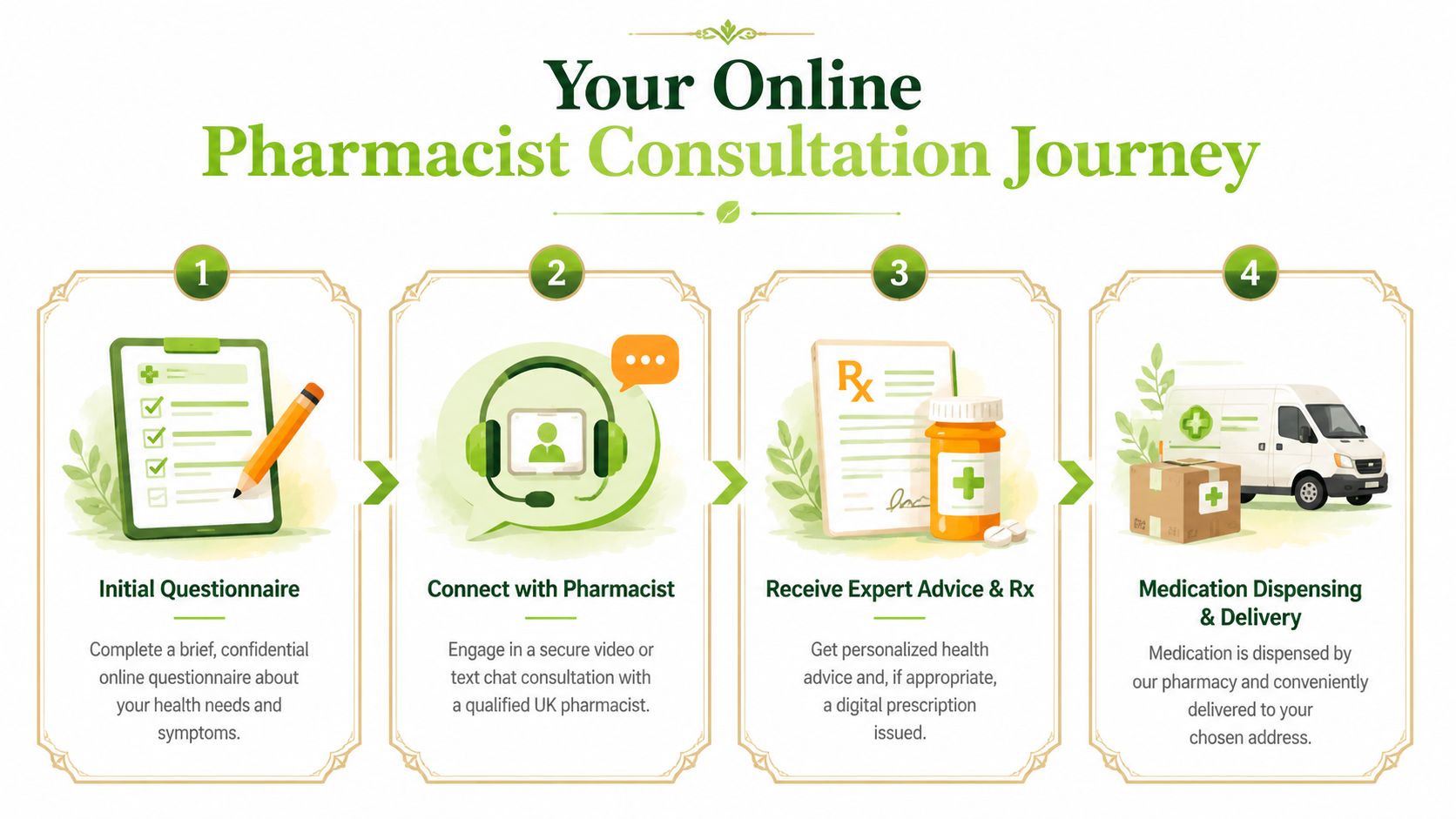
The usual journey step by step
A good online consultation works more like a written clinic appointment than an online checkout. You answer clinical questions, a regulated professional reviews what you have said, and the next step depends on whether treatment is safe and suitable.
You complete a secure questionnaire.
You describe your symptoms, medical history, current medicines, allergies, and any previous problems with treatment. The clearer your answers, the easier it is for the clinician to judge what is appropriate.A clinician reviews your information.
This is the part many patients do not see. A pharmacist prescriber or another qualified prescriber reads the consultation, checks for warning signs, and considers whether the requested treatment matches the information provided.You may be asked follow-up questions.
A secure message, photo request, phone call, or another form of two-way contact may be needed if something is unclear. For some medicines, especially sensitive or higher-risk treatments, extra checks are part of proper prescribing rather than a sign that anything has gone wrong.A prescribing decision is made.
You may be approved for treatment, advised to use a different option, given self-care advice, or told that you need in-person assessment. A safe service is prepared to say no when the online route is not suitable.
You can also review how some services handle and protect clinical information in their page about patient consultation data.
When a pharmacist needs more information
The form is the starting point, not the whole consultation.
That matters because UK rules have become stricter. GPhC guidance updates for 2024 and 2025 place clear expectations on online prescribing, particularly for medicines with greater risk or potential for misuse. In those cases, prescribers should not rely only on a questionnaire. They may need timely two-way communication, access to relevant records, or contact with your GP or regular prescriber where appropriate and with your consent [2].
A simple way to view it is this. The questionnaire opens the door, but professional judgement decides whether treatment should follow.
For example, a patient might request a medicine for a sensitive condition, but their symptoms may not fit the usual pattern. Another patient may list medicines that could interact. Someone else may report a warning sign that points to an infection, a side effect, or a problem needing examination. In each case, the prescriber should pause, clarify, and only proceed if the information supports safe prescribing.
Some consultations are straightforward. Others need a message, phone call, or GP check. That is part of safe care.
Pharmacist's tip
Pharmacist's tip: Fill in the form as if you were speaking face to face with a clinician. Include allergies, long-term conditions, pregnancy status if relevant, and every regular medicine, including over-the-counter products and supplements.
Featured answer
Do pharmacists really read online consultation forms?
Yes. In a legitimate UK service, a clinician reviews the consultation and may contact you if anything needs checking, especially for higher-risk or sensitive medicines.
Who can benefit most from seeing a pharmacist online

Real-life examples
Some people get the most value from online care because the usual routes don't fit their lives very well.
Busy parent
A parent notices a child has a worsening skin problem late in the evening. They don't want to spend the next morning ringing for an appointment while sorting breakfast, uniforms, and a school bag crisis. An online pharmacist consultation lets them start the process at home, then follow the next steps based on the clinician's advice.
Shift worker
A nurse, warehouse worker, or delivery driver may sleep during the day and work when most clinics are open. Online services make it easier to ask for help outside the usual routine. That can be especially helpful for repeat treatment reviews, skin issues, migraines, or private concerns.
Gym-goer
Someone training regularly may want advice about a recurring rash, asthma inhaler use, or a wellbeing concern they'd rather not discuss at a busy counter. Remote care can feel simpler and more discreet.
Person seeking support with weight management
Someone exploring medically supervised weight loss may value privacy, structured questions, and a careful review before treatment. A condition-specific page such as online weight-loss treatment support shows the kind of information a pharmacy may need before moving ahead.
Accessibility matters
Online care shouldn't be one-size-fits-all. Research in UK pharmacy practice says pharmacists should be “proactive in asking what your patient needs to feel comfortable, particularly if they are vulnerable or have a disability” and that good remote services should offer different communication methods so the quality feels equal to face-to-face care [3].
That matters more than many websites admit. A standard video call might not suit someone with chronic fatigue. A rushed phone call may not help a person with hearing difficulties. A long form may be hard for someone with brain fog or pain.
A good service can adapt by:
- Offering choice: Secure message, phone, or video where appropriate.
- Giving clear contact routes: So you know how to ask for help.
- Recognising limits: Some symptoms still need an examination in person.
Pharmacist's tip
Pharmacist's tip: If you need adjustments, say so early. Ask for written follow-up, extra time, or another contact method. Good clinicians would rather adapt the consultation than guess.
Featured answer
Who is online pharmacy care best for?
It often suits busy adults, carers, shift workers, and people who want discreet help, as long as their problem is appropriate for remote assessment.
Is an online pharmacist consultation safe and regulated
Yes, it can be safe. The important word is regulated.
In the UK, legitimate online pharmacies and prescribers work within professional rules. Public attitudes changed sharply after COVID-19, and remote care became a normal part of healthcare access. At the same time, regulators tightened the rules around online prescribing, especially for medicines with higher risk [4].
If you're checking a service, start with whether it's a proper UK online pharmacy. Regulation matters far more than slick branding.
What the rules now require
For high-risk medicines like weight loss drugs, UK prescribers cannot make decisions based on an online questionnaire alone. Updated General Pharmaceutical Council guidance says they must independently verify patient information through timely two-way communication, access to clinical records, or direct GP contact [5].
That means the safer model is also the more human one. The clinician may need to ask follow-up questions, confirm your details, or check your wider health picture before they prescribe.
This also helps separate regulated UK services from risky websites that appear to sell prescription medicines with little real assessment. If a website seems willing to approve anything instantly, that's not convenience. That's a concern.
How to spot a legitimate UK service
Look for signs that the service takes clinical safety seriously:
- Registered professionals: You should be able to see who regulates the pharmacy or prescriber.
- Clear questions: The form should ask about medical history, allergies, and current medicines.
- A real review process: The service should explain that a clinician reviews the request.
- Follow-up if needed: There should be a route for secure messages or calls.
- Willingness to say no: Safe pharmacies don't supply treatment just because you asked for it.
A short explainer can help here:
A regulated service doesn't prove itself by being fast. It proves itself by being careful when careful is needed.
When to seek urgent help
An online pharmacist consultation is not right for emergencies. Seek urgent help if you have:
- Chest pain
- Severe shortness of breath
- Signs of stroke
- Heavy bleeding
- A severe allergic reaction
- Rapidly worsening infection with severe illness
Pharmacist's tip
Pharmacist's tip: If your symptoms are getting worse by the hour, don't wait for an online reply. Use urgent care services straight away.
Featured answer
Are online pharmacist consultations legal in the UK?
Yes, if the service is properly regulated and follows UK prescribing rules. High-risk medicines need extra checks and two-way verification [5].
Online pharmacist vs your GP which should you choose
Choosing between an online pharmacist, your GP, and an in-person community pharmacist isn't about picking a winner. It's about picking the right tool for the job.
Pharmacist-led care can be much more substantial than people assume. In an NHS England pathfinder programme, the average pharmacist-led consultation lasted 28.4 minutes, based on 1,153 consultations across 13 pathfinder sites. During that period, 334 consultations resulted in a new prescription and 114 led to prescription changes [1].
Comparing your healthcare options
| Feature | Online Pharmacist Consultation | GP Appointment | In-Person Community Pharmacist |
|---|---|---|---|
| Best for | Straightforward conditions, treatment reviews, discreet care, some prescribing | Undiagnosed complex problems, long-term diagnosis, referrals, full medical oversight | Quick advice, minor ailments, medicine questions |
| Convenience | High. Often started from home at a time that suits you | Lower if appointments are limited | High for walk-in advice |
| Privacy | Good for sensitive issues | Good, but appointment access may take longer | Can vary depending on pharmacy setting |
| Physical examination | Limited | Available where needed | Limited |
| Prescribing scope | Depends on service and clinician | Broad | Some services and advice, but not every case |
| When it may not suit | Emergencies, severe symptoms, unclear diagnosis | Less convenient for simple, time-sensitive issues | Cases needing prescribing or deeper review |
When each option makes sense
Choose an online pharmacist consultation if:
- You know the issue is straightforward: For example, a recurring condition already assessed before.
- You need convenience: You can't easily get to a surgery during working hours.
- You want privacy: Sensitive health concerns can feel easier to discuss from home.
Choose your GP if:
- Your symptoms are unclear: New pain, unexplained weight change, or symptoms affecting several body systems.
- You may need tests or referral: Especially if diagnosis is uncertain.
- You have a complex medical history: Joined-up care may matter more than speed.
Choose an in-person pharmacist if:
- You need quick over-the-counter advice
- You want help using a medicine correctly
- You'd benefit from being signposted to the right service
Your pharmacist and your GP don't compete. They often support different parts of the same care journey.
Featured answer
Should I see an online pharmacist or my GP?
Use an online pharmacist for suitable, lower-risk issues and practical treatment questions. Use your GP for complex, unexplained, or serious health problems.
Common conditions treated via online consultations
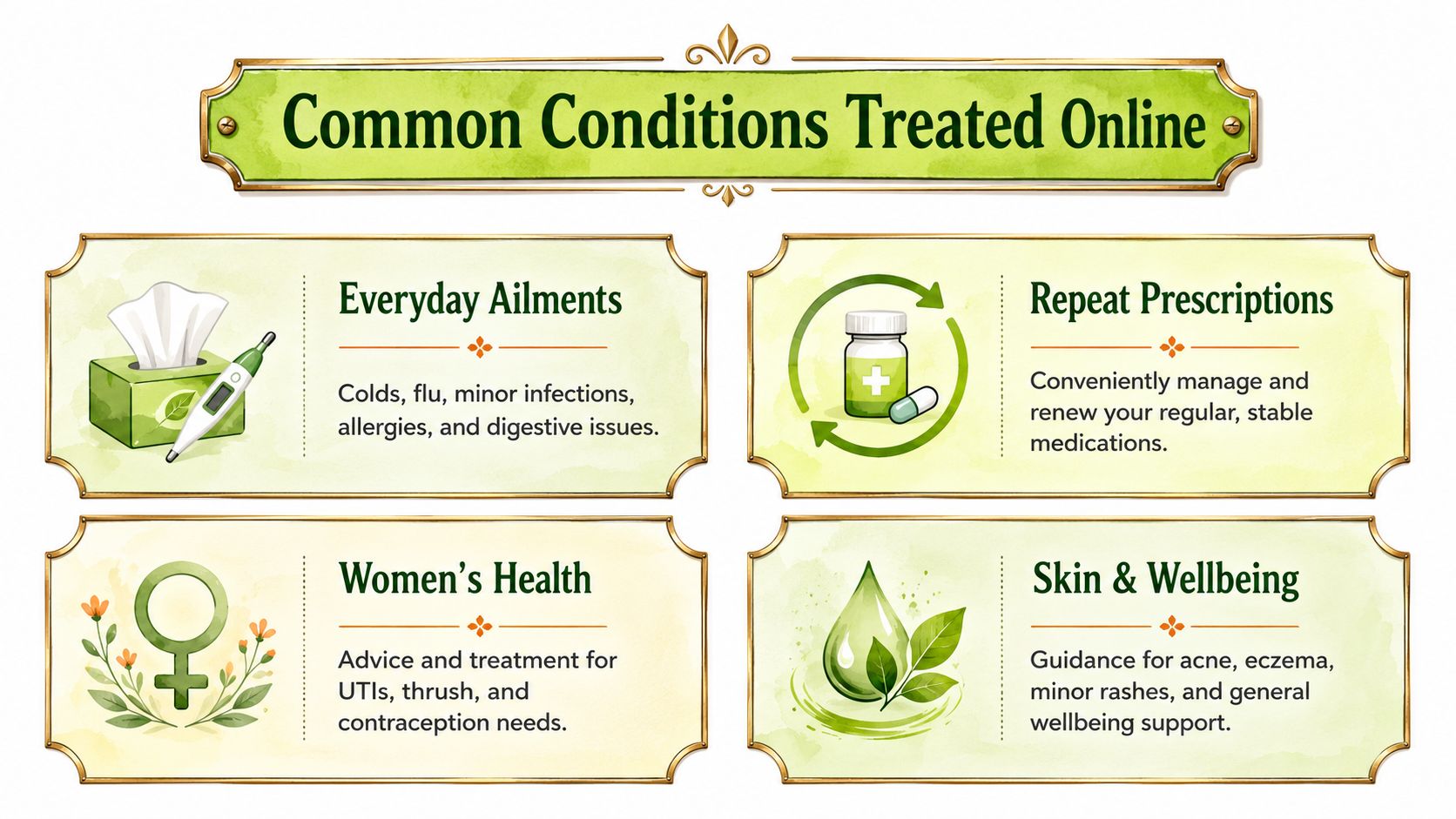
You might be filling in a consultation form late in the evening, once the children are asleep or after a long shift, wondering what can be dealt with online and what still needs a face-to-face appointment.
Quite a lot can be assessed remotely, provided the condition is suitable and a real clinician reviews the answers properly. That human review matters. Under current UK expectations, especially for higher-risk or sensitive treatments, online care should work like a triage conversation written down clearly, not a vending machine for medicines.
Examples of conditions often managed online
Online pharmacist services often help with:
- Men's health: Erectile dysfunction, hair loss, and treatment checks for ongoing problems.
- Women's health: Cystitis, thrush, contraception queries, HRT support, and period-related symptoms.
- Skin conditions: Acne, eczema, minor rashes, and some straightforward skin infections.
- Recurring treatment needs: Allergy treatment, migraine support, asthma-related reviews, and stable repeat treatment questions.
- Lifestyle and wellbeing care: Sleep problems, sexual health concerns, and clinically assessed weight management treatment.
Some pharmacies also support people with longer-term or more complex conditions through medicine reviews or personalised prescribing arrangements. That does not mean every part of care can happen online. It means online review can be one useful part of a wider treatment plan, much like sending a clear snapshot to a clinician before deciding whether you need a fuller examination.
If you want to see the range of problems commonly assessed by one service, you can browse this online treatment list for different conditions.
Why sensitive treatments need more than a form
Sensitive treatments are a good example of why regulation now places so much weight on proper clinical checks. A questionnaire may start the process, but it should not be the whole process where extra risk is involved.
Weight management is a clear case. For medicines such as Wegovy or Mounjaro, the prescriber needs enough reliable information to confirm the treatment is appropriate, including checking weight-related details rather than accepting every answer at face value. The same principle applies more broadly in areas such as sexual health or treatments where symptoms might point to another underlying problem.
A well-run online consultation works like a pharmacist asking careful follow-up questions across a counter, just in digital form. If something does not fit, the clinician should pause, ask for more detail, request evidence where appropriate, or direct the patient to in-person care.
Two realistic examples
A private men's health concern
A man in his forties wants help with erectile dysfunction but has delayed asking because the conversation feels awkward. An online consultation gives him privacy and time to answer properly. If his history suggests the issue is suitable for remote treatment, the prescriber can consider options. If his answers raise concerns about blood pressure, heart health, or another cause, he may be advised to see his GP first.
A familiar bout of cystitis before the weekend
A woman notices symptoms she recognises and wants advice quickly. The online consultation can help separate a straightforward pattern from warning signs such as fever, flank pain, pregnancy, or symptoms that do not match simple cystitis. That is the difference between safe digital care and a tick-box exercise. The clinician is judging suitability, not just processing an order.
Pharmacist's tip
Pharmacist's tip: Before starting, jot down when your symptoms began, any medicines you already take, what you have tried so far, and whether you have had the same problem before. Clear information helps the clinician make a safer decision, and it often speeds things up too.
Featured answer
What conditions can an online pharmacist treat?
Often straightforward or recurring problems such as some skin conditions, men's and women's health concerns, treatment reviews, allergies, and selected weight management or sexual health services. New, severe, or hard-to-explain symptoms usually need in-person assessment.
If you want a regulated UK service that combines digital convenience with human clinical review, Courier Pharmacy offers secure online consultations, personalised treatment options, discreet delivery, and support for a wide range of everyday, sensitive, and specialist health needs.
Summary
An online pharmacist consultation is a real clinical service, not just an online order form.
It gives many UK patients a practical way to get advice and treatment from home.
The process works best when a clinician reviews your information properly and follows up if needed.
UK rules are clear that high-risk medicines need more than a questionnaire alone.
That makes good online care both convenient and carefully regulated.
For simple or suitable problems, it can save time.
For complex, urgent, or unclear symptoms, face-to-face care is still the right choice.
FAQs
Can a pharmacist prescribe online in the UK?
In some settings, yes. The exact setup depends on the service and the prescriber involved. A regulated service should explain who reviews your consultation and how prescribing decisions are made.
Is an online pharmacist consultation just an online form?
No. The form is only the starting point. In legitimate UK practice, a clinician reviews it and may contact you for more information before making a decision.
How long does an online pharmacist consultation take?
The time varies by service and by how complex your case is. In NHS England pathfinder data, pharmacist-led consultations averaged 28.4 minutes [1], which shows these reviews can be detailed.
Are online consultations private?
They should be. Good services use secure systems and explain how they handle your information. You should also do your bit by completing the consultation in a private place when possible.
Will the pharmacist contact my GP?
Sometimes, yes, if it's needed for safe prescribing and you consent. For some higher-risk medicines, UK guidance allows prescribers to verify information through clinical records or direct GP contact [5].
Can I get weight loss medication through an online consultation?
Possibly, but the checks are stricter. Prescribers must independently verify key details such as weight, height, and/or BMI before issuing weight-management medicines online [6].
What if I have a disability or find remote consultations hard?
Tell the service what you need. Good pharmacy teams should ask what helps you feel comfortable and offer different communication methods where possible [3].
When should I avoid using an online pharmacist consultation?
Don't use it for emergencies or severe symptoms such as chest pain, severe breathing problems, stroke signs, heavy bleeding, or rapidly worsening illness. Those need urgent medical help.
Meta description
Online pharmacist consultation explained for UK patients. Learn how it works, who it suits, and the safety rules that make online prescribing more secure.
Suggested internal links
- How ordering treatment works
- Patient consultation data
- Online pharmacy UK
- Weight loss treatments
- Browse all conditions
Byline and clinical review
Author: Medical Mojo Editorial Team, health educators
Clinical review: UK-registered pharmacist, GPhC-registered reviewer
How this content was created
This article was written using UK pharmacy guidance, professional pharmacy publications, and healthcare regulation updates listed below. A clinical reviewer checked the content for accuracy, safety, tone, and relevance to UK patients. This information is for education only and isn't a substitute for personal medical advice.
References
[1] Pharmaceutical Journal. 2024. Pathfinder sites report 28-minute consultation times, finds NHS England analysis. Available at: https://pharmaceutical-journal.com/article/news/pathfinder-sites-report-28-minute-consultation-times-finds-nhs-england-analysis
[2] Bioslice Blog. 2025. Online pharmacies required to strengthen safeguards to prevent unsafe supply of medicines in the UK. Available at: https://www.biosliceblog.com/2025/02/online-pharmacies-required-to-strengthen-safeguards-to-prevent-unsafe-supply-of-medicines-in-the-uk/
[3] Pharmaceutical Journal. 2024. Remote consultations. How pharmacy teams can practise them successfully. Available at: https://pharmaceutical-journal.com/article/ld/remote-consultations-how-pharmacy-teams-can-practise-them-successfully
[4] PMC. 2021. Public attitudes before COVID-19 and the shift toward online consultations and digital care. Available at: https://pmc.ncbi.nlm.nih.gov/articles/PMC7937442/
[5] Centre for Pharmacy Postgraduate Education. 2025. GPhC publish updated guidance for online pharmacy services. Available at: https://cpe.org.uk/our-news/gphc-publish-updated-guidance-for-online-pharmacy-services/
[6] Happy Pharmacy. 2025. 2025 changed everything. How online UK pharmacy regulations changed this year. Available at: https://happypharmacy.co.uk/blogs/wellbeing-and-pharmacy-updates/2025-changed-everything-how-online-uk-pharmacy-regulations-changed-this-year


