Online Prescription Pharmacy: How It Works and Is It Safe
Learn what an online prescription pharmacy is, how digital prescribing works, UK rules from the GPhC and MHRA, and how to choose a safe provider.
An online prescription pharmacy lets you request medicines and complete consultations remotely, with home delivery for suitable orders. Before using one, ask what happens after you submit the questionnaire: who reviews it, how they assess whether treatment is appropriate, and what happens if you need care the service cannot provide online?
A questionnaire begins clinical assessment; it does not replace professional judgement. Look for a clear pathway from your answers to a prescriber's decision, pharmacy checks, and follow-up where needed. Some concerns require an in-person examination or urgent care, rather than an online order.
Five key takeaways
- Check the register: Match the pharmacy's details to its website.
- Look for clinical review: A questionnaire starts the assessment; a prescriber must decide whether treatment is appropriate.
- Share your medicines: Include supplements, allergies and treatment from other services.
- Choose the right care route: Physical checks and urgent symptoms may need in-person care.
- Know how follow-up works: Find out who to contact about treatment or concerns.
What an Online Prescription Pharmacy Is
An online prescription pharmacy provides pharmacy care remotely, with prescription approval and dispensing checks before supply. The main changes are how you contact the team and receive your medicine, not a lower standard of care.
Say Sam, aged 34, works rotating shifts and needs a repeat asthma inhaler. He sends a request from his phone when the local pharmacy is closed. The service reviews whether a repeat is suitable, rather than treating his previous prescription as automatic approval.
If Sam reports worsening breathlessness or much more inhaler use, the clinician may direct him to a different care route. Delivery is useful for planned treatment. It isn't a way to manage an asthma emergency.
What changes and what stays the same
| Part of care | What an online route means |
|---|---|
| Contact | You provide information remotely rather than at a counter |
| Clinical decision | A prescriber still decides whether treatment is appropriate |
| Dispensing | A pharmacy checks and supplies the medicine |
| Receipt | Delivery replaces collection, where offered |
| Examination | The service may refer you for an in-person assessment |
In 2024, 6.6% of adults in England who used NHS pharmacy services said they usually used an online pharmacy, according to the Office for National Statistics' Health Insight Survey [1]. Online services therefore complement local pharmacies rather than replace them.
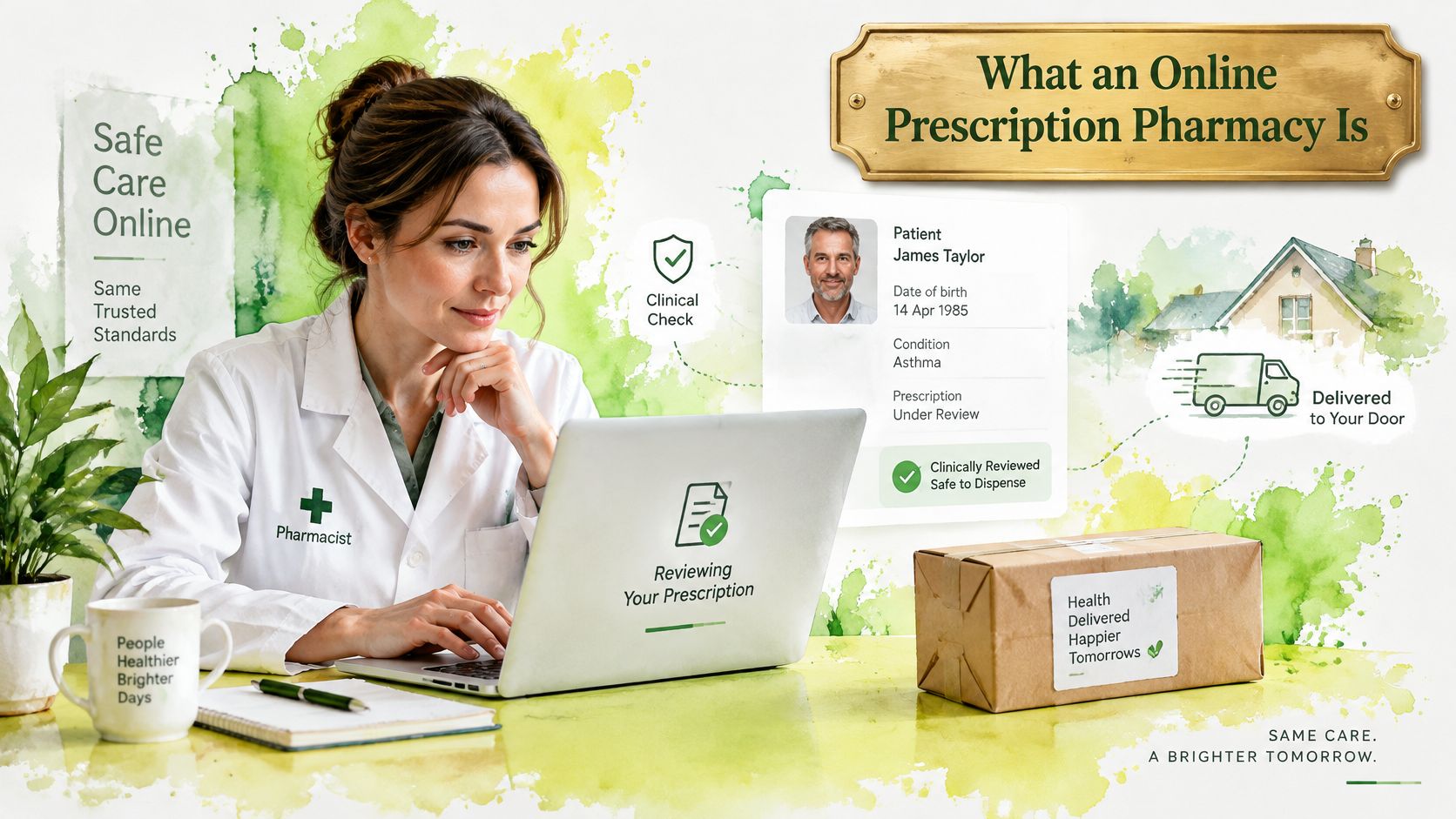
The image shows the clinical review behind a home-delivery service.
Check where the pharmacy operates
Great Britain and Northern Ireland don't have identical online-selling rules. The MHRA's Distance Selling Logo guidance explains that Great Britain sellers haven't needed the EU common logo since 1 January 2021, while relevant Northern Ireland sellers must register and display it [2].
Don't judge a pharmacy by a logo alone. Check its location and the regulator that applies before sharing health details.
How Digital Prescribing Works, Step by Step
Online prescribing means a clinician assesses your request before deciding whether to issue a prescription. Paying for a consultation doesn't guarantee medicine.
The MHRA's guidance accompanying its illegal-medicines enforcement report states that prescription-only medicines need an authorised prescriber and supply through a pharmacy or specifically licensed premises [3]. A website bypassing that route can expose you to unsafe or counterfeit products.
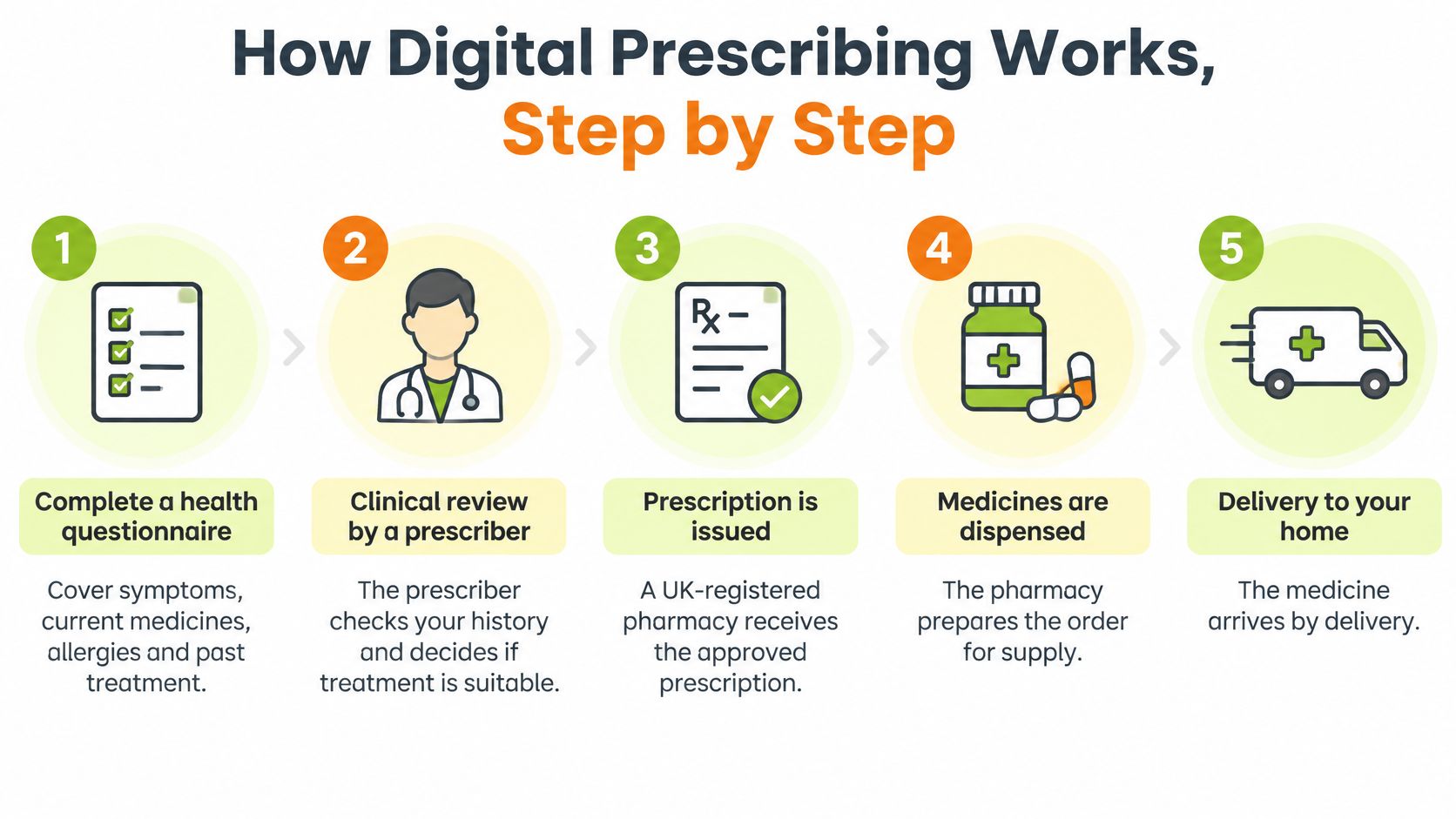
This infographic gives the broad pathway. The detailed checks may add stages before approval.
From request to follow-up
Complete the health questions carefully. Describe symptoms, past treatment, allergies and current medicines. Leaving out a supplement or previous reaction can change the decision and delay a safe assessment.
A prescriber reviews your answers. They may ask questions by message or phone. Don't assume silence means approval, and check the contact details you entered.
Unclear information needs further checks. The clinician may seek records, contact your regular prescriber or recommend an examination. A vague symptom description isn't a reason to guess at treatment.
The prescriber approves or declines treatment. They issue a prescription only when it's appropriate. If they decline, ask what care route they recommend rather than changing your answers elsewhere.
A pharmacist checks the prescription. They review the dose, instructions and possible problems with other medicines. A missing medicines list can stop dispensing even after the initial review.
The pharmacy prepares the delivery. Check the service's packing, tracking and storage arrangements. At Courier Pharmacy, we send orders in discreet packaging; enter your delivery address carefully.
Follow-up checks treatment progress. You may need a review, test or discussion about side effects. Missing a planned check can mean further supply isn't appropriate.
Prepare before you start
Have these details within reach:
- Medicines: Names, strengths and how often you take them.
- GP details: Your surgery and regular prescriber.
- Allergies: What caused the reaction and what happened.
- Recent treatment: Your last prescription date and any changes.
Pharmacist's tip: Use the labels on your current packs, not memory, when completing a medicines list.
A phone call isn't the only form of clinical contact. Our guide to how ordering treatment works and why you might not get a call explains the distinction between reviewing a request and calling every patient.
For another explanation of the ordering process, watch the video below.
Who regulates online prescription pharmacies in the UK
Which organisations oversee an online pharmacy, its medicines and the people who prescribe them? Each has a different role, so a pharmacy's registration is only one part of the check.
Who regulates what in the UK online pharmacy sector
| Body | What it controls | What you can check |
|---|---|---|
| General Pharmaceutical Council (GPhC) | Registers pharmacies and pharmacists in Great Britain and sets standards for online pharmacy services | Whether the pharmacy appears on the GPhC register |
| Medicines and Healthcare products Regulatory Agency (MHRA) | Licenses medicines, oversees the supply chain and issues safety alerts | Medicine licensing information and safety alerts |
| Information Commissioner's Office (ICO) | Enforces data protection rules, including those for health information | The privacy notice and named data controller |
| General Medical Council (GMC) | Regulates doctors who prescribe online | Whether the prescriber appears on the GMC register |
| Nursing and Midwifery Council (NMC) | Regulates nurse and midwife prescribers | Whether the prescriber appears on the NMC register |
Pharmacies in Great Britain, including online pharmacies, must register with the GPhC and meet its standards. Check the GPhC register before sharing personal or medical information. The register is a starting point, not a substitute for checking who is prescribing or whether a treatment is suitable.
Under UK GDPR and the Data Protection Act 2018, health information is special category data. A privacy notice should explain who controls your information, why it is collected and how it is used.
Why oversight matters
The GPhC annual report for 2023–24 records 680 online-pharmacy inspections since April 2019, with 72% meeting all applicable standards, compared with a historical 84% across all pharmacy inspections [5]. These figures describe inspection findings; they do not rate every online provider today.
The government's medicines-supply report states that approximately 80% of licensed UK medicine products were prescription-only in 2022 [6]. That helps explain why a clinical decision must come before dispatch.
The same report describes hospitalisations involving fake pens sold as semaglutide or liraglutide, including cases of hypoglycaemic shock and coma [6]. Hypoglycaemia means dangerously low blood sugar.
A questionnaire is the start of a clinical pathway, not proof by itself that a provider has one. Check whether the service identifies its pharmacy and prescriber, explains how a clinical decision is made, and provides a route for follow-up. The medicine's source and the person authorising it both matter.
Online and high street pharmacies compared
| Factor | Online prescription pharmacy | High street pharmacy |
|---|---|---|
| Access | Submit requests from home at any time; staff review during service hours | Visit during opening hours |
| Speed for a new medicine | Requires assessment and approval; the request can be declined | Requires an appropriate prescription or another lawful supply route |
| Face-to-face advice | Usually message, phone or video, rather than physical contact | In person, often without an appointment |
| Repeat prescriptions | Request through an account, with delivery where offered | Collect in person or ask about delivery |
| Urgent or same-day needs | Postal supply isn't suitable for urgent needs | May help the same day, subject to stock and clinical needs |
| Privacy | Can avoid a queue; check packaging arrangements | Ask for a private consultation space |
| Continuity of care | Needs reliable information-sharing with your usual team | May support local coordination; record access isn't automatic |
Choose for the problem, not just convenience
Consider a busy parent with a child who has ear pain. The child may need someone to examine the ear and assess how unwell they are. Waiting for a delivery won't answer those questions.
The same parent may prefer postal repeats for their own stable blood pressure medicine. That can save a trip, provided required readings and reviews stay up to date.
Online care also relies on a working internet connection and clear communication. If you can't describe a rash, pain or change in symptoms well, an in-person conversation may help.
Pharmacist's tip: Choose in-person care when the question needs eyes, hands or urgent action. Use remote services for needs that clinicians can safely assess at a distance.
Look beyond the headline price
Compare the whole service, not just the pack price. Consider delivery charges, assessment, access to advice and any monitoring you need.
Our article on comparing sildenafil purchases from Tesco or Boots addresses a common price question. Whatever the medicine, a cheaper option isn't useful if it bypasses a proper suitability check.
You don't need to choose one route forever. A local pharmacist, GP and online team can each have a role, provided they know enough about your treatment to avoid conflicting advice.
Confirm the right provider before you order
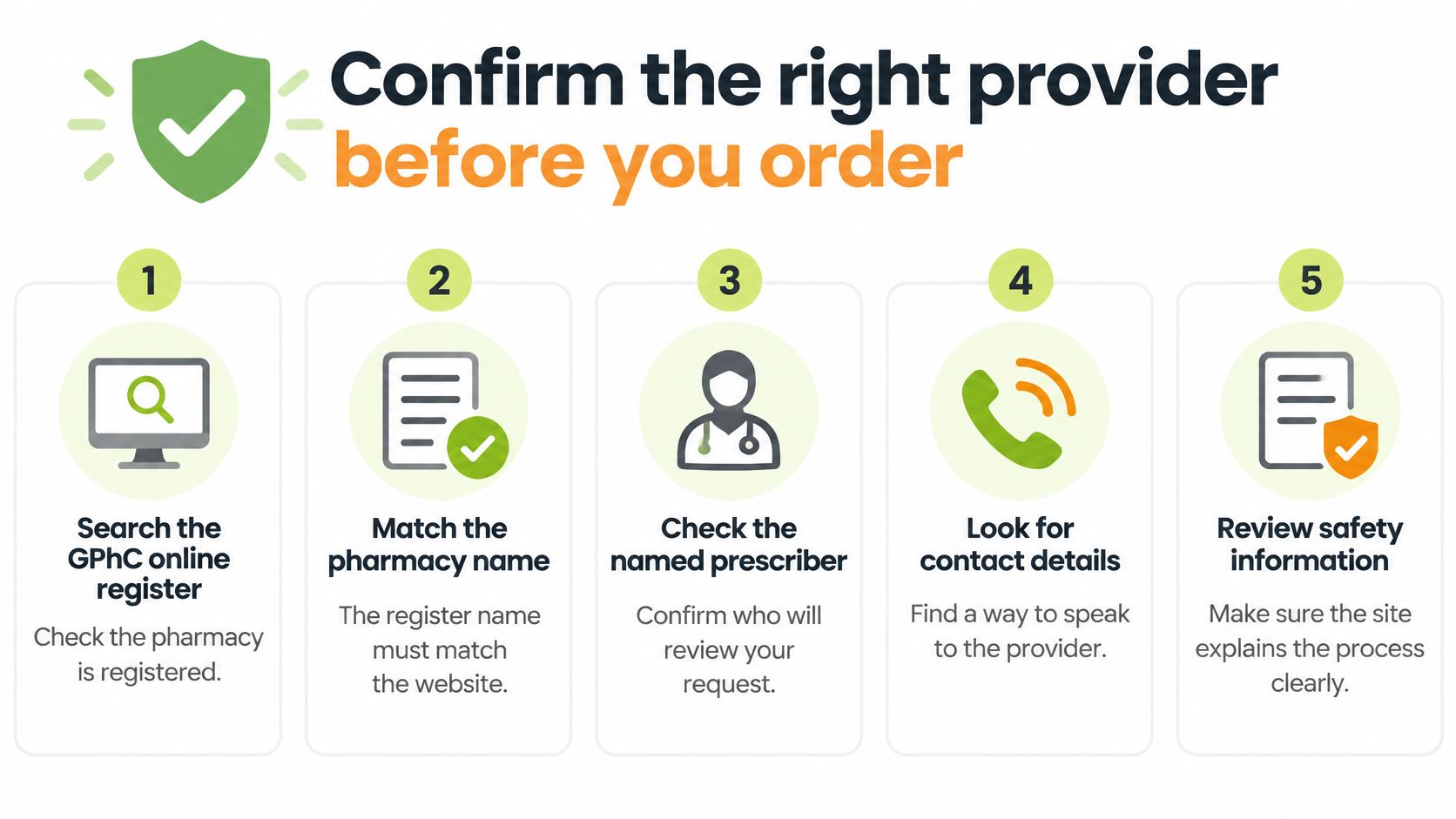
A registration number is the starting point, not the whole safety check. Match the pharmacy's registered details to the business operating the website, including any clearly explained trading name.
The GPhC's guidance on buying medicines safely online says prescribing decisions must not rely on a questionnaire alone [7]. Services should independently verify information through suitable two-way contact, clinical records or your GP or regular prescriber.
Provider checklist before you order
| Check | Where to look | Red flag |
|---|---|---|
| GPhC registration | GPhC online register search | No listing, or an unexplained mismatch with website details |
| Named prescriber | Name, registration number and location | No way to identify the clinician responsible |
| Contact with your GP | GP questions and explanation of information-sharing | No questions about your GP or other medicines |
| Medicines and allergy review | Questions about treatment and past reactions | Checkout with no clinical questions |
| Prescription-only medicines | Assessment before treatment and quantity selection | Prescription medicine sold without a prescription or assessment |
| Follow-up and monitoring | Route to a prescriber after dispatch | No clinical contact after the order |
| Price | Total cost, including consultation and delivery | Hidden fees or unclear charges |
| Privacy | Notice naming the data controller | No explanation of health-data use |
| Sourcing | Information about legitimate suppliers and packaging | Social-media-only sales or implausibly low prices |
Use this visual checklist alongside the fuller checks above.
Apply the test to a real provider
At Courier Pharmacy, we're GPhC-registered and follow strict NHS and MHRA guidelines. Our doctors and pharmacists are UK-based. You should still check those details independently, rather than rely on our statement.
We list online consultation, prescription and follow-up as FREE. That doesn't mean the medicine or every other part of an order is free, so read the full total before paying.
Our guide to getting tretinoin safely and legally in the UK applies this approach to a specific prescription treatment.
Test the clinical pathway
Ask what happens if your answers don't establish a clear picture. A safe response may involve more questions, records, tests or a refusal, rather than a faster checkout.
Location matters too, especially where overseas prescribers take part. You need to know who holds clinical responsibility and how their regulator oversees them.
Don't proceed if you can't establish who supplies, prescribes and supports your treatment. If you're unsure whether remote care suits your condition, discuss it with your GP.
Services You Can Get Online
Online services cover different needs, but not every pharmacy offers every option. Access to a service doesn't mean it's appropriate for you.
Online pharmacy services, what they involve and their limits
| Service | What it involves | Best suited to | Main limit |
|---|---|---|---|
| Repeat prescription | Re-order a stable medicine after review | Stable long-term conditions | Not every medicine can be repeated online |
| Minor condition consultation | Health questions and prescriber review | Common, well-defined conditions | Not for red flag symptoms |
| Compounded medicine | Pharmacy-made version of a medicine | People who can't take a standard form | Needs suitable sourcing and documented checks |
| Home finger-prick test | Small blood sample sent to a laboratory | Selected basic blood checks | Results may need GP follow-up |
| Home venous blood draw | A trained professional takes a larger sample | Tests needing more blood | Check whether visits cover your area |
| Weight-management medicine | Assessment, prescription and monitoring | People who meet clinical criteria | Not suitable for everyone |
Minor-condition services may assess problems such as migraine or some skin infections. However, new, severe or unusual symptoms can need an examination instead of remote treatment.
Weight-management medicines also need more than an order form. The team must assess suitability, consider other medicines and plan ongoing review.
What compounding means
Compounding means preparing a medicine for a particular clinical need. A clinician might consider a liquid instead of a tablet, a different strength or a formulation without an ingredient that causes a reaction.
It isn't automatically better than a standard licensed product. Ask why the usual option won't meet your needs and what is known about the proposed preparation.
The pharmacy needs appropriate ingredients, preparation records and quality checks. Our guide to what a compounding pharmacy does explains the process in more detail.
What home testing can and can't tell you
A finger-prick sample suits some tests, while others need a larger sample from a vein. Follow the kit instructions carefully, including timing and return arrangements.
A test result isn't a diagnosis on its own. A clinician may need your symptoms, examination findings or further tests to interpret it.
Pharmacist's tip: Before a test, establish who reviews the result, who contacts you and what happens if it needs prompt action.
A useful service connects the result to a sensible care plan. Receiving a number without a clear next step can leave you more worried, not better informed.
What Happens After Your Order, and When to Get Urgent Help
What happens after your order arrives? Safe care can still require advice, monitoring or a change in treatment. A delivery confirms that a parcel reached you, not that the medicine remains right for you.
The GPhC's FAQs about buying medicines online explain that pharmacies should provide information on safe use and disposal, arrange suitable monitoring and make it possible to contact prescribers. The guidance also describes safeguards for prescription-only medicines, including an appropriate consultation before a medicine or quantity is selected.
Keep your care connected
Keep a current list of your medicines and tell your GP about any new treatment. Avoid ordering the same medicine from several providers: each team may not know what another has supplied.
For example, someone starting an online treatment for type 2 diabetes may still need blood tests arranged with their usual care team. Agree who will organise the tests and who will review the results. That makes it clearer what to do if a result or symptom needs attention.
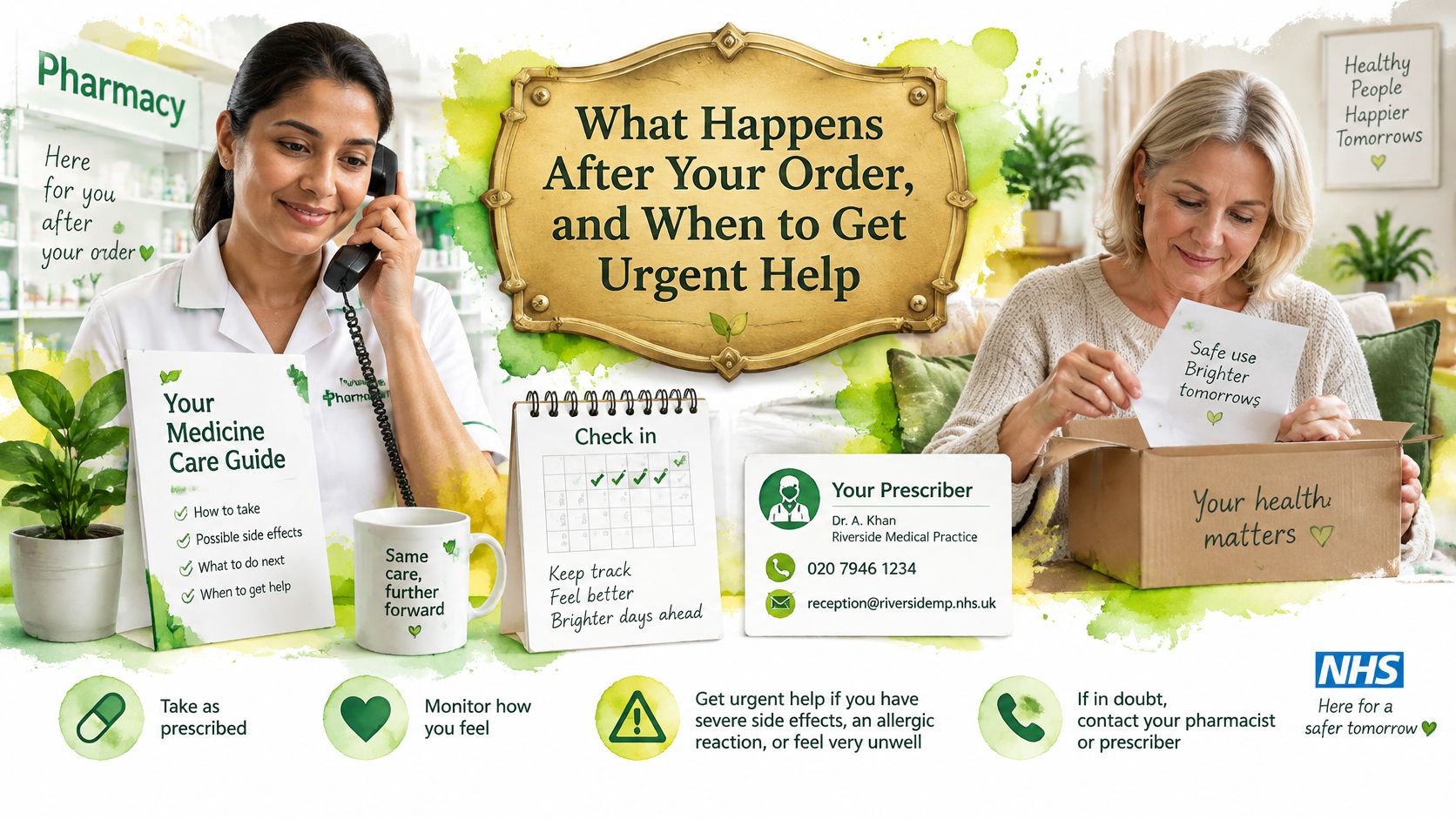
When to seek urgent help
- Call 999 for chest pain, severe difficulty breathing, collapse or possible stroke signs, such as facial drooping, arm weakness or slurred speech.
- Call 999 for a severe allergic reaction. If you have been prescribed an adrenaline auto-injector, use it according to its instructions.
- Contact NHS 111 for urgent advice when you are unsure which service to use. Use a local urgent-care service when appropriate.
- Contact your GP or prescribing team if side effects are getting worse. Seek urgent care for severe or rapidly worsening symptoms.
After an unexpected reaction, get advice before taking another dose. Some medicines can also cause problems if stopped suddenly, so tell the clinician exactly what you take.
Do not wait for an online reply in an emergency. Remote consultations cannot provide emergency treatment or every type of specialist assessment.
Summary
Online pharmacy care can suit planned treatment when appropriate. Check who is responsible for your care, provide accurate health information and ask what follow-up to expect. Keep your usual care team involved in tests and reviews. Choose urgent or in-person care when your symptoms call for it.
Frequently asked questions
Is an online prescription pharmacy legal in the UK?
Yes, provided it follows the relevant pharmacy and prescribing rules. Prescription-only medicines must be authorised by a qualified professional after an appropriate assessment.
Does completing a questionnaire guarantee a prescription?
No. A prescriber may ask for more information, recommend a different care route or decide that treatment is not suitable.
Will I always get a phone call?
Not necessarily. Contact may take different forms, but the prescriber needs enough reliable information to make a safe decision.
Can I get repeat prescriptions online?
Often, if the treatment is suitable and any required monitoring and reviews are in place. Some medicines may need a different route.
Can an online pharmacist examine me?
A pharmacist can discuss your symptoms and may review images or video. They cannot carry out a hands-on examination remotely.
What if my delivery is late?
Contact the pharmacy before you run out. If missing a dose could put you at risk, seek prompt advice from your usual clinician, a local pharmacist or an urgent-care service.
Disclaimer: This information supports understanding and is not a substitute for personal medical advice.
Meta description: Understand what happens after an online prescription order, how to keep care connected and when to seek urgent or in-person help.
References
- Office for National Statistics (2024), Experiences of NHS healthcare services in England, September 2024. Linked in the definition section.
- Medicines and Healthcare products Regulatory Agency (n.d.), Register for the Distance Selling Logo. Linked in the definition section.
- Medicines and Healthcare products Regulatory Agency (2024), Illegal medicines worth more than £30 million seized in the UK in 2023. Linked in the prescribing section.
- UK Government (n.d.), Avoiding fake beauty products for businesses. Linked in the regulation section.
- General Pharmaceutical Council (2024), Annual report 2023–24. Linked in the regulation section.
- Department of Health and Social Care (n.d.), Managing a strong and resilient supply of medicines. Linked in the regulation section.
- General Pharmaceutical Council (n.d.), Buying medicines safely online. Linked in the provider checklist section.
- General Pharmaceutical Council (n.d.), Buying medicines online FAQs. Linked above.
Courier Pharmacy is a UK-regulated, GPhC-registered pharmacy offering online consultations. Prescription medicines can be ordered after completing an online health questionnaire, and orders are sent in discreet packaging for home delivery. Each online consultation, prescription and follow-up is listed as free. You can explore the process at Courier Pharmacy.


