Oral Minoxidil vs Topical: Which is Best for Hair Loss?
Oral minoxidil vs topical: which is better for hair loss? Our 2026 UK guide compares efficacy, side effects, and cost to help you choose wisely.
SEO brief
- Primary keyword: oral minoxidil vs topical
- Secondary keywords: oral minoxidil, topical minoxidil, minoxidil for hair loss, low-dose oral minoxidil, hair loss treatment UK
- Search intent: Informational, comparison, treatment decision
- Target reader: UK adults with pattern hair loss who want a practical guide to choosing between tablet and scalp treatment
- Product/service mention: Courier Pharmacy CTA only, kept out of main body
- Internal links available: Assumed from brief and included where specified
Hair loss research often starts the same way. You notice more scalp in the mirror, open ten tabs, and end up stuck between a tablet and a bottle.
The short answer is simple. Neither oral minoxidil nor topical minoxidil is universally “better”. The best option depends on your scalp, your routine, your tolerance for side effects, and whether you’re likely to keep using it.
This guide gives you the practical version of the debate. It covers how minoxidil works, what the strongest trial found, which side effects matter most, and how UK patients usually access each option. If you want a broad overview of hair loss treatment options in the UK, start there too.
Introduction
Minoxidil helps some hair follicles stay active for longer. In plain English, it can help “wake up” follicles that are shrinking and support thicker growth over time. You can use it as a topical treatment on the scalp or as an oral tablet taken by mouth.
That sounds like a simple choice, but it rarely feels simple when you’re the one losing hair. Some people hate the mess and effort of applying a product twice a day. Others would rather avoid a tablet that works throughout the whole body.
Five key takeaways:
- Topical is usually the first step. It has a long track record and acts mainly where you apply it.
- Oral can be easier to stick to. A survey found users missed fewer treatment days and found it easier to use [1].
- Neither won outright overall. A key randomised trial found no overall superiority of oral over topical minoxidil [2].
- Oral may have an edge at the crown. In that trial, oral did better on vertex hair density and clinician-rated crown improvement [2].
- Side effects differ, not just in size but in type. Oral tends to bring more whole-body effects such as unwanted hair growth, while topical more often causes scalp irritation [2][3].
Practical rule: The best hair loss treatment isn’t the one that looks best on paper. It’s the one you can use safely and consistently for the long term.
What is minoxidil and how does it work for hair loss
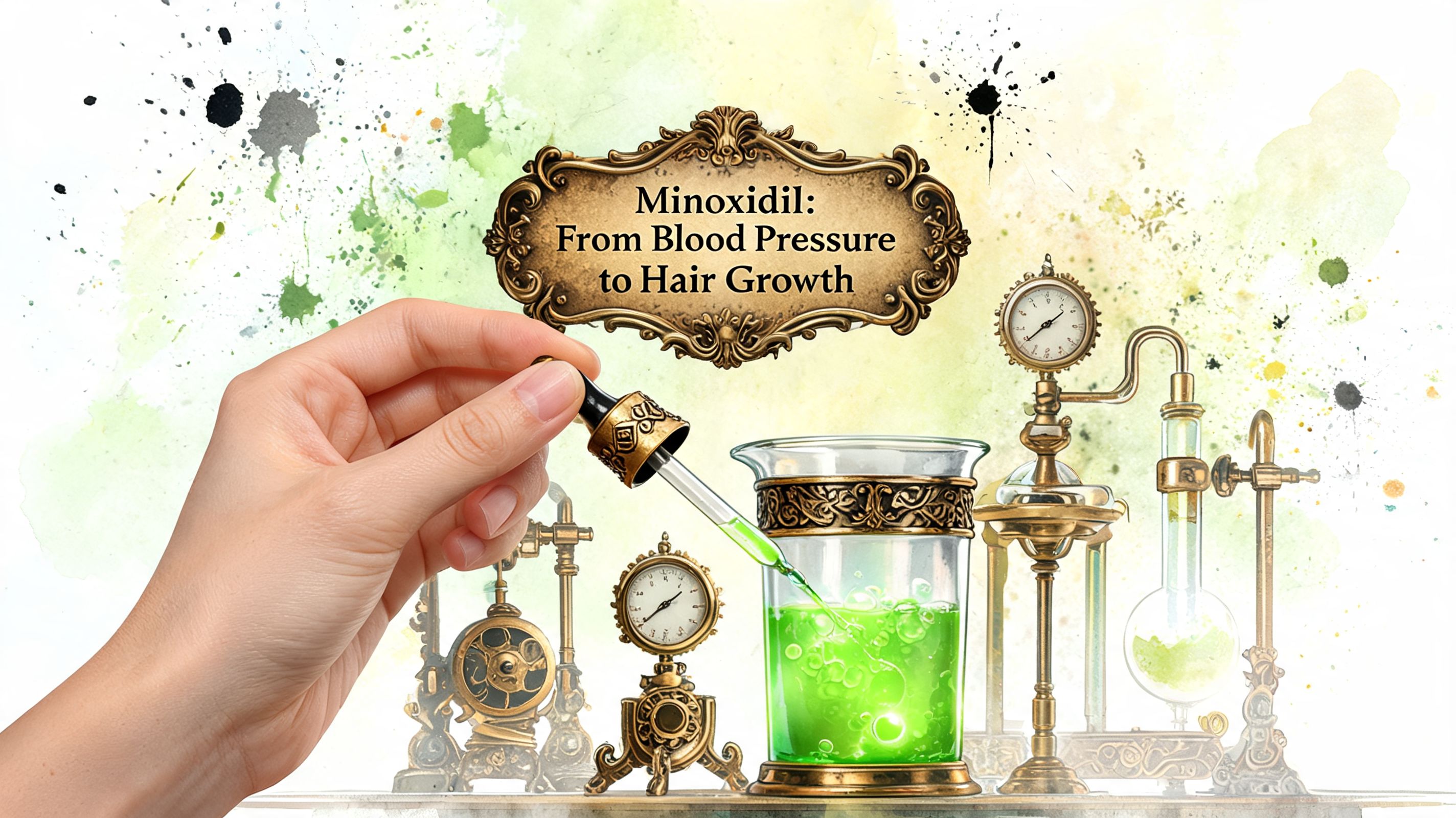
Minoxidil started life as a medicine used for blood pressure. Doctors then noticed a useful side effect. Some people grew more hair.
For hair loss, minoxidil works as a growth support treatment, not a cure for the cause of pattern hair loss. It doesn’t remove the hormonal drive behind androgenetic alopecia. What it can do is help follicles stay in the growing phase for longer and push thinner hairs towards stronger growth.
A simple way to think about it is this. Some follicles in pattern hair loss act half-asleep. Minoxidil can help nudge them back into action.
Topical and oral reach the scalp differently
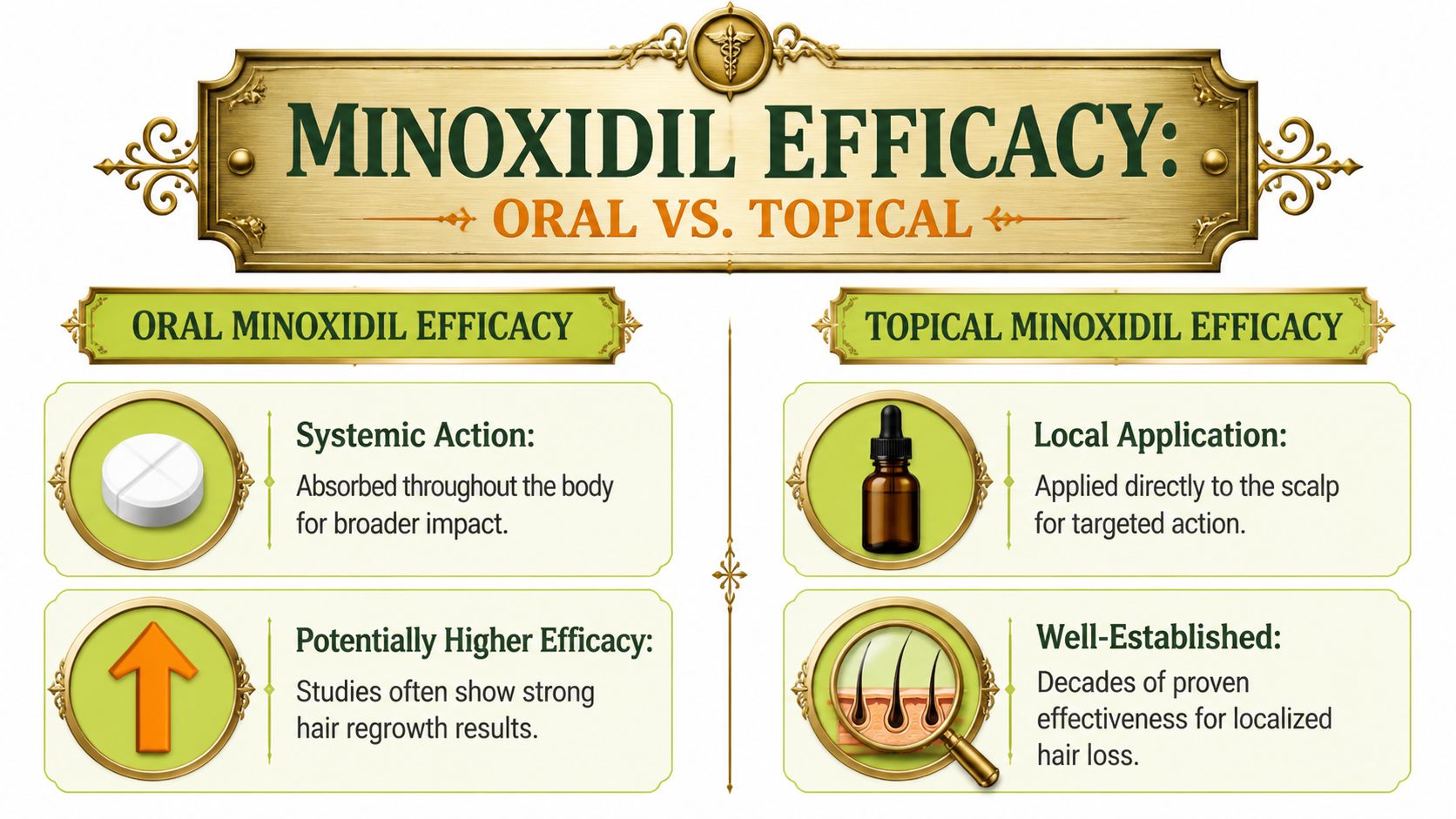
Topical minoxidil goes straight onto the scalp. That makes it a local treatment. It suits people who want treatment focused on thinning areas and who don’t mind building application into their routine.
Oral minoxidil is swallowed as a tablet. Your body absorbs it, so it reaches follicles through the bloodstream. That wider route is one reason some people prefer it, especially if they struggle with twice-daily scalp application.
The trade-off is obvious. Local treatment tends to mean local problems. Systemic treatment can mean systemic side effects.
Why topical doesn’t work for everyone
One reason topical minoxidil can feel hit-and-miss is that the scalp has to activate it properly. In practice, some people respond well and some don’t. That helps explain why one patient can get solid regrowth with a foam or solution while another sees very little despite using it correctly.
That “non-responder” problem is part of why oral minoxidil has gained attention in specialist hair clinics and pharmacies. In the UK, patients often ask about it after frustration with standard topical use. If you want a deeper explanation of the science, this guide on minoxidil and hair growth mechanisms gives a useful background.
Why UK patients hear more about oral minoxidil now
Topical minoxidil has been MHRA-approved since 1988, while low-dose oral minoxidil is used off-label in the UK and adoption has increased since 2020 [4]. “Off-label” doesn’t mean experimental or unsafe by default. It means the prescriber is using an established medicine in a way that sits outside its formal marketing licence for that condition.
That matters because people often assume off-label means dubious. It doesn’t. It means the prescriber needs to judge whether it’s appropriate for you.
Clinical effectiveness oral vs topical minoxidil
A common UK scenario is this. A patient has used topical minoxidil on and off for months, misses evening applications, sees little change, then asks whether a tablet would work better. The honest answer is more useful than a simple yes or no. Oral minoxidil is not clearly better overall, but it may be the better practical choice for some patients.
A 2024 randomised clinical trial in men with androgenetic alopecia compared oral minoxidil 5 mg once daily with topical minoxidil 5% twice daily over 24 weeks. The main result was no overall superiority for oral minoxidil [2].
That headline matters, but it does not settle the decision on its own.
At a glance comparison
| Feature | Oral Minoxidil (Low-Dose Tablet) | Topical Minoxidil (5% Foam/Solution) |
|---|---|---|
| How it’s used | Swallowed once daily in the key trial [2] | Applied to the scalp twice daily in the key trial [2] |
| Overall trial result | No overall superiority over topical [2] | Performed similarly overall to oral [2] |
| Crown response | Better vertex result in the key trial [2][5] | Weaker vertex result than oral in the key trial [2][5] |
| Best fit | People who struggle with scalp application or adherence | People who prefer local treatment and want to avoid whole-body exposure |
| Main drawback | More systemic side effects, especially unwanted hair growth [3] | More scalp irritation and application burden [3] |
| UK status | Off-label for hair loss [4] | MHRA-approved for hair loss since 1988 [4] |
What the best trial showed
Oral minoxidil did not outperform topical minoxidil across all measures. Total hair density changes were small and not statistically significant overall. On the vertex, the oral group showed a +2.1% difference versus topical (95% CI -8.1 to 12.3; P=0.27). On the frontal scalp, the difference was -0.2% (95% CI -8.4 to 8.0; P=0.89) [2].
The more clinically interesting signal was in terminal hair density, meaning thicker, more visible hairs rather than fine miniaturised hairs. Oral minoxidil produced a 27.1% greater increase in terminal hair density on the vertex compared with topical (95% CI, 6.5-47.8; P=.005) [5]. On the frontal scalp, the difference was 13.1%, but this was not statistically significant (95% CI, −11.5 to 37.5%; P=.15) [5].
Blinded dermatologists also judged visible improvement on the crown more favourably with oral treatment. Seventy per cent of oral users improved on the vertex compared with forty-six per cent of topical users (difference 24%; 95% CI, 0-48; P=.04) [2]. Frontal results were closer, with sixty per cent improved on oral and forty-eight per cent on topical (P=.24) [2].
For patients bothered mainly by crown thinning, that distinction is relevant.
What matters in practice for UK patients
In clinic and pharmacy practice, the better question is rarely “which one won the trial?” It is usually “which option am I more likely to use properly for six months, and which part of my scalp am I trying to improve?”
That is where generic comparisons often fall short. A tablet can be easier to stick with than a twice-daily scalp treatment, especially for patients with busy routines, curly or textured hair, scalp sensitivity, or cosmetic concerns about residue. Topical minoxidil still suits many people well, particularly those who want to start with an MHRA-approved option and avoid systemic exposure.
The UK route also affects the decision. Topical minoxidil is easy to access. Oral minoxidil usually needs assessment through a specialist prescriber, often privately, and sometimes with a personalised plan from a compounding pharmacy if a standard strength does not fit the patient well. That does not make oral treatment better. It means the choice is often shaped by access, monitoring, tolerability, and whether the patient can realistically stay on treatment.
Expectations need managing from the start. Minoxidil helps some people maintain and improve density. It does not reliably restore a juvenile hairline, and it does not work quickly. Patients who want a realistic timeline should read our guide on how long minoxidil takes to work.
Featured snippet answer
Is oral minoxidil better than topical minoxidil?
Not overall. The best trial found no overall superiority, but oral minoxidil showed a better result for crown thinning in men [2][5].
Side effects and safety a head-to-head comparison
Effectiveness matters, but side effects usually decide whether someone stays on treatment. In practice, the split is straightforward. Oral minoxidil tends to cause more systemic effects. Topical minoxidil tends to cause more local scalp problems.

Systemic versus local effects
In the 2024 JAMA Dermatology trial, hypertrichosis or unwanted hair growth happened in 49% of oral minoxidil users, and headache occurred in 14% [3]. With topical minoxidil, the standout issue was scalp eczema, which affected 16% of users [3].
That side effect split often shapes the whole choice.
Oral minoxidil may be harder to tolerate if you would find extra facial or body hair very distressing. Some patients don’t mind it. Others absolutely do.
Topical minoxidil may be harder to tolerate if your scalp is sensitive. Itching, dryness, and irritation can make a treatment technically effective but practically unworkable.
A separate patient survey found something else that matters in actual use. Oral users missed fewer days of treatment, with a mean of 0.15 days missed versus 1.2 days in topical users (P=0.0022), and they reported higher satisfaction with hair volume and change [1].
Real life examples
Busy parent scenario
A parent with young children often tells me the same thing. The morning routine is chaos, evenings are worse, and a scalp product twice a day lasts about a week before life gets in the way.
That’s where oral minoxidil can make practical sense. In the survey above, users found oral treatment easier to use and missed fewer doses [1]. The catch is that this same person may be unhappy if they develop extra facial hair, so convenience has to be weighed against tolerability.
Sensitive scalp scenario
A patient with dandruff-prone or reactive skin may start topical minoxidil full of good intentions and stop because the scalp becomes itchy, flaky, or inflamed. For that person, “just keep applying it” is poor advice.
In a case like that, a prescriber may consider whether oral minoxidil is more realistic, or whether a different topical base is needed. If hair loss treatment is part of a wider plan that also involves hormone-sensitive treatment such as finasteride, this guide to minoxidil and finasteride in the UK can help frame the options.
Some people quit topical minoxidil because it irritates the scalp. Others quit oral minoxidil because the body-wide effects bother them more than the hair loss does.
Pharmacist's tip
Pharmacist's tip: If you get scalp irritation with topical minoxidil, don’t assume minoxidil itself is always the problem. The formulation can matter. A prescriber or specialist pharmacy may be able to advise on a better tolerated version.
Pharmacist's tip
Pharmacist's tip: If you start oral minoxidil, keep an eye on new symptoms rather than guessing. Headache, swelling, or feeling faint deserve proper review, especially early on.
When to seek urgent help
Seek urgent medical help if you develop:
- Chest pain
- Severe dizziness or fainting
- Fast or pounding heartbeat
- Shortness of breath
- Sudden swelling that feels significant or worsening
These aren’t the usual day-to-day hair treatment annoyances. They need prompt assessment.
Featured snippet answer
Which minoxidil has more side effects?
Oral minoxidil tends to cause more whole-body side effects, especially unwanted hair growth and headache, while topical minoxidil more often causes scalp irritation or eczema [1][3].
Who is the ideal candidate for each treatment
The right choice usually becomes clearer when you stop thinking like a researcher and start thinking like a patient. Your diary, your scalp, and your risk tolerance matter as much as the trial summary.
When topical often makes more sense
Topical minoxidil is often the better fit if you are a cautious beginner. It suits people who want a well-established, local treatment and who feel uncomfortable taking an off-label tablet.
It also fits people who are very bothered by the idea of extra facial or body hair. If that would damage confidence more than the scalp thinning itself, topical often wins before the conversation has even started.
Topical can work well for:
- The careful first-timer who wants to start with the standard option
- The targeted user whose thinning is limited to a clear area
- The side-effect-averse patient who wants to avoid systemic exposure where possible
- The person happy with routine who already has a consistent grooming schedule
When oral often makes more sense
Oral minoxidil often suits the convenience-seeker or the topical dropout. The patient survey supports that. Oral users missed fewer treatment days, found treatment easier to use, and reported higher satisfaction with hair volume and change [1].
That doesn’t make oral “better” in a universal sense. It means it may work better in ordinary life for someone who won’t stick to scalp application.
Oral can be attractive for:
- The shift worker who can’t keep a neat morning-and-evening routine
- The gym-goer who hates product sitting on the scalp during sweat-heavy sessions
- The busy parent whose personal routine gets pushed to the bottom of the list
- The topical non-responder who has used scalp treatment properly and still feels stuck
A simple decision route
Here’s the mental roadmap I usually suggest.
- Start with honesty about routine. If you know you won’t apply a scalp treatment consistently, admit it early.
- Think about side effects that matter to you most. Some people fear scalp irritation. Others care more about body hair growth.
- Map the thinning pattern. Crown-focused thinning may push the discussion more towards oral treatment.
- Check the UK pathway. Topical is the simpler route. Oral needs prescribing and review because it’s off-label.
- Build in follow-up. Don’t start and drift. Review response, tolerance, and whether you’re using it.
The ideal candidate for oral minoxidil isn’t just someone who wants stronger treatment. It’s someone who can use it safely and is more likely to stick with it than topical.
Real-life example
James, a shift worker
James works rotating shifts and forgets evening applications. He has already stopped and restarted topical minoxidil more than once. He may be a sensible person to discuss oral minoxidil with because adherence is his weak point, not motivation.
Aisha, a cautious beginner
Aisha wants a hair loss treatment but feels nervous about taking a tablet off-label. She has no issue with using a scalp product as part of her bedtime routine. Topical minoxidil is often the more comfortable and proportionate starting point for someone like her.
Featured snippet answer
Who should choose oral minoxidil?
Oral minoxidil often suits people who struggle to keep up with topical treatment, dislike scalp irritation, or want a simpler routine, provided a prescriber thinks it’s safe for them.
A practical guide to starting and managing treatment in the UK
For most UK patients, the practical difference isn’t just tablet versus liquid. It’s also standard licensed treatment versus off-label prescribing.
How access usually works
Topical minoxidil is the simpler route. In the UK, it has been MHRA-approved since 1988 [4]. Many people start there because it’s familiar and easier to obtain.
Low-dose oral minoxidil is different. It is used off-label, and UK use has increased since 2020 as interest has grown in alternatives for people who don’t do well with topical treatment [4]. GPhC-regulated pharmacies can also compound bespoke doses where clinically appropriate [4].
That matters because “oral minoxidil” isn’t always one standard experience. Dose, formulation, and follow-up can vary depending on the prescriber and the pharmacy pathway.
If you’re looking at a prescribed option, patients often see products such as Loniten 2.5mg tablets during that process.
What to expect after starting
The first rule is patience. Hair treatment rarely rewards impatience, and minoxidil is no exception.
A few practical points help:
- Be consistent. Stop-start use makes it hard to judge response.
- Don’t panic over every shed. Early shedding can happen as hairs cycle.
- Take photos in the same light. Memory is unreliable. Photos are better.
- Review fit, not just results. Ask whether the treatment still suits your life.
Pharmacist's tip
Pharmacist's tip: Before starting oral minoxidil, make sure the prescriber checks whether it’s suitable for you and whether baseline blood pressure monitoring is needed. That’s a simple but important safety step.
How specialist pharmacy support helps
The UK advantage is personalisation. Some patients need a bespoke oral dose. Others need a topical preparation adapted for scalp sensitivity or ingredient intolerance. That is where regulated compounding can be helpful rather than just “premium”.
Good support also means follow-up. Many hair loss treatments fail in real life because nobody checks in once the box arrives. Questions crop up later. Is the irritation normal? Is the shedding expected? Is it worth carrying on?
A useful explainer video is below.
Practical treatment habits that actually help
The best plans stay simple.
- Pick one anchor point in the day. Link treatment to brushing your teeth, breakfast, or another fixed habit.
- Keep expectations realistic. Aim for improvement and stabilisation, not perfection.
- Report side effects early. Small issues are easier to manage before they become reasons to stop.
- Review the whole plan. Hair loss treatment often works best when the wider cause and pattern are considered too.
Pharmacist's tip
Pharmacist's tip: Don’t switch products every few weeks. If a treatment is safe and tolerable, give it a fair run before deciding it “doesn’t work”.
Pharmacist's tip
Pharmacist's tip: If your scalp reacts badly to a standard topical product, ask whether the vehicle or inactive ingredients might be the problem. Sometimes the answer is formulation, not abandonment.
Featured snippet answer
How do you get oral minoxidil in the UK?
Oral minoxidil for hair loss is usually prescribed off-label after assessment by a clinician. Topical minoxidil is the more straightforward licensed option, while oral treatment often needs monitoring and follow-up [4].
FAQs about oral and topical minoxidil
Is oral minoxidil stronger than topical minoxidil?
For overall results, the best evidence does not show oral minoxidil clearly outperforming topical treatment in every patient [2]. The difference is more practical than absolute. Oral minoxidil may suit some people better because they can take it more consistently, while topical treatment can still be the better fit for someone who wants a local treatment and is happy with the routine.
Is topical minoxidil safer than oral minoxidil?
Topical minoxidil usually carries less whole-body risk because exposure is mainly limited to the scalp. The trade-off is local irritation. Scalp itching, dryness, and dermatitis are common reasons people stop otherwise effective treatment.
In practice, “safer” means safer for a particular patient, not automatically safer in every sense. A patient with sensitive skin may tolerate a low-dose oral option better than a standard topical liquid, while a patient with cardiovascular risk factors may be better served by sticking with topical treatment.
Can I switch from topical minoxidil to oral minoxidil?
Yes, and in UK practice this is a common discussion. People usually ask about switching for three reasons. Scalp irritation, difficulty keeping up with daily application, or disappointment with the routine rather than the biology of the treatment itself.
Oral minoxidil for hair loss is prescribed off-label in the UK, so the switch should be planned with a prescriber [4]. That matters more than many comparison articles admit. On the NHS, access may be limited and usually depends on local prescribing practice or specialist input. In private care, assessment is often more straightforward, and some patients also benefit from compounded strengths or personalised formulations when standard options have not worked well for them.
What if I stop minoxidil?
Any benefit usually fades after stopping treatment. Hair commonly returns towards its previous baseline over time.
That is why the key question is not only whether minoxidil can work. It is whether you can stay on the version you choose for long enough to judge it properly.
Is oral minoxidil easier to stick to?
For many patients, yes. A cross-sectional study reported better adherence and higher satisfaction among oral minoxidil users than topical users [1].
That does not make oral treatment automatically better. It means convenience matters. From a pharmacist’s point of view, a treatment that is slightly less convenient on paper often underperforms in real life if it is messy, irritating, or easy to forget.
Does oral minoxidil cause more unwanted hair growth?
Yes. This is one of the clearest trade-offs. The randomised trial reported more hypertrichosis with oral minoxidil, and the cross-sectional study also found this was reported more often with oral treatment than topical treatment [1][2].
This point matters in real prescribing conversations, particularly for women and for anyone who would find extra facial or body hair difficult to accept. Good adherence only helps if the treatment remains acceptable to live with.
Is topical minoxidil still a good first choice?
Yes. For many UK patients, it remains the most sensible starting point because it is licensed, easy to access, and familiar to both pharmacists and GPs. It also avoids the extra prescribing and monitoring steps that often come with oral treatment.
If a standard topical product causes irritation, the answer is not always to abandon minoxidil completely. In specialist pharmacy practice, changing the vehicle or using a compounded preparation can sometimes make treatment much easier to tolerate.
Can women use oral minoxidil?
Women can be prescribed low-dose oral minoxidil in specialist practice, but it needs proper clinical review. The decision usually comes down to balancing convenience against the chance of side effects, especially hypertrichosis.
Self-directing treatment is a poor idea here. A review of medical history, current medicines, blood pressure, and treatment goals is part of safe prescribing.
Are compounded versions worth considering?
Sometimes. Compounding is most useful when the standard product is the problem rather than minoxidil itself. That may mean a different topical base for a sensitive scalp, an adjusted strength, or a more individualized oral dose where appropriate.
This is one area where private specialist care can offer options that are not usually available through routine NHS pathways. Personalisation does not make treatment stronger by default, but it can make it more usable.
What’s the best choice overall in oral minoxidil vs topical?
The better option is the one a patient can use safely, consistently, and for long enough to see whether it helps. Oral minoxidil often enters the conversation when adherence is poor, crown thinning is the main concern, or topical treatment has become a burden. Topical minoxidil often remains the right first step for patients who want a licensed, local treatment with less systemic exposure.
In UK practice, access matters too. Some patients prefer to start with an over-the-counter topical product. Others need a prescriber-led private route, especially if they are considering oral minoxidil or a compounded option. If you’re weighing up oral and topical minoxidil and want a regulated UK route to treatment, Courier Pharmacy offers online assessment, prescribing where appropriate, and personalised support, including specialist compounded options for patients who need a more individualized approach.
Summary
Oral minoxidil and topical minoxidil each have a place in treatment. Topical minoxidil remains a sensible first option for many UK patients because it is licensed and acts locally. Oral minoxidil is often the more practical option for patients who struggle with the daily topical routine or want to discuss alternatives through a prescriber. Overall effectiveness appears similar, with some evidence of an oral advantage for vertex or crown response [2]. The main trade-off is side-effect pattern. Oral treatment brings more systemic concerns and more unwanted hair growth, while topical treatment more often causes scalp irritation. A sound decision takes account of safety, access, formulation, and the reality of long-term adherence.
Meta description Oral minoxidil vs topical for hair loss. Learn UK trade-offs on effectiveness, side effects, safety, access, and which option may suit you best.
Suggested internal links for medicalmojo.co.uk
- A guide to pattern hair loss in men and women
- How long minoxidil takes to work
- Finasteride vs minoxidil for hair loss
- Hair shedding after starting treatment
- Off-label prescribing in the UK explained
Visual guidance for designer
Infographic idea 1: Oral minoxidil vs topical decision tree in lime green, pale yellow-green, and light grey, with ornate brass plaque labels.
Alt text: Decision tree showing when oral or topical minoxidil may suit different UK patients.Infographic idea 2: Side effects split panel with systemic effects on one side and scalp effects on the other.
Alt text: Comparison graphic of oral minoxidil whole-body side effects and topical minoxidil scalp side effects.Infographic idea 3: UK treatment pathway from over-the-counter topical to prescriber-assessed oral and compounded options.
Alt text: UK pathway diagram for accessing topical and oral minoxidil with pharmacist and prescriber review.Illustration idea 4: Bathroom shelf with foam, dropper, tablets, and a calendar, using a painterly steampunk style.
Alt text: Hair loss treatment routine illustration showing topical minoxidil and oral minoxidil in a home setting.
Disclaimer
This article is for information only and isn’t a substitute for personal medical advice, diagnosis, or treatment.
Byline
By Medical Mojo Editorial Team, written in the voice of a UK specialist clinical pharmacist
Clinical review
Clinically reviewed by a UK-registered pharmacist
How this content was created
This article was written using verified trial and survey data, UK regulatory context, and pharmacy practice principles. A clinical reviewer checked it for accuracy, balance, readability, and UK relevance before publication.
References
[1] JDD Online. Comparing adherence, side effects, satisfaction in oral and topical minoxidil cross-sectional study. Available at: https://jddonline.com/articles/comparing-adherence-side-effects-satisfaction-in-oral-topical-minoxidil-cross-sectional-study-S1545961625P8424X
[2] Jimenez-Cauhe, J. et al. Oral Minoxidil vs Topical Minoxidil for Male Androgenetic Alopecia A Randomized Clinical Trial. JAMA Dermatology. Available at: https://jamanetwork.com/journals/jamadermatology/fullarticle/2817326
[3] PubMed. Oral minoxidil versus topical minoxidil for androgenetic alopecia. Available at: https://pubmed.ncbi.nlm.nih.gov/38598226/
[4] American Academy of Family Physicians. POEMs Oral vs Topical Minoxidil. Available at: https://www.aafp.org/pubs/afp/issues/2025/0200/poems-oral-vs-topical-minoxidil.html


