Order Ciprofloxacin Online in the UK Safely
Order ciprofloxacin online in the UK safely with our step-by-step guide. Learn prescriptions, GPhC checks and key safety tips before you buy.
You can't safely order ciprofloxacin online in the UK as a simple click and buy purchase. It's prescription-only, and a prescriber must decide that other options aren't appropriate first. The quickest questionnaire isn't the safest care. A good service asks more questions, checks your history, and may say no or suggest a test. This guide shows you how to spot a regulated UK pharmacy, what a proper consultation covers, when ciprofloxacin fits, and how to take it safely if you receive it.
Five key takeaways
- Prescription first: You need a clinical assessment before supply.
- Friction protects you: Extra questions help prevent harm.
- First-line first: Safer antibiotics usually come before ciprofloxacin.
- Check registration: Verify the pharmacy and prescriber.
- Timing matters: Dairy and minerals can block absorption.
Why Ciprofloxacin Is Not a Normal Click and Buy
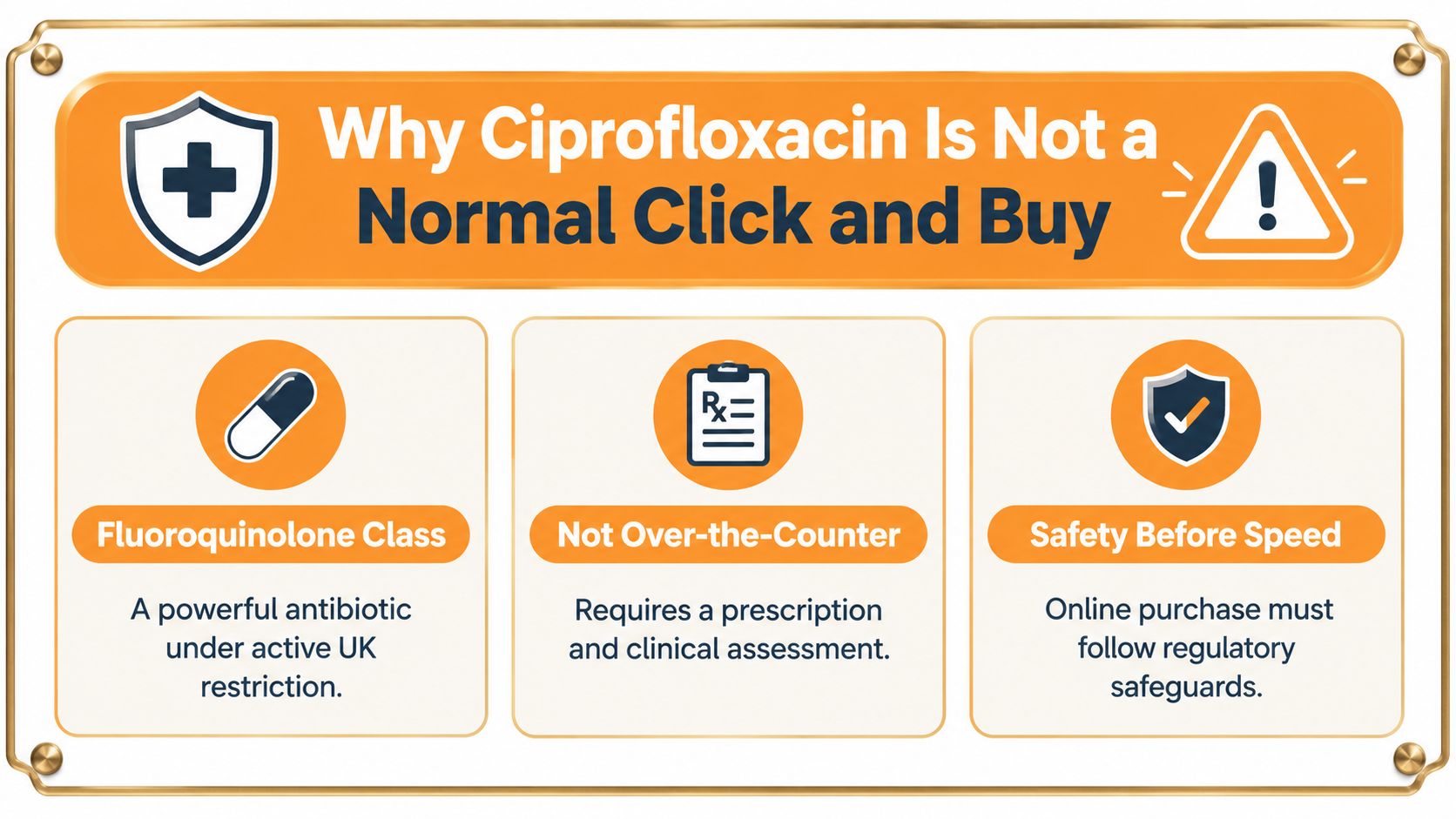
Many pages sell speed as the main benefit. That's the wrong test for this medicine. Ciprofloxacin is a fluoroquinolone antibiotic. Doctors use it for certain bacterial infections, but UK regulators treat it with special caution.
What changed in UK rules
First, in March 2019, the MHRA limited fluoroquinolone use for uncomplicated cystitis and mild infections. It asked prescribers to take extra care with people over 60, people with kidney problems, and transplant recipients. Tendon injury risk runs higher in these groups.
Next, rules tightened again. On 22 January 2024, the MHRA said systemic fluoroquinolones, including oral ciprofloxacin, should be prescribed only when other commonly recommended antibiotics are inappropriate, because of rare but potentially disabling, long-lasting or irreversible effects, as set out in the MHRA fluoroquinolone safety update.
Inappropriate can mean resistance, a reason you can't take a first-line drug, side effects that stopped treatment, or treatment failure. Preference alone doesn't count. Your prescriber needs a clear clinical reason.
What this means for you
A legitimate service won't treat your request like a retail order. It should check your symptoms, allergies, age, kidney function, other medicines, and past reactions. It should also consider whether another antibiotic suits you better.
Pharmacist's tip: If a site offers ciprofloxacin with no prescription or no real questions, close the tab. That speed signals risk, not quality.
You should expect some delay while a human reviews your answers. You may get a message asking for more detail. You may also get a different treatment, a test request, or advice to see a clinician in person.
This information supports your decisions, but it doesn't replace medical advice. Seek urgent help if you have severe pain, fever, vomiting, blood in urine, or rapidly worsening symptoms. Online care has limits, and a safe prescriber will name them clearly.
The UK Clinical Picture Behind the Prescription
Resistance explains many refusals that frustrate patients. If bacteria no longer respond to a drug, a fast delivery still fails. You stay ill, and you may need stronger treatment later.
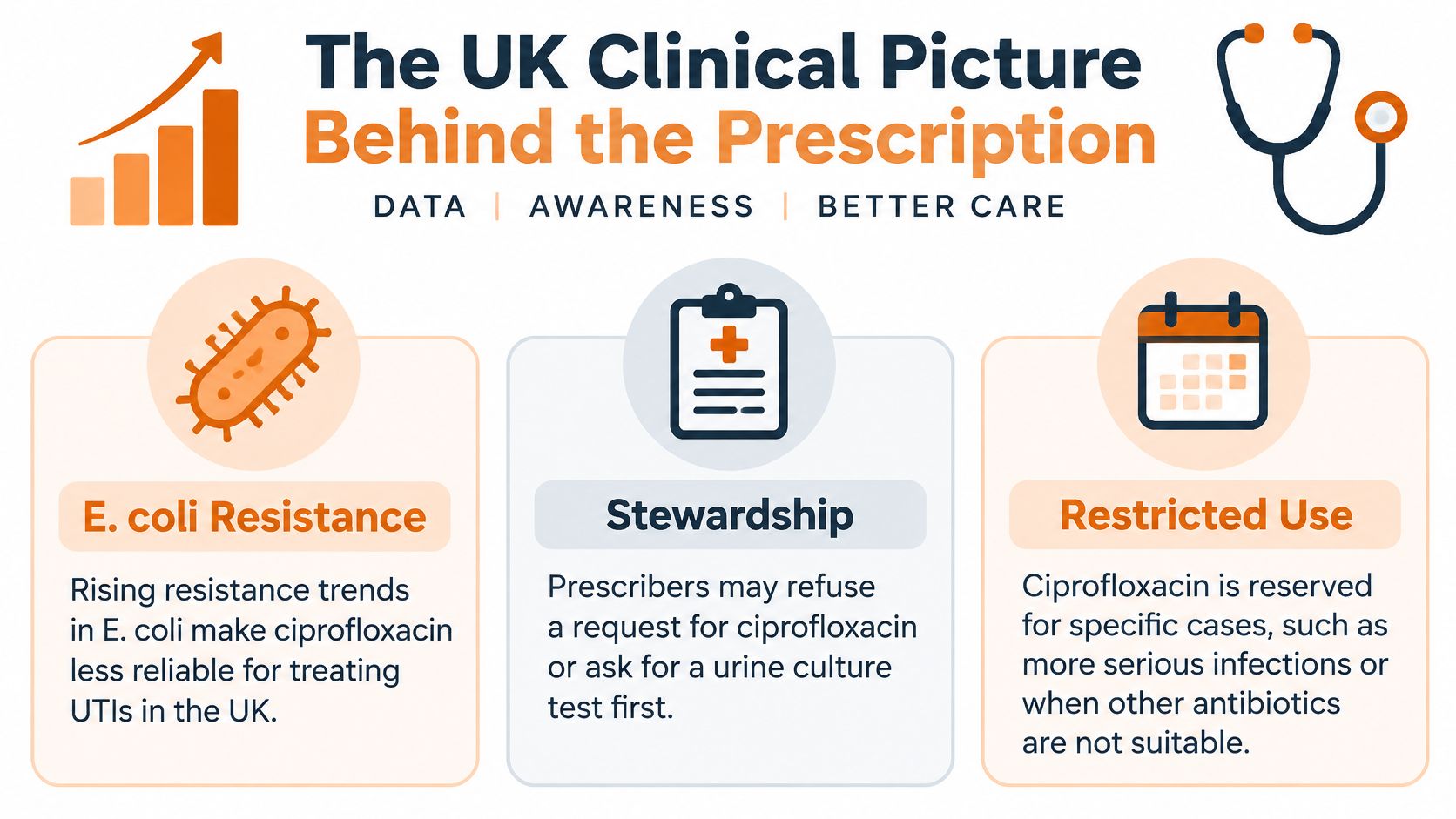
UK government data published in October 2014 recorded an 18% rise in ciprofloxacin resistance among reported E. coli infections between 2010 and 2013, climbing from 3,654 resistant cases to 4,321, alongside a 28% increase in cephalosporin resistance and a 27% increase in gentamicin resistance, according to the UK report on antibiotic use and resistance.
E. coli causes most urinary tract infections. So, that trend matters directly for UTI care. A prescriber can't assume ciprofloxacin will work for your symptoms.
Why you may need a test first
Other UK data in the verified evidence shows gonococcal ciprofloxacin resistance rose from 39.8% in 2018 to 42.7% in 2019. English primary care prescribing of ciprofloxacin also fell by about 5% per year between 2019 and 2023. Both points show careful, targeted use, not routine supply.
For example, if you've had repeated UTIs, your prescriber may want a urine culture. That test grows the bacteria and checks which antibiotics still work. If sexual infection could explain symptoms, you may need sexual health testing instead.
People with repeated bladder symptoms often benefit from reading about recurrent cystitis patterns and assessment before they request another course. Patterns, triggers, and past cultures change the safest choice.
Questions this data should trigger
- What infection do you suspect: Your prescriber needs a working diagnosis, not a guess.
- What did you take before: Past antibiotics can select resistant bacteria.
- What did tests show: Culture results guide the drug choice.
- What local resistance looks like: Local patterns affect likely success.
A refusal can mean the prescriber protects you from a drug that likely won't work.
That approach forms part of antimicrobial stewardship. In plain English, clinicians save powerful antibiotics for cases that need them. You get better odds now, and the drug stays useful for future patients too.
How to Choose a Regulated UK Online Pharmacy
Start with registration, not price or delivery promises. A UK pharmacy that dispenses prescription medicines should appear on the General Pharmaceutical Council register. Check the pharmacy name, premises address, and registration number yourself.

Your verification checklist
- Find the GPhC number: The site should display it clearly, and you should match it on the register.
- Name the superintendent pharmacist: A real person carries legal responsibility for pharmacy standards.
- Identify the prescriber: The service should explain who prescribes, their UK registration, and their authority.
- Check the supply route: Medicines should come from the UK pharmacy, not an unknown overseas sender.
- Look for contact routes: You should reach a pharmacist with questions about dose, timing, or side effects.
The voluntary internet pharmacy logo can help, but don't trust a logo alone. Click it and confirm it leads to the correct register entry. Copied badges mean nothing.
You can see how a regulated service presents its model on the UK online pharmacy overview, then compare that transparency with any site you consider. Clear ownership, clear clinicians, and clear complaints routes build trust.
Safeguards for antibiotics
Antimicrobials need enhanced safeguards. The General Pharmaceutical Council expects prescribers to independently verify patient information through timely two-way communication, clinical records, or another healthcare professional, and to share prescription information with your regular prescriber where you consent, a standard reflected in the NICE lower UTI prescribing guidance.
That verification matters because patients sometimes use several providers at once. Duplicate antibiotics raise harm risk. Shared information helps your GP spot clashes and failed courses.
Red flags include no prescription needed claims, guaranteed supply, no identity check, and pressure to buy larger packs. Another warning sign is silence about side effects. A trustworthy service explains risks before payment, not after dispatch.
Pharmacist's tip: Search the pharmacy premises on the GPhC register in a fresh tab. Don't rely on screenshots or logos on the sales page.
Ask who handles problems after delivery. Ask how the team records consent to contact your GP. If answers sound vague, choose another provider.
What a Safe Remote Consultation Should Ask You
A safe consultation feels thorough, and sometimes a bit inconvenient. That friction helps the prescriber build a complete picture. A short symptom form can't do that job on its own.

Example one with a shift worker
A busy shift worker reports burning, urgency, and a third suspected UTI this year. She lists her medicines, allergy history, pregnancy status, and past urine culture result. She also notes which antibiotic helped before and which one upset her stomach.
The prescriber asks follow-up questions about fever, back pain, vaginal symptoms, and kidney problems. Because infections keep returning, the prescriber requests a urine test and checks first-line options first. If ciprofloxacin fits, the prescriber records why and counsels her on warning signs.
That process takes longer than five minutes. However, it reduces the chance of the wrong drug and missed kidney infection.
Example two with a gym-goer
A gym-goer ticks uncomplicated UTI, selects ciprofloxacin, and pays within minutes. The form never asks about tendon pain, supplements, other medicines, or past reactions. Nobody checks whether symptoms could reflect a sexually transmitted infection or prostate problem.
That pattern should worry you. The service hasn't verified key facts, and it hasn't explained safer options. Speed has replaced care.
RCGP teaching material reports an odds-of-resistance estimate for ciprofloxacin of 0.982, with a 95% confidence interval of 0.965 to 0.999 in the cited UK UTI context, in the NICE primary care antimicrobial summary. In plain terms, test results and risk checks keep treatment targeted.
Details you should prepare
- Symptoms and timing: Say when they started and how severe they feel.
- Allergies and past reactions: Include rash, tendon pain, nerve symptoms, or mood changes.
- Current medicines and supplements: List prescribed, bought, and herbal products.
- Health background: Mention pregnancy, kidney problems, catheter use, and long-term conditions.
- Recent antibiotics and tests: Share names, dates, and results if you have them.
Don't rely only on an NHS App medicines list. It may miss recent private prescriptions, supplements, or short courses. Add anything the list leaves out.
If you wonder why a prescriber may message instead of call, this guide on how online treatment ordering and follow-up contact works explains the logic. Two-way contact matters more than the exact channel. The prescriber must resolve gaps before supply.
Pharmacist's tip: Write your medicine list from the actual boxes. Memory alone misses inhalers, supplements, and occasional painkillers.
Expect safety-net advice too. You should know which tendon, nerve, mood, heart, or severe diarrhoea symptoms need urgent help. You should also know when lack of improvement needs reassessment.
Supply, Delivery and Follow-up Checks That Matter
Clinical approval doesn't end the safety chain. Dispensing, packaging, delivery, and follow-up can still fail. A regulated pharmacy controls each step and records what happened.
What good dispensing looks like
Pharmacists check the prescription against your consultation details. They confirm the drug, strength, dose, course length, and patient name. They also check for clashes the prescriber may need to review.
Your pack should carry a clear dispensing label with directions and warnings. Keep the patient leaflet and read it before your first dose. Check the medicine name and expiry date as soon as it arrives.
Licensed stock should come through MHRA-registered wholesalers. That route supports batch traceability if a recall occurs. Loose tablets in unlabelled packaging should alarm you.
Delivery controls to expect
- Discreet but secure packaging: The parcel should protect privacy and keep medicines intact.
- Tracked delivery: Tracking helps you plan receipt and spot delays.
- Identity checks where needed: The pharmacy should reduce wrong-person delivery risk.
- Child-resistant packaging where appropriate: Safe storage starts with safe supply.
Delays matter with acute infections. If delivery slips, contact the pharmacy rather than doubling up from another provider. Duplicate supply can cause harm and confuses follow-up.
Follow-up after you start
A pharmacist-led follow-up call after antibiotic treatment adds real value. The pharmacist can ask whether symptoms eased, whether side effects appeared, and whether you finished the course. That call also creates a route back for advice.
Seek urgent help for tendon pain or swelling, severe or bloody diarrhoea, palpitations, fainting, severe mood changes, or signs of allergy. Also seek help if fever, back pain, or vomiting develops. Those signs may point to spread of infection.
Keep a simple note of dose times and symptoms. Bring that note to any GP, urgent care, or pharmacy review. Clear records help the next clinician act fast.
When Ciprofloxacin May, or May Not, Be the Right Choice
Symptoms alone rarely settle the antibiotic choice. Infection site, severity, past cultures, allergies, and other medicines all shape the decision. Ciprofloxacin sometimes fits, but it rarely leads the list.
A practical decision table
| Situation | Usual UK position | What may happen online |
|---|---|---|
| Suspected lower UTI | Nitrofurantoin or trimethoprim usually come first | Prescriber checks suitability and may request urine testing |
| Catheter-associated UTI | First-choice options come first, with ciprofloxacin only if unsuitable | Prescriber asks about catheter care, symptoms, and cultures |
| Repeat symptoms after antibiotics | Reassessment beats automatic reorder | Prescriber may refer you or arrange culture testing |
| Fever, back pain, vomiting | Possible kidney or systemic infection | You may need urgent in-person assessment |
| Traveller's diarrhoea or prostate symptoms | Choice depends on cause, severity, and history | Prescriber needs detailed history and may not supply remotely |
For catheter-associated UTI, NICE lists ciprofloxacin 500 mg twice daily for 7 days only when other first-choice antibiotics are unsuitable, and cross-refers prescribers to MHRA restrictions, as shown in the NICE catheter-associated UTI recommendations. Don't copy that dose for another condition. Dose and duration depend on the infection and your body.
Why first-line drugs often win
Nitrofurantoin and trimethoprim target lower UTI without the same fluoroquinolone concerns. They still need checks for allergy, kidney function, pregnancy, and interactions. Safer doesn't mean casual.
If you want the mechanism in plain English, read how nitrofurantoin works in the urinary tract. That background helps you understand why a prescriber may offer it instead of ciprofloxacin.
Ciprofloxacin may enter the discussion when first-line drugs can't be used, tests show resistance, prior treatment failed, or infection involves tissue that needs different coverage. Even then, the prescriber must weigh tendon, nerve, heart, and mental health risks.
Persistent symptoms deserve curiosity, not a repeat click. Resistance, the wrong diagnosis, stones, prostate involvement, or a sexual infection could explain them. A new assessment may include urine culture, sexual health tests, examination, or referral.
Mini answer: Can you order ciprofloxacin online for a simple UTI? Only if a UK prescriber assesses you and records why first-line options don't suit you.
Other recent UK surveillance in the evidence base found fluoroquinolone resistance in Mycoplasma genitalium rose from 16.7% in 2024 to 20.2% in 2025. That trend reinforces a simple point. Genital or urinary symptoms don't always need the same antibiotic, and guesswork wastes time.
Taking Ciprofloxacin Safely if You Do Receive It
Getting the right drug still leaves room for error. Food, supplements, and dose timing can change how much medicine your body absorbs. Small routine changes protect the course.
Swallow tablets whole with water and follow your dispensing label. UK prescribing information says dairy products such as milk and yoghurt and mineral-fortified fruit juice reduce absorption, with one NHS document advising ciprofloxacin 1 to 2 hours before, or at least 4 hours after, mineral products, as detailed in the NHS ciprofloxacin prescribing document.
Calcium, magnesium, aluminium, iron, and zinc can cause the same problem. Check antacids, multivitamins, and sports supplements carefully. Ask a pharmacist to map dose times around products you can't pause.
Your final safety checklist
- Verify the pharmacy: Confirm GPhC registration yourself.
- Answer fully: Include supplements, allergies, and recent antibiotics.
- Check the parcel: Match the label, leaflet, and expiry date.
- Time doses well: Separate dairy and minerals as instructed.
- Watch warning signs: Act fast on tendon pain or severe symptoms.
- Close the loop: Tell your GP and report lack of improvement.
Three quick FAQs
Can you transfer an NHS prescription online? Often yes through a nominated pharmacy route, but private online consultations follow a separate prescriber process. Ask the pharmacy to explain which route applies before you pay.
What if symptoms worsen after starting? Contact the prescriber, pharmacist, GP, NHS 111, or urgent care promptly. Worsening can signal resistance, spread, or a different diagnosis.
How do you report side effects? Tell your pharmacist or prescriber, and use the Yellow Card scheme to report suspected reactions. Your report helps regulators spot safety signals.
Online care works best when it slows down at the right moments. Check the pharmacy, answer truthfully, accept testing when needed, and take doses exactly as directed. Those steps turn convenience into safe care.
If you need a regulated route for assessment and treatment, Courier Pharmacy offers UK-based online consultations with human prescriber review, clear pharmacy accountability, and pharmacy support after supply. Start by reviewing your options and complete the clinical questions at Courier Pharmacy, so the team can decide whether ciprofloxacin or a safer alternative suits you.


