Pharmaceutical Quality Assurance: A Guide to Safe Medicines
Explore pharmaceutical quality assurance principles, UK regulations, and trusted systems that keep medicines safe and effective.
In this article
- Five Key Takeaways
- Your Guide to Safe and Effective Medicines
- What to Expect in This Guide
- What Pharmaceutical Quality Assurance Really Means
- Beyond the Final Product
- How This Works in a Pharmacy
- How UK Regulations Create a Chain of Trust
- The Journey of a Medicine
- A Pharmacist's Perspective on Safety
- Quality Assurance vs Quality Control Explained
- Proactive Processes vs Reactive Testing
- Comparing Quality Assurance and Quality Control
- Working Together for Patient Safety
- Inside a Pharmacy's Quality Assurance System
- Standard Operating Procedures: The Rulebook for Safety
- Supplier Qualification: The First Line of Defence
- Sourcing APIs: The Purity Promise
- Managing Temperature-Sensitive Medicines
- Your Checklist for Choosing a Quality Pharmacy
- Checklist for Patients
- Checklist for Pharmacy Operators
- Summary
- FAQs
- How can I check if a UK online pharmacy is legitimate?
- What does 'pharmaceutical grade' mean?
- Are online pharmacies as safe as high street pharmacies?
- What is the difference between QA and QC?
When you receive a prescription, you're placing your trust in a system designed to protect your health. That trust is built on a critical process called pharmaceutical quality assurance (PQA), a comprehensive framework ensuring every medicine is safe, effective, and reliable. It’s the silent guardian working behind the scenes, from the moment a drug is developed to the second it reaches your hands. This guide will demystify PQA, giving you the knowledge to make confident healthcare choices.
Five Key Takeaways
- PQA is a comprehensive system. It's a proactive approach designed to prevent errors throughout a medicine's entire journey, not just a final check at the end.
- UK regulations are among the strictest. Bodies like the MHRA and the GPhC enforce world-class standards to guarantee patient safety.
- Quality Assurance and Quality Control are different but related. QA focuses on building quality into the process, while QC focuses on testing the final product.
- Specialist treatments rely on exceptional QA. For bespoke treatments like compounded medicines, a robust quality system is absolutely non-negotiable.
- You can verify a pharmacy's credentials. As a patient, you have tools to check if a pharmacy is legitimate and adheres to high-quality practices.
Your Guide to Safe and Effective Medicines
This guide is designed to pull back the curtain on this vital process. We'll explore what PQA really means, especially when you're navigating the growing world of online pharmacies. It's about empowering you with the knowledge to make confident, informed decisions about your healthcare.
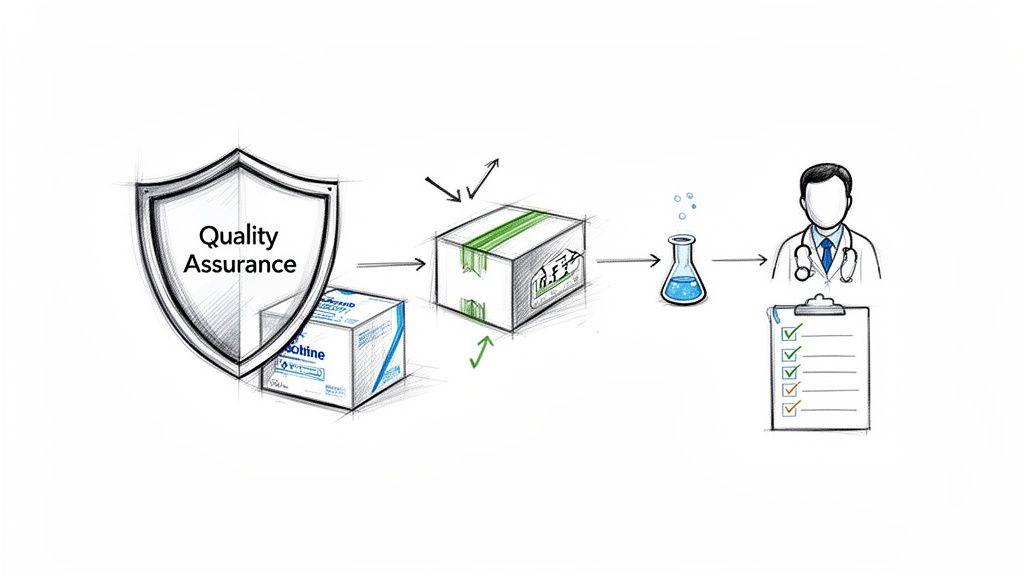
The focus on robust quality systems is only getting stronger. In the UK pharmaceutical sector, vacancies for quality assurance roles are projected to jump by 11.1% in 2025, a trend that highlights just how critical these skills are. This commitment is central to pharmacies like Courier Pharmacy, which sources all its medicines from MHRA-registered wholesalers.
This understanding is crucial whether you're getting a standard prescription filled or need more specialised medical supplies.
What to Expect in This Guide
Throughout this guide, a practising pharmacist will share real-world examples and practical tips to help you make smart choices. We’ll break down key concepts, explain the UK’s regulatory landscape, and give you a simple checklist for choosing a trustworthy online pharmacy. By the end, you’ll have a clear picture of what excellent care looks like and feel more in control of your health journey.
What Pharmaceutical Quality Assurance Really Means
Let's clear up what pharmaceutical quality assurance is all about with a simple analogy: building a house. Real quality isn't just about giving the finished building a quick once-over. It’s about making sure the architect’s blueprint is perfect, the foundation is solid, the materials are certified, and every single stage of construction is watched over from beginning to end.
That’s exactly what PQA does for your medicine. It’s a proactive, comprehensive framework designed to build safety and effectiveness into a product from the moment of conception right up until it reaches you. The entire system is geared towards preventing errors before they can happen, not just catching them after the fact.

Beyond the Final Product
Pharmaceutical quality assurance looks at every single element that could possibly affect the final medicine you receive. It's a holistic approach that guarantees consistency and reliability, dose after dose.
- People and Training: Are the pharmacists, technicians, and prescribers properly qualified and getting continuous training?
- Premises and Equipment: Is the pharmacy environment clean, controlled, and right for storing and preparing medicines? Is all the equipment—from simple scales to complex compounding machines—regularly calibrated and checked?
- Processes and Procedures: Are there clear, written instructions (we call them Standard Operating Procedures) for every task? This ensures everyone performs their duties correctly and consistently, every time.
- Products and Materials: Are the medicines and their raw ingredients sourced from reputable, regulated suppliers? Is there a paper trail proving their origin and quality?
Pharmacist's Tip: "Quality assurance is our promise to the patient. It's the reason we can confidently say that the medicine you receive today is just as safe and effective as the one you received last month. It’s about building a system of trust, where every detail is managed to protect your health."
This systematic approach is essential. Just relying on manual checks and final batch testing can be slow and inefficient, often spotting problems only after a lot of time and resources have been wasted. A robust QA system provides real-time oversight.
How This Works in a Pharmacy
At a patient-focused pharmacy like Courier Pharmacy, we live and breathe these principles every day. Our prescribers are GPhC-registered professionals who carefully review each consultation. Every licensed medicine we dispense is sourced from MHRA-approved wholesalers, ensuring it has been handled correctly right through the supply chain.
For our specialist compounded medicines, this is even more vital. We only use pharmaceutical-grade active pharmaceutical ingredients (APIs), and each one comes with a Certificate of Analysis to verify its purity and potency. This is how quality is truly built in, not just inspected at the end.
This comprehensive oversight means that whether you're receiving a common antibiotic or a personalised treatment, the underlying commitment to pharmaceutical quality assurance is exactly the same. It's the bedrock of safe and reliable healthcare.
How UK Regulations Create a Chain of Trust
Here in the UK, the safety of your medicine is never left to chance. A robust framework of regulations and independent bodies works together to create an unbroken "chain of trust." This system ensures that every medicine, from its creation to its arrival at your door, is safe, effective, and of the highest quality. It's the very backbone of pharmaceutical quality assurance.
Two key guardians stand at the centre of this system. First is the Medicines and Healthcare products Regulatory Agency (MHRA), which acts as the national gatekeeper. The MHRA is responsible for making sure all medicines meet strict standards for safety, quality, and effectiveness before they can ever be sold in the UK.
The second is the General Pharmaceutical Council (GPhC), which regulates individual pharmacists, pharmacy technicians, and the pharmacies themselves. The GPhC ensures that the professionals handling your medicines are qualified and that every pharmacy, whether on the high street or online, operates to the highest professional standards.
The Journey of a Medicine
Think of a medicine’s path as a secure chain of custody. Each link is governed by specific rules designed to protect the product's integrity. This journey starts with Good Manufacturing Practice (GMP), the set of standards that manufacturers must follow to produce medicines consistently and safely.
Once a medicine is made, its journey is protected by another crucial set of rules. This is where the principles of Good Distribution Practice (GDP) come in, forming a vital part of quality assurance in the UK. Rigorously enforced by the MHRA, these guidelines safeguard a medicine's integrity all the way from the wholesaler to the patient, demanding precise temperature control, secure storage, and impeccable record-keeping. For a pharmacy like Courier Pharmacy, GPhC-registered since 2014, sticking to GDP is non-negotiable for dispatching every prescription securely.
A Pharmacist's Perspective on Safety
"Our GPhC registration isn't just a certificate on the wall; it’s our public commitment to patient safety. It means we are held accountable to the highest professional standards every single day. When we source medicines, we only use MHRA-registered wholesalers. This isn't just a preference—it's a critical quality assurance step. A real-life example is the cold chain for temperature-sensitive drugs like insulin. We use validated packaging and temperature monitors to ensure the product never deviates from its safe range during transit, providing a verifiable record of its integrity right to the patient's door."
This commitment creates a direct line of trust for patients. Whether you're seeking a common treatment for an infection or a specialised therapy like Low-Dose Naltrexone, this regulatory chain ensures the medicine you receive is legitimate and has been handled correctly at every stage. It eliminates the risks tied to counterfeit or poorly stored medications, which can be ineffective at best and downright dangerous at worst.
This system is especially important for online pharmacies, where trust is everything. The same strict rules apply, making sure that the convenience of digital access doesn't come at the cost of safety. Understanding how your personal information is handled is also a key part of this trust, which is why transparent policies are so important. You can learn more about how we protect your information in our guide on patient consultation data.
In short, the UK's regulatory framework, led by the MHRA and GPhC, provides a powerful guarantee of quality. By enforcing standards like GMP and GDP, they ensure every link in the supply chain is secure, creating a system where you can have complete confidence in your prescribed treatments.
Quality Assurance vs Quality Control Explained
In the world of pharmaceuticals, two terms pop up all the time: Quality Assurance (QA) and Quality Control (QC). They might sound similar, and people often use them interchangeably, but they represent two very different—and equally vital—functions.
Getting the distinction right is key to understanding how your medicine is kept safe from the moment it’s conceived to the second it reaches your hands.
Think of it like building a high-performance car. Quality Assurance is the entire design blueprint, the engineering plan, and the assembly line process. It's everything you do before and during manufacturing to prevent faults. It's about designing a system so robust that every car coming off the line is built to perfection.
Quality Control, on the other hand, is the final inspection. It’s the rigorous series of checks a car undergoes before it leaves the factory—testing the brakes, checking the engine, and making sure the electronics work flawlessly. It’s the final confirmation that the system worked.
Proactive Processes vs Reactive Testing
At its heart, the difference comes down to one thing: timing. QA is proactive and process-oriented. It’s all about creating and managing systems to build quality in from the very beginning, preventing mistakes before they can even happen.
QC, in contrast, is reactive and product-oriented. Its job is to spot defects in the finished article through hands-on testing and inspection. It’s the proof that the QA systems are performing as they should.
Let’s put this into a pharmacy setting:
- A QA process would be creating a strict Standard Operating Procedure (SOP) for how pharmacists calibrate the sensitive scales used for compounding medicines. This ensures every measurement is accurate from the get-go.
- A QC step would involve taking a sample from a finished batch of a compounded cream and sending it to a lab to confirm its potency and purity are exactly as specified.
To make this even clearer, this table breaks down the fundamental differences between the proactive nature of Quality Assurance and the reactive checks of Quality Control.
Comparing Quality Assurance and Quality Control
| Aspect | Quality Assurance (QA) | Quality Control (QC) |
|---|---|---|
| Focus | Proactive: Focused on preventing defects in the process. | Reactive: Focused on identifying defects in the final product. |
| Goal | To build quality into the system and ensure processes are reliable and effective. | To verify that the final product meets all predefined quality standards. |
| Activities | System design, staff training, SOP development, supplier audits, documentation. | Product testing, inspections, lab analysis, batch sample reviews. |
| Timing | Implemented throughout the entire lifecycle, from development to distribution. | Typically performed at the end of the production process, before release. |
| Example | Ensuring a pharmacist is trained and certified on new compounding equipment. | Testing a batch of capsules for correct weight and dissolution time. |
As you can see, QA lays the foundation for quality, while QC confirms the final structure is sound.
Working Together for Patient Safety
Neither QA nor QC can work in isolation. They are two sides of the same coin, working in perfect harmony to guarantee patient safety. A strong QA framework drastically reduces the chances of anything going wrong, which makes the QC process much smoother—turning it into a final seal of approval rather than a frantic hunt for errors.
Pharmacist’s Tip: "We rely on our QA systems every minute of the day. They guide how we handle prescriptions, manage stock, and communicate with patients. QC is our final check to prove those systems are working, giving both us and our patients complete peace of mind. For example, our QA system dictates double-checking every prescription, but a QC step might involve a senior pharmacist randomly auditing a selection of dispensed items each day to verify accuracy independently."
This partnership ensures that every single medicine dispensed meets the demanding standards set by regulators like the MHRA. The strength of a pharmacy’s quality framework is a direct reflection of its commitment to patient care. You can learn more about our patient-first philosophy and commitment to quality by exploring our company’s story and values. It's this deep, integrated approach that builds a truly trustworthy pharmaceutical service.
Inside a Pharmacy's Quality Assurance System
Let’s step behind the counter to see what a robust pharmaceutical quality assurance system looks like in action. This isn't just about ticking boxes; it’s a living framework of interconnected processes, all designed with one goal in mind: ensuring every single medicine that leaves the pharmacy is safe, effective, and reliable. From the simplest task to the most complex preparation, quality is meticulously planned and documented.
This hierarchy diagram shows how overall Quality is supported by the proactive systems of Quality Assurance (QA) and the reactive checks of Quality Control (QC).
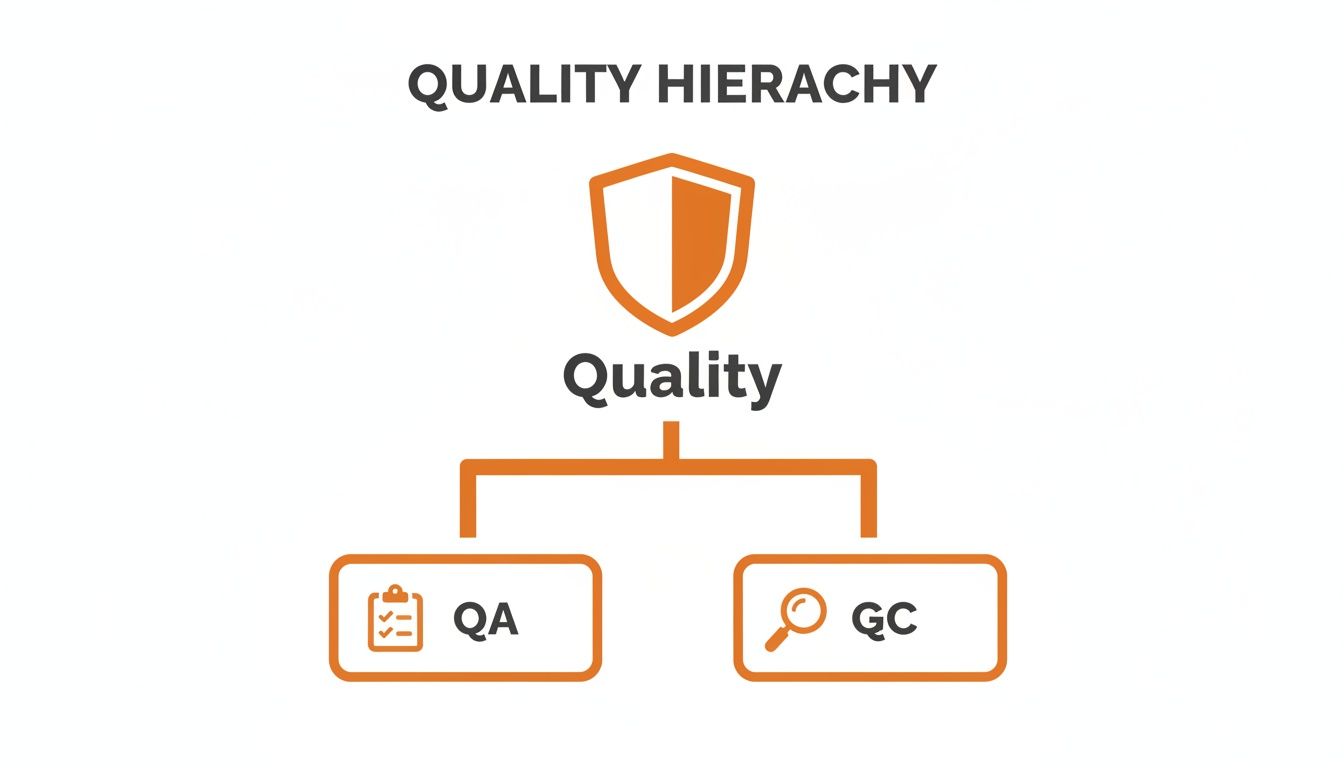
This visualisation clarifies that Quality Control is a component within the broader, all-encompassing strategy of Quality Assurance, which governs the entire process.
Standard Operating Procedures: The Rulebook for Safety
At the core of any pharmacy's QA system are its Standard Operating Procedures (SOPs). Think of SOPs as the detailed instruction manuals for every single task performed within the pharmacy. They leave nothing to chance, ensuring consistency and adherence to best practices, no matter who is performing the task.
These aren't just vague guidelines. A good SOP document will specify:
- Step-by-step instructions for processes like dispensing a prescription, cleaning equipment, or handling a patient enquiry.
- Roles and responsibilities, clarifying who is accountable for each step.
- Documentation requirements, ensuring a clear, traceable record is kept of all actions.
- Contingency plans for what to do if something deviates from the norm.
By following these meticulously crafted procedures, pharmacies minimise the risk of human error and ensure every patient receives the same high standard of care.
Supplier Qualification: The First Line of Defence
A pharmacy is only as good as the medicines and ingredients it uses. That's why supplier qualification is a critical part of quality assurance. This process involves thoroughly vetting and approving every company that supplies medicines or the raw ingredients used in compounded preparations.
This isn't a one-time check. It's an ongoing relationship built on trust and verification. Pharmacies must ensure their suppliers are MHRA-registered and adhere strictly to Good Distribution Practice (GDP) standards. The UK's pharmaceutical wholesaling sector, projected to support 2,840 businesses in 2025, is heavily driven by these regulations. This rigorous oversight ensures that pharmacies like Courier Pharmacy can confidently source licensed treatments—from men’s health therapies like TRT to GLP-1 weight-loss medicines such as Mounjaro—knowing their integrity is protected.
Sourcing APIs: The Purity Promise
For specialist services, especially a compounding pharmacy in the UK, this process goes even deeper. The quality of the Active Pharmaceutical Ingredient (API)—the core component of a medicine—is paramount.
Pharmacist's Tip: "When receiving a compounded medicine, ask if the pharmacy uses pharmaceutical-grade APIs with a Certificate of Analysis. This demonstrates a commitment to quality that goes beyond the minimum requirements. For instance, we recently prepared a custom-strength thyroid medication for a patient with specific allergies. By using a certified API, we could guarantee it was free from the exact fillers the patient was sensitive to, ensuring both efficacy and safety."
A Certificate of Analysis (CoA) is a document from the supplier that confirms the API has been tested and meets stringent purity and potency standards. At Courier Pharmacy, we only use APIs accompanied by a CoA, providing an auditable guarantee of quality for every bespoke preparation we create.
Managing Temperature-Sensitive Medicines
The QA system doesn't stop once a product is in the pharmacy. Many modern medicines, such as GLP-1 treatments like Wegovy or certain biologics, are temperature-sensitive. Maintaining the "cold chain" is a non-negotiable part of quality assurance.
This involves:
- Using calibrated, temperature-monitored refrigerators for storage.
- Implementing strict protocols for packing and shipping, using validated insulated packaging.
- Using tracked delivery services to minimise transit time.
A failure at any of these points could render an expensive and vital medicine ineffective. A strong QA system ensures these protocols are followed without exception, safeguarding the treatment right up to the patient's doorstep.
Your Checklist for Choosing a Quality Pharmacy
Navigating the world of online healthcare can feel like a bit of a minefield. But knowing what to look for is the key to making safe, informed decisions.
Whether you're a patient looking for treatment or a pharmacy operator dedicated to building a trusted service, the core principles of pharmaceutical quality assurance are your best guide. This practical checklist will help you spot a trustworthy provider and understand what a truly safe pharmacy experience looks like from behind the scenes.
Checklist for Patients
When you’re choosing an online pharmacy in the UK, you need to see clear proof that they take your safety and the regulations seriously. These checks are your first line of defence.
Verify GPhC Registration: Every legitimate UK pharmacy must be registered with the General Pharmaceutical Council (GPhC). You should find their registration number easily on the website, usually in the footer. Don't just take their word for it—pop that number into the official GPhC register to confirm they are who they say they are.
A Prescription is Non-Negotiable: The pharmacy absolutely must require a valid prescription from a registered prescriber. This means you either upload your own prescription or go through a thorough online consultation that is properly reviewed by a real healthcare professional—not just a simple algorithm.
Look for Clear Contact Information: A trustworthy pharmacy won’t hide. They should provide a physical UK address, a phone number, and have customer support you can actually reach. Vague or missing details are a massive red flag.
Review Their Policies: Take a moment to look for transparent privacy policies. They need to explain exactly how they protect your sensitive health data. They should also have clear information on delivery, returns, and how they handle any questions you might have.
Checklist for Pharmacy Operators
For those of you running a pharmacy, putting a solid quality assurance system in place isn't just about ticking regulatory boxes—it's the very foundation of patient trust and safety.
Document Everything with SOPs: You need detailed Standard Operating Procedures (SOPs) for every single critical task. We're talking dispensing, stock management, patient communication, data handling—the lot. These are the rulebooks that guarantee consistency and quality every single time.
Qualify Your Suppliers Rigorously: Never, ever source medicines or ingredients from unverified suppliers. Your system must include a formal process for vetting, approving, and regularly reviewing all your wholesalers and API providers. This ensures they are MHRA-registered and GDP-compliant.
Invest in Continuous Staff Training: Your team is your greatest asset, but also your biggest responsibility. You should have a regular training schedule covering SOPs, data protection, patient confidentiality, and all the latest regulatory updates. Make sure you document every session to maintain a clear record of competence.
Ensure Secure, Tracked Delivery: The final step in the journey is just as crucial as the first. Use a reliable courier service that offers tracked and "Signed For" delivery, particularly for prescription medicines. If you're dealing with temperature-sensitive products, validated cold-chain packaging is a must to maintain the medicine's integrity right up to the patient's door.
Summary
Pharmaceutical quality assurance is the comprehensive, proactive system that ensures the safety, efficacy, and reliability of every medicine you take. It's built on a foundation of strict UK regulations from bodies like the MHRA and GPhC, which govern every step from manufacturing to delivery. By understanding the difference between process-focused Quality Assurance and product-testing Quality Control, and by knowing what to look for in a pharmacy—such as GPhC registration and transparent procedures—you can confidently navigate your healthcare journey. A commitment to PQA is a direct commitment to patient safety, forming the bedrock of a trustworthy pharmacy service.
FAQs
How can I check if a UK online pharmacy is legitimate?
Every pharmacy in the UK, online or on the high street, must be registered with the General Pharmaceutical Council (GPhC). Look for their registration number on the website and verify it on the official GPhC online register. This confirms they are held to the UK's high professional and safety standards.
What does 'pharmaceutical grade' mean?
"Pharmaceutical grade" is a standard that guarantees an ingredient, especially an Active Pharmaceutical Ingredient (API), has been tested for exceptional purity and potency. This is verified by a Certificate of Analysis (CoA), which provides documented proof of the ingredient's quality, ensuring it is suitable for medical use.
Are online pharmacies as safe as high street pharmacies?
Yes, provided they are GPhC-registered. A regulated online pharmacy must adhere to the exact same stringent safety, quality, and professional standards as a physical pharmacy. The rules set by the MHRA and GPhC apply equally, ensuring patient safety regardless of the platform.
What is the difference between QA and QC?
Quality Assurance (QA) is a proactive, process-focused system designed to prevent defects by building quality into every step of the lifecycle. Quality Control (QC) is a reactive, product-focused check that involves testing and inspecting the final product to ensure it meets specifications. QA is the blueprint for quality, while QC is the final inspection.


