Quick Gout Relief: What Works and When to Get Help
Find quick gout relief options, medicine safety checks, red flags and when to see a GP or NHS 111 urgently.
You wake at 3am and even the sheet resting on your big toe feels unbearable. The medicine cupboard looks tempting, but the strongest tablet within reach is not automatically the right one.
A gout flare is a sudden attack of severe pain, heat, swelling and tenderness. It responds best when a clinician-chosen anti-inflammatory starts as early as possible, ideally on the first day symptoms appear. Rest, a raised leg and a cold pack wrapped in cloth ease pain while you wait. Chest pain, severe breathlessness, sudden weakness on one side, confusion or heavy bleeding needs urgent care, not home treatment.
Quick gout relief in the UK is a decision about safety as much as speed. Your kidneys, stomach, heart and current tablets decide whether an NSAID, colchicine or a short oral corticosteroid is suitable. Those options are not interchangeable, and the fastest route for one person can be unsafe for another.
Five points to keep in view
- Start early: begin a prescribed anti-inflammatory as soon as symptoms appear, ideally on day one.
- Match the medicine to your body: kidney, stomach and heart health, plus your current tablets, change which option is safe.
- Do not stack painkillers: two anti-inflammatories together can cause harm.
- Keep long-term gout tablets going: stopping them mid-flare is a common slip.
- Plan the follow-up: the flare plan is separate from the plan that prevents the next attack.
Quick gout relief options compared
A flare settles faster when one suitable anti-inflammatory starts early. Rest, a raised leg and a cold pack wrapped in a cloth help in the meantime. They do not replace a proper plan.
A gout flare is a sudden attack of severe pain, heat, swelling and tenderness. It often lands in the big toe and can make walking hard.
The NICE gout guideline lists three equal first-line prescription options: an NSAID such as ibuprofen or naproxen, colchicine, or a short course of an oral corticosteroid such as prednisolone [1]. No single option wins for pain, tenderness or swelling. Your kidneys, stomach, heart and current tablets decide the choice.
A corticosteroid injection is an option when those tablets are unsuitable, poorly tolerated or ineffective. A clinician gives it, sometimes after joint aspiration.
Side by side
| Option | Best used for | How it helps | Where you get it |
|---|---|---|---|
| NSAID, such as ibuprofen or naproxen | Adults with no kidney, stomach or heart risks that rule them out | Reduces the inflammation behind pain and swelling | Pharmacy or GP; check with a pharmacist first |
| Colchicine | Flares when kidney and liver function allow and no interacting medicines are taken | Targets the inflammation driving the flare | Prescription from a GP or prescriber |
| Oral corticosteroid, such as prednisolone | Use when NSAIDs or colchicine are unsuitable, poorly tolerated or ineffective | Calms inflammation across the body | Prescription from a GP or prescriber |
| Corticosteroid injection | One or a few swollen joints when tablets are unsuitable | Strong anti-inflammatory action within the joint | Given by a clinician, sometimes after joint aspiration |
| Ice, rest and raised leg | Support alongside prescribed treatment, not a replacement | Eases pain and swelling | At home; wrap ice in a cloth |
Practical rule: Use the table to start a conversation with a pharmacist or GP. It is not a menu to pick from alone.
If naproxen is even a maybe, read what naproxen is and who it suits before you open a pack from the shelf.
Snippet: There is no single fastest gout medicine. The right one is the one that is safe for your body and your other tablets.
Red flags that need urgent care
Some joints that look like gout are not gout. A hot, swollen joint can be an infection, and infection can damage the joint within days. Home treatment is the wrong first step when a red flag is present.
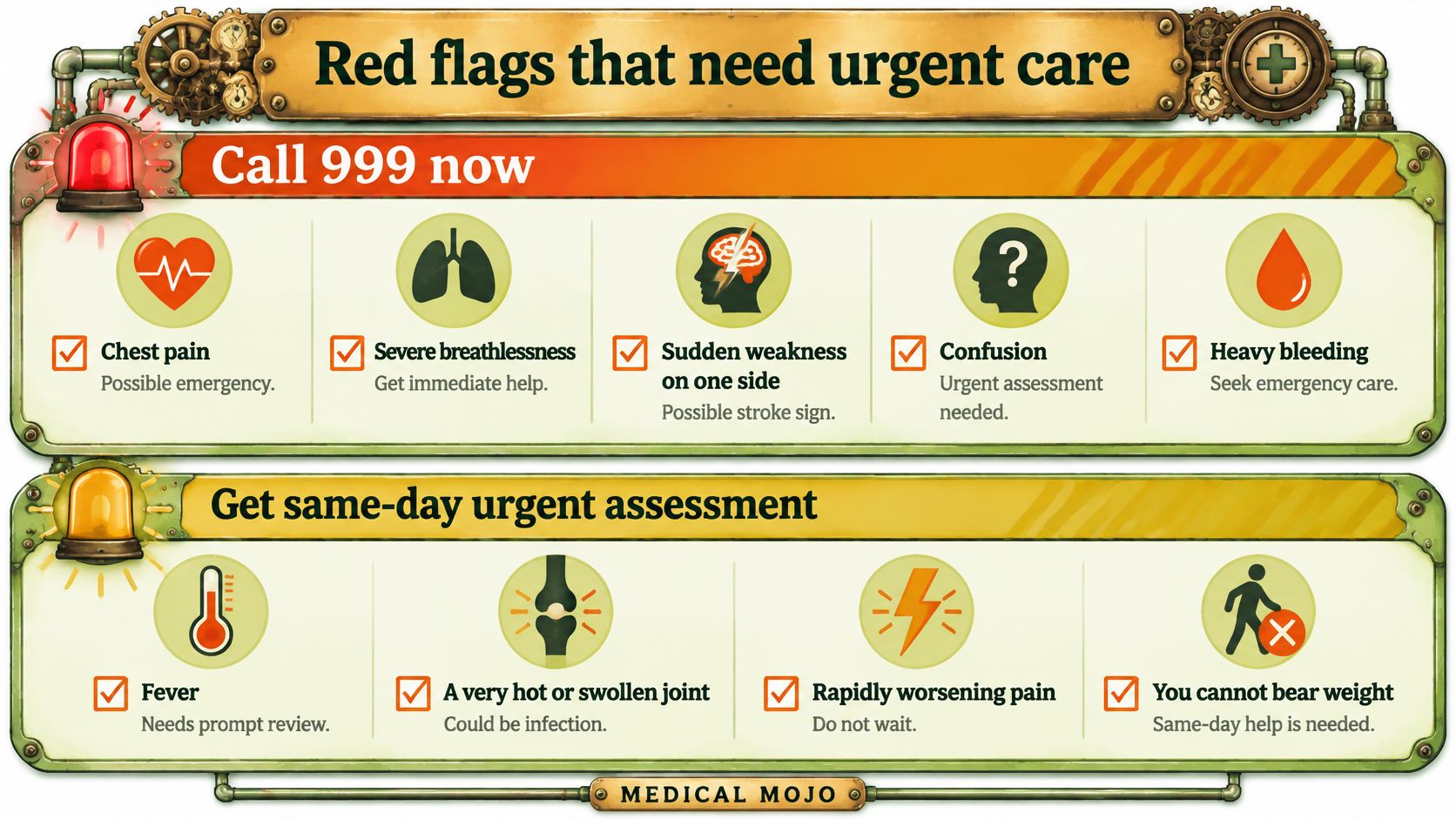
Call 999 now
- Chest pain: this can be an emergency, not a joint problem.
- Severe breathlessness: get immediate help.
- Sudden weakness on one side: this can be a stroke sign.
- Confusion: you need urgent assessment.
- Heavy bleeding: seek emergency care.
Get same-day urgent assessment
- Fever, chills or feeling very unwell with a hot joint: infection must be ruled out.
- A joint so tender you cannot bear weight: do not wait overnight.
- Redness spreading fast across the skin: this needs a same-day look.
- Pain in an unusual joint, such as the knee, hip or wrist: gout is less certain here.
- A recent injection, surgery or wound near the joint: infection risk is higher.
- Black or bloody stools, or vomiting blood, while you take an anti-inflammatory: stop and get urgent help.
- Much less urine, or new leg swelling: your kidneys or heart may be involved.
- A first-ever flare: the diagnosis is still uncertain.
A GP may arrange joint aspiration, a needle test of joint fluid, to confirm gout or to rule out infection.
If a prescribed plan has not helped after a day or two, call back for a review. If you are unsure, call NHS 111. For the 999 list above, call 999.
Tell the call handler where it hurts, when it began, which medicines you took, and any kidney or heart conditions.
Medicine safety checks before you take anything
The cupboard habit is the risky one. Ibuprofen, colchicine and steroids are not interchangeable swaps. The NICE gout guidance says the choice must fit your other conditions, your other medicines and your preferences [2]. NICE also says more research is still needed on colchicine versus corticosteroids in people with chronic kidney disease, so nobody can promise one safest fast option.
Many people take shop-bought ibuprofen before anyone checks their kidneys, heart, stomach or interactions. That speed can backfire.
Match the situation first
| Situation | NSAIDs (ibuprofen, naproxen) | Colchicine | Oral corticosteroid |
|---|---|---|---|
| Chronic kidney disease | Often avoided; can be hazardous | Dose and safety need review; toxicity risk rises | Discuss with prescriber |
| Stomach ulcer or past bleeding | Avoid unless a stomach-protecting medicine is added and a clinician agrees | Check with prescriber | Check with prescriber |
| Heart failure or uncontrolled high blood pressure | Can be hazardous | Check with prescriber | Check with prescriber |
| Blood thinners such as warfarin | Can raise bleeding risk; check first | Check interactions | Check interactions |
| Liver impairment | Ask a pharmacist before any dose | Toxicity risk rises; check with prescriber | Discuss with prescriber |
| Pregnancy or breastfeeding | Ask a pharmacist before any dose | Ask a pharmacist before any dose | Ask a pharmacist before any dose |
Pharmacist's tip: Bring a full list of medicines to every consultation, including those you bought over the counter.
Pharmacist's tip: If you have had reflux, ulcers or stomach bleeding, ask whether an NSAID needs a stomach-protecting medicine, and only take it if your clinician agrees. A naproxen gastro-resistant tablet is still a prescription decision, not a safer DIY swap.
Pharmacist's tip: Never combine two anti-inflammatory painkillers. Call before you start any new painkiller if you take a blood thinner such as warfarin.
Say you train most evenings and you already take ibuprofen for sore muscles, and you also have high blood pressure. Tell the prescriber that habit before any gout treatment. A pharmacist can check a planned medicine against your full list in a few minutes.
How to act in the first 24 hours
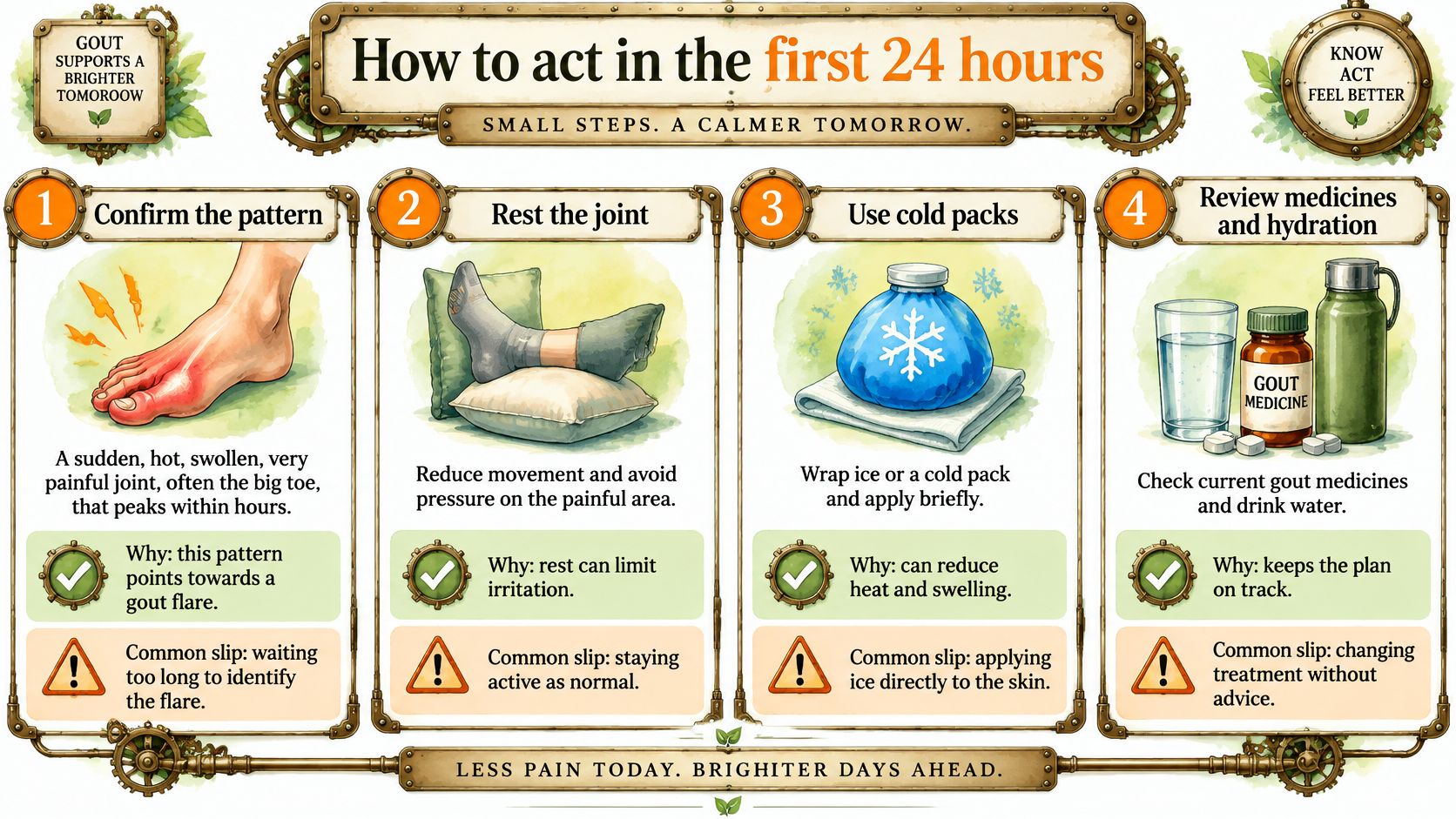
The first day of a gout flare rewards a clear order of operations. Treat it as triage: rule out danger, confirm the pattern, get a clinician's plan, then support the joint while the prescribed medicine starts.
Confirm the pattern. A joint that turns hot, swollen and very painful over a few hours, often the big toe, fits gout. Other problems can look similar. The common slip is waiting all day to see whether it is only a sprain.
Check the red flags before any home treatment. Fever, feeling very unwell, or an unusual joint needs urgent care first. Treating an infection as gout wastes the day that matters.
Contact a GP, a pharmacist or NHS 111 the same day. A clinician should confirm the picture and choose one first-line option. The NICE recommendations support an NSAID, colchicine, or a short oral corticosteroid, chosen with your kidneys, stomach, heart and current tablets in mind, along with your preferences [3]. A short course of steroid tablets is the third first-line option when the other two do not fit. Colchicine needs a prescription. Pharmacists can advise on over-the-counter options, but do not add shelf painkillers without checking.
Rest the joint, raise the leg, and use a wrapped ice pack for a short spell. Keep a cloth between the pack and your skin. Direct ice can hurt the skin. Walking it off is the usual slip.
Take the prescribed medicine as soon as you have it, exactly as directed. The slip is adding an extra painkiller from the shelf. NSAIDs can be hazardous with chronic kidney disease, ulcers, blood thinners, heart failure or uncontrolled high blood pressure. Colchicine toxicity risk rises with kidney or liver problems and with interacting medicines.
Drink water through the day and limit alcohol. Alcohol can set off another attack. Diet changes will not switch off today's pain.
A short film walks through the same early steps if reading is hard while you are in pain.
Say you finish a night shift, wake at 3am with a throbbing big toe, call NHS 111 at 8am and have a plan by lunchtime. That is a good first day. If colchicine is the chosen option, a prescriber can assess colchicine 500 microgram tablets for you.
Progress looks like less pain on walking within a day or two, then less swelling. If the joint is no better, call back.
Timing your treatment across the flare
A flare has a clock, but the clock is not the only thing that matters. The fastest option for one person can be unsafe for another because the choice turns on the kidneys, stomach, heart and current tablets. Timing narrows which treatment still fits. Those safety checks decide whether it is suitable.
An NHS primary-care rheumatology guide says colchicine should generally be started within 1 to 3 days of onset, and it may help less once an attack has lasted about a week [4]. In that later window, a short steroid course may help more. The same guide says to check reasons not to use a medicine, and check interactions, before treatment.
Timing works like a narrowing funnel. At the start, more options may be open. As the days pass, the early colchicine window closes, and the conversation shifts toward what is still safe for your body. An NSAID, colchicine and a steroid are not interchangeable. A stomach ulcer, heart failure or a kidney problem can rule one out while leaving another possible. That is why the start date is more useful than a guess about how bad the pain feels.
A simple timeline
| Timing | What the guidance says | What to do |
|---|---|---|
| First 1 to 3 days | Colchicine is generally started within this window | Start the prescribed option as soon as it is issued |
| After about a week | Colchicine may help less; a short steroid course may help more | Tell your clinician the attack is still going |
| During the flare | Established urate-lowering treatment should not be stopped | Keep taking it unless your doctor says otherwise |
Write down the morning the pain started. That one date helps your clinician pick the option that still fits.
A three-day delay changes the conversation. If a swollen knee is still painful on day four, colchicine may now help less, and the clinician needs that delay on the record. Waiting to see if it settles is common. It also removes the early window from the discussion. Do not raise the dose yourself if the first day does not bring relief.
If an NSAID is suitable and a standard one is not, a prescriber may look at a short course such as etoricoxib 120 mg tablets. Do not start that, or any other anti-inflammatory, on top of one you already take.
Book your gout follow-up once the flare settles
A flare settling is a good sign. It is also the point to ask why it happened and what will reduce the chance of another. Today's anti-inflammatory treats today's pain. Repeated flares may need urate-lowering treatment, a medicine that lowers uric acid over time rather than another painkiller.
The follow-up usually confirms the diagnosis, checks a blood test for serum urate and kidney function, and decides on long-term treatment. It is also the moment to review your other tablets. The right plan depends on your kidneys, stomach, heart and current medicines, so bring a list of everything you take, including anything bought over the counter.
NICE generally recommends starting urate-lowering therapy two to four weeks after a flare has settled. If attacks are frequent, a clinician may consider starting it during a flare. Some people stop allopurinol during an attack because they fear it will make the pain worse. The NHS gout advice is clear that established urate-lowering therapy should continue during a flare unless your doctor says otherwise. Keep taking it.
Lifestyle steps help between flares. Limit alcohol, drink enough water, keep a healthy weight and cut back on sugary drinks. Those habits support treatment. They do not end a flare on their own.
Book that visit within two to four weeks of the flare settling. Keep a simple diary with the date, the joint, the medicine and how well it worked. Our gout treatment page sets out how a UK prescriber reviews flare medicine.
Questions worth asking
- Do I need urate-lowering treatment after this flare?
- What blood urate level should I aim for?
- Which tablets are safe with my kidneys and my other medicines?
- How will you check my results?
In short, quick gout relief is one safe anti-inflammatory, started early, plus rest, elevation and a wrapped cold pack. The right medicine depends on your kidneys, stomach, heart and other tablets. Red flags need same-day or emergency care. Do not mix anti-inflammatories, and do not stop allopurinol if you already take it. Once the flare settles, book follow-up so the next attack is less likely.
FAQs
What is the fastest way to treat a gout flare? Get a clinician-chosen anti-inflammatory started early, ideally within 24 hours, and rest, raise and cool the joint. There is no one tablet that is fastest for everyone.
Can I take ibuprofen from the cupboard? Only if a pharmacist or prescriber has checked your kidneys, stomach, heart and other medicines. Do not add it to another anti-inflammatory.
Should I stop allopurinol during a flare? No. Keep established urate-lowering treatment going unless your doctor tells you to stop. It prevents future attacks. It is not the painkiller for today.
When should I go to A&E or call 999? Call 999 for chest pain, severe breathlessness, sudden one-sided weakness, confusion or heavy bleeding. Get same-day care for fever with a hot joint, or if you cannot bear weight.
How soon should the pain ease? Prescribed medicine may start to work within two days. If you are no better after that, contact the prescriber again rather than raising the dose.
When does long-term treatment start? NICE generally suggests starting urate-lowering therapy two to four weeks after the flare settles. Frequent attacks may change that timing.
If a prescriber confirms your flare medicine, Courier Pharmacy can assess suitable gout treatments through a secure online consultation, including options such as colchicine when they fit your health and your other tablets. Our UK-qualified prescribers check each request before anything is supplied. Visit Courier Pharmacy to start a consultation or to ask which flare option is realistic for you.


