Rashes That Look Like Scabies: How to Tell
Not every itchy rash is mites. Rashes that look like scabies can be eczema, bites or psoriasis. Learn UK clues and when a pharmacist or GP should check.
Rashes that look like scabies can have several causes, including eczema, dermatitis, fungal infections, bites, psoriasis or a reaction to a medicine. The rash's pattern, timing and whether close contacts are itchy matter more than redness alone. An itchy patch cannot identify the cause by itself.
Does worse itching at night settle the question? No. Other skin conditions can itch after dark, and scabies may not leave clear tracks. A rash's appearance can also vary with skin tone, so notice changes from your usual colour as well as texture and raised spots.
Itching that continues after scabies treatment can be an allergic response to dead mites, rather than proof that mites remain. This distinction can help you avoid repeating treatment unnecessarily. A pharmacist can advise on suitable next steps, while a medical check may be needed if the cause is unclear or symptoms are concerning.
Rashes that look like scabies compared
Scabies is a skin infestation caused by tiny mites. Eczema and contact dermatitis cause skin inflammation instead. Fungus needs a different treatment again, while a drug eruption means a rash linked to a medicine.
These causes can overlap. The NHS scabies guide notes that scabies can worsen eczema or psoriasis, so an existing skin condition doesn't rule it out. [1]
Five key takeaways
- Redness isn't a diagnosis: Check where the rash sits and when it began.
- Night itch is a clue: It doesn't prove that mites caused the rash.
- Household treatment needs a plan: Seek advice before treating an uncertain rash as scabies.
- Itch can outlast mites: Ongoing inflammation doesn't always mean treatment failed.
- More cream isn't always better: Repeated mite treatment can irritate already sore skin.
Scabies and rashes that copy it
Use this chart to organise what you've noticed, not to choose a medicine on your own. On darker skin, put extra weight on texture, raised spots, scale and changes from your usual skin colour.
| Condition | Usual sites | Itch pattern | Contacts or burrows | Pause self-treatment if |
|---|---|---|---|---|
| Scabies | Finger webs, wrists, waist, armpits, groin, genitals, buttocks | Intense, often worse at night | Fine burrows; close contacts may itch | A young child, pregnancy, crusting or spreading infection needs assessment |
| Eczema | Skin folds, hands, known dry areas | Day or night; irritants may trigger flares | No mite burrows; eczema itself doesn't spread through a household | A steroid or scabies cream makes the rash worse |
| Contact dermatitis | Skin touched by a product, plant, nickel or gloves | Burning or itch after contact, sometimes delayed | No mite burrows; may settle after avoiding the trigger | The rash matches an exposure and nobody else itches |
| Fungal infection | A ring on the body, groin or feet | Itch with a scaly, sometimes raised edge | No burrows; no specific night-only pattern | There's a one-sided scaly ring without affected contacts |
| Insect bites | Exposed skin, ankles, clusters after sleep | Itch around individual bites | No burrows; people sharing an exposure may react differently | Clusters follow a bed, garden or pet exposure |
| Psoriasis | Elbows, knees, scalp, lower back | Can itch, but itch alone doesn't distinguish it | Defined scaly patches; no new household spread | Thick plaques, meaning raised patches, dominate rather than new tracks |
| Drug eruption | Often widespread, including the trunk | May itch mildly or intensely | A new medicine may precede it; no mite-contact pattern | A tablet or antibiotic recently started |
No affected contacts makes some alternatives worth considering, but it doesn't exclude scabies. Equally, several itchy people may share an irritant or insect exposure rather than mites.
If a product seems involved, this guide to choosing a dermatitis cream can help you prepare questions for a pharmacist. Don't assume that the strongest cream is the right one.
Scratching can add crust, raw patches and eczema-like changes. It can also lead to bacterial infection, which further blurs the picture. The chart is a sorting aid, not a home diagnosis.
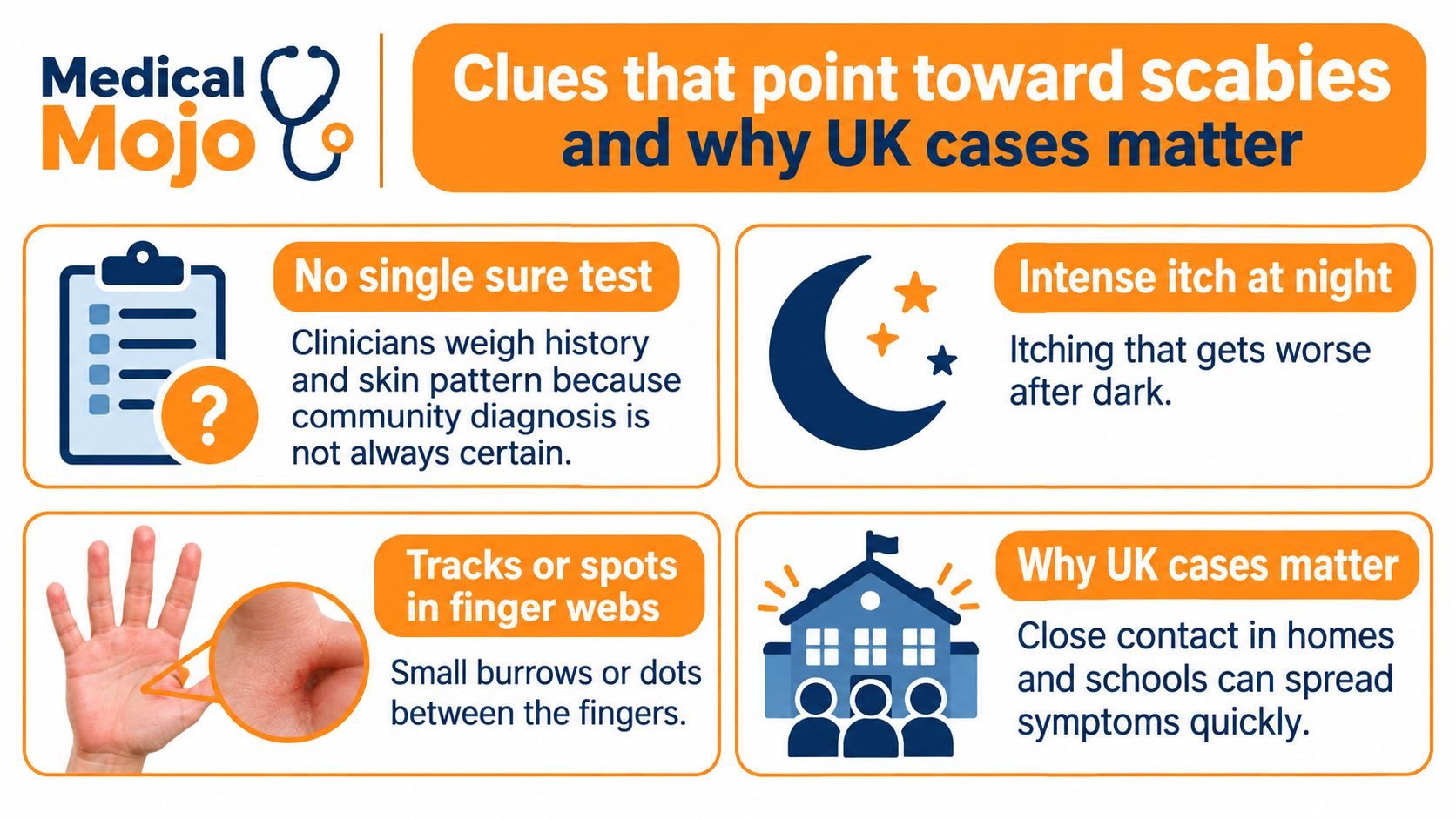
Clues that point toward scabies and why UK cases matter
A clinician combines your history with a skin examination. They'll ask where the itch started, what changed beforehand, and whether household or sexual contacts have symptoms.
The most useful clues form a pattern:
- Night-time itch: Often intense, though not unique to scabies.
- Typical sites: Finger webs, wrists, waist, genital skin and breasts.
- Other sites: Palms and soles can also be involved.
- Close-contact symptoms: Similar itch in someone with prolonged skin contact.
- Burrows: Short, fine, wavy lines, sometimes with a tiny dot at one end.
This checklist highlights the pattern without turning it into a diagnosis.
Skin tone and tests can change the picture
On darker skin, redness may be hard to see. Spots can look darker than nearby skin, and inflamed patches may have a grey or purple tone. Look for changes in shape, feel and spread rather than waiting for a bright red rash.
An NHSBSA Pharmacy First scabies prescribing pathway draft discusses the difficulty of spotting redness on darker skin. It is a draft document, not evidence that a final pathway has been adopted. [2]
Dermoscopy means examining skin with a lit magnifier. It can reveal a mite or burrow. Microscopy means checking a skin scraping under a microscope, but the sample can miss the infestation.
The Cumbria NHS prescribing guidance explains that scraping has poor sensitivity, meaning it can miss genuine cases. A negative result therefore doesn't reliably rule scabies out. [3]
A missing burrow isn't an all-clear. A visible scratch isn't proof of a mite.
What UK figures do and don't tell us
Sexual-health services in England recorded 4,872 scabies diagnoses in 2024, up 44% from 3,393 in 2023, according to UKHSA's Health Protection Report. [4]
Wales recorded more than 12,000 reported scabies consultations in 2023–24, compared with 1,300 in 2018–19, according to BBC reporting of Welsh figures. Consultations and diagnoses aren't the same measure. [5]
UKHSA's closed-setting guidance defines an outbreak as at least 2 linked cases within 8 weeks. It reports more than 241 institutional outbreaks notified in England in 2016 and estimates that approximately 1 in 50 long-term-care facilities experiences an outbreak each year. [6]
The same guidance describes an investigation of 10 elderly-care-home outbreaks involving 230 residents. 61 residents, or 27%, met definite, probable or possible scabies criteria; among those residents, 31, or 51%, had no symptoms and 25, or 41%, had visible burrows. [6]
Dermoscopy found mites in 7 diagnosed residents, or 11%, while microscopy confirmed infestation in 3, or 5%, in that investigation. These findings show why symptoms and tests need careful interpretation in care-home outbreaks. [6]
National figures can't diagnose your rash. An unusual distribution, a clear product trigger, or worsening after repeated scabies cream should prompt a fresh assessment. Eczema, dermatitis and bites can also itch intensely, while crusted scabies may cause less itch than expected.
How each lookalike is usually managed
Treatment should match the cause. Ask a pharmacist or prescriber to assess an unclear rash before you start mixing creams.
A product that helps dry eczema won't kill mites. A mite-killing cream won't treat fungus, and repeated use may make irritated skin harder to assess.
Match the treatment to the problem
| Likely cause | Usual management approach |
|---|---|
| Scabies | Use a pharmacy-supplied or prescribed scabicide, meaning a mite-killing treatment. Follow its full application plan and arrange contact treatment. |
| Eczema | Use an emollient, meaning a moisturiser that protects dry skin. A clinician may add a topical steroid to calm a flare. |
| Contact dermatitis | Avoid the suspected trigger and protect the skin with an emollient. Ask whether a short steroid course is suitable. |
| Fungal infection | Use an appropriate antifungal for the full labelled course. Get a check if it doesn't improve or the diagnosis is unclear. |
| Insect bites | Use soothing care. Ask a pharmacist whether an antihistamine is suitable if itch disrupts sleep. |
| Psoriasis | Follow a prescriber-led plan, often using emollients and specific topical medicines. |
| Drug eruption | Contact the prescriber promptly. Don't stop or continue a suspected medicine without advice about the reaction and its severity. |
For a ring-shaped rash, this ringworm information page explains the fungal condition. Despite its name, ringworm isn't a worm.
Ask about application, not just the product
If a clinician recommends scabies treatment, check which skin areas need coverage. Ask about hands, nails, folds and any age-specific instructions. Don't assume that treating only the visible spots will work.
Also check how long the product should stay on and whether the course includes another application. Different products and patient groups need different instructions.
Practical rule: Bring the packaging of every cream you've tried. The ingredients matter more than the brand colour.
Seek urgent help for a medicine-related rash with breathing trouble, facial swelling, blistering or sores in the mouth. Those symptoms need more than a routine cream review.
Itch that stays after treatment
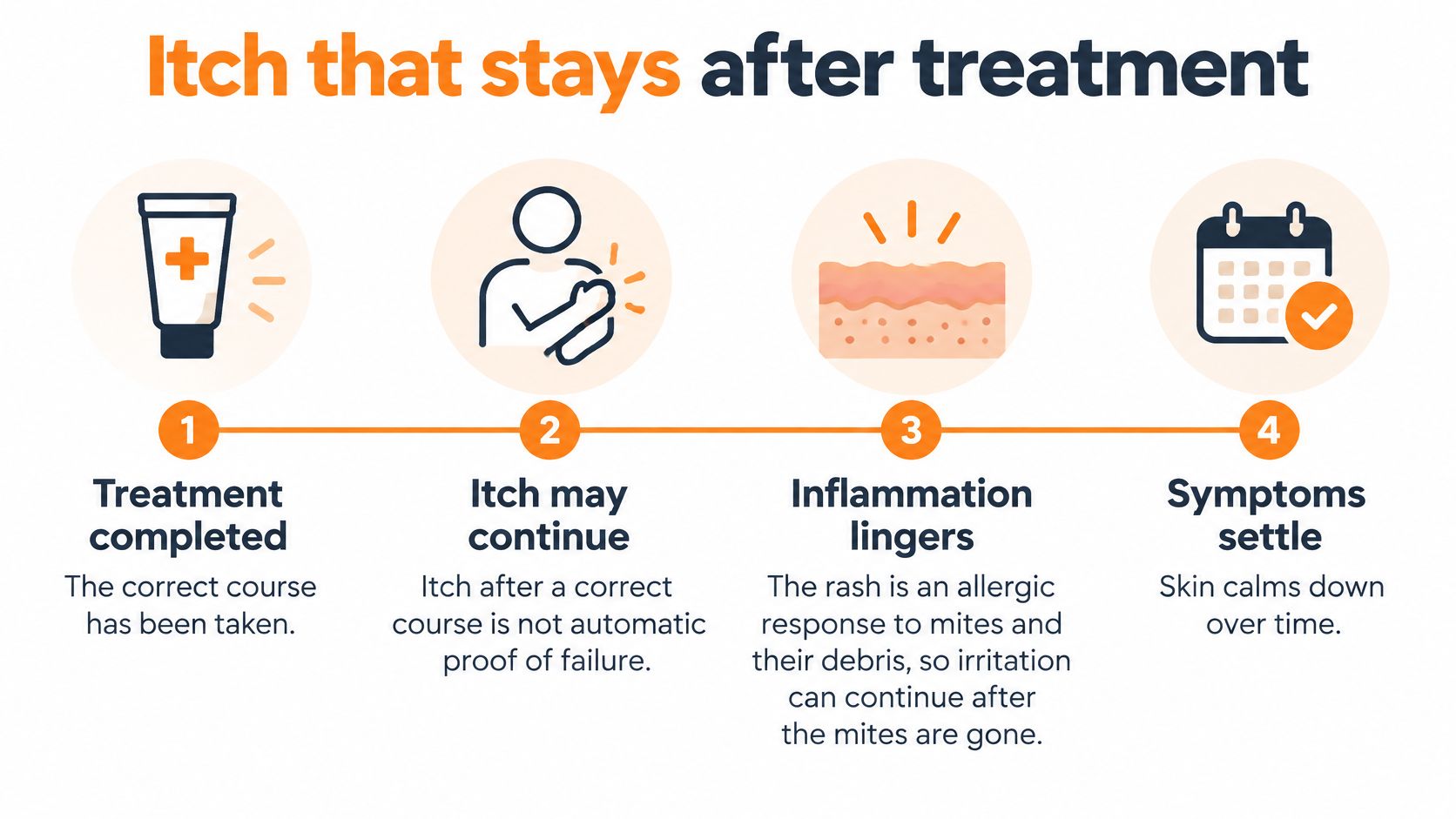
Itch after a correct course isn't automatic proof of failure. The body can keep reacting to dead mites and their debris after treatment has cleared the infestation.
The Frimley Health NHS scabies guide says post-treatment itching may last 2–3 weeks. Ongoing inflammation can therefore explain discomfort even when treatment has worked. [7]
This timeline shows why itch alone can mislead.
What itch means after scabies treatment
The stages below are checkpoints, not a promise that every rash follows the same schedule. New lesions and worsening illness matter more than the calendar.
| When | What is common | What needs a review |
|---|---|---|
| Day the course finishes | Correct treatment aims to clear mites, but itch needn't stop immediately | Missed folds, uncertainty about age-specific scalp coverage, or untreated household contacts |
| Weeks 1 to 2 | Itch and eczema-like inflammation may continue | Rapidly worsening pain, pus or fever |
| Weeks 2 to 3 | Itch may still fall within the hospital guide's expected recovery period [7] | New burrows or a rash that keeps spreading |
| Weeks 2 to 4 | Persistent itch reaches the NHS review window [8] | Crusting on hands, feet, elbows or knees, or symptomatic untreated contacts |
Four reasons symptoms may continue
- Lingering allergy: Your skin still reacts to mite material after successful treatment.
- Application gaps: A missed area or an incomplete course may leave mites alive.
- Reinfestation: An untreated close contact may pass mites back.
- Another diagnosis: Dermatitis may have caused the original rash or followed irritating treatment.
The British Association of Dermatologists scabies leaflet provides patient guidance on treatment and ongoing symptoms. A review should consider how you applied treatment and who else needed it, not which stronger product to try. [9]
Scabies can also stir up existing eczema or psoriasis. A familiar dry plaque returning doesn't, by itself, prove a new infestation.
Don't stack repeat permethrin courses without advice. Ask about gentle skin care and suitable itch relief while the cause becomes clearer. This dry-skin information page can support that conversation, but moisturiser isn't a substitute for mite treatment when scabies remains active.
New burrows, spreading lesions, pus, rising pain or fever need assessment. Thick crusting needs urgent clinical care because crusted scabies can be easy to miss and highly contagious.
Three UK days with the same itch
The same word, itchy, can describe very different problems. These fictional scenarios show why the surrounding details matter.
A child's rash needs an age-aware assessment.

A busy parent notices scratching
A parent spots itchy wrists on a toddler. An older sibling keeps scratching too, so the parent wonders whether they've passed something between them.
That contact pattern deserves attention, but it doesn't settle the diagnosis. Because the toddler is very young, the parent calls the GP rather than guessing which tube is suitable.
A shift worker blames night-time mites
A warehouse worker scratches after a night shift. The rash sits under new gloves and around the cuffs, where detergent and sweat collect.
Nobody at home itches. A pharmacist asks about glove materials and cleaning products, then considers contact dermatitis rather than treating night itch as proof of scabies.
A gym-goer spots a scaly ring
After using shared gym facilities, someone notices a scaly ring in the groin. The edge looks more active than the centre, and their partner has no itch.
That pattern raises fungus as an explanation. Shared mats alone don't prove where an infection came from, so the pharmacist examines the rash before recommending treatment.
A new antibiotic plus a widespread trunk rash raises a different question. That person needs advice from the prescriber, not a search for hidden mites.
For further discussion of the topic, the video below can supplement, but not replace, a skin assessment.
Pharmacist's tips for a useful consultation
Pharmacist's tip: Write down recent creams, gloves, detergents and tablets before buying anything. Include things you've used before without trouble.
Pharmacist's tip: Don't layer a steroid and scabies product, or start another course, on broken or weeping skin without advice.
Pharmacist's tip: Flag pregnancy, a weak immune system or a young child when booking. Mention pus, spreading heat, pain or fever straight away.
A clear history helps the clinician choose the next step. Photos taken in consistent light can show change, but they can't always replace examining the skin.
When to get the rash checked
Don't self-treat an uncertain rash when there are added risks. A pharmacist, GP or sexual-health clinic can help assess the pattern and decide whether scabies treatment fits.
NHS advice on scabies says to seek medical help for a child under 2 with symptoms or household exposure. It also advises review if itching continues 2–4 weeks after completing pharmacy treatment. [8]
Who needs prompt assessment
- Pregnancy: Check treatment suitability before using a mite-killing product.
- A weakened immune system: Symptoms may be less typical and need closer assessment.
- Crusted, flaky skin: Especially on elbows, knees, hands or feet.
- Possible infection: Pus, spreading warmth, swelling, increasing pain or fever.
- Existing eczema or psoriasis: More than one process may affect the same patch.
Use urgent care for severe infection, rapid deterioration or feeling very unwell. Don't wait for a routine online reply if symptoms worsen quickly.
For weeping or sore eczema, this infected eczema information page explains why a treatment review matters. Infection may need a different approach from either moisturiser or scabies cream.
Treat contacts and bedding as one plan
When a clinician suspects or diagnoses scabies, everyone in the home should receive treatment at the same time, including people without itch. People can carry mites before symptoms appear, so treating only the visible rash can allow reinfestation. [8]
Sexual contacts need a coordinated plan too. Tell the clinician about close contacts rather than asking each person to wait until they start scratching.
Clothes and bedding also need attention alongside treatment. Follow the advised hot-wash and bagging instructions so contact treatment and laundry happen together, rather than as separate efforts.
Make the examination count
Ask for a face-to-face assessment when the picture remains unclear. A clinician may need to inspect finger webs, nails, folds and other affected areas that a single photo misses.
Bring your treatment dates, medicine list and the names of products you've used. Explain whether new spots appeared before treatment, during it or after the course finished.
If you've already repeated treatment without a clear diagnosis, say so. One focused conversation is safer than another unsupervised tube.
What to do before another tube
Before using another scabies treatment, check whether the whole pattern still fits. Look at where the rash appears, when it began, how it has changed, and whether close contacts are itchy. Redness alone does not prove mites. Night-time itching can have other causes, and not seeing burrows does not rule scabies out.
If a pharmacist or prescriber thinks scabies is likely, follow the treatment plan they recommend. If the rash looks more like a glove-shaped patch, a scaly ring, a thick plaque or a reaction to a new medicine, pause further mite treatment and ask for the cause to be checked. The right next step depends on the pattern, not itch alone.
Itching can continue after treatment even when mites have been killed. The skin may still be reacting to material left behind, including dead mites, so persistent itch does not automatically mean the treatment failed. New spots, a changing rash or worsening symptoms deserve a fresh assessment rather than an automatic repeat dose.
Courier Pharmacy offers online consultations reviewed by human prescribers for skin infections and inflamed rashes. The assessment may help identify an appropriate next step, or advise an in-person examination when a clinician needs to see the rash directly.
Frequently asked questions
Can bedbugs or fleas cause a scabies-like rash?
Yes. Bites can cause itchy bumps in clusters, but their arrangement cannot reliably identify the insect. Mention pets, travel and shared sleeping spaces when describing the rash, as well as any skin contact with people who are itchy.
Does a negative skin scrape rule scabies out?
No. A sample may miss a mite even when scabies is present. A clinician considers the result alongside the skin examination and history of contact with others.
Can fungus in the groin look like mites?
Yes. Scratching can alter the appearance of a groin rash, making the original cause harder to recognise. A scaly edge may point towards fungus, but several conditions affect this area, so an assessment can help distinguish them.
Should I use a steroid cream while I wait?
Ask a pharmacist or prescriber first if you are unsure what is causing the rash. Steroids reduce inflammation, but they do not kill scabies mites and can change the rash's appearance.
Is a rash on darker skin harder to read?
Colour changes may be less obvious, especially in photographs. Describe other changes too, such as raised or rough areas, warmth, and differences from your usual skin tone. These clues can help a clinician understand what you are seeing.
Can folliculitis look like scabies?
Yes. Folliculitis means inflammation around hair follicles, which can produce itchy, spot-like bumps. If spots appear centred on hairs, mention this when asking for an assessment. Fine burrows between the fingers are a different clue.
Publication details
Meta description: Rashes that look like scabies may be eczema, bites or fungus. Compare skin-tone-aware clues, understand lingering itch and learn when to seek help in the UK.
Disclaimer: This information supports understanding and isn't a substitute for medical advice or a skin examination.


