Retatrutide: The Definitive 2026 UK Patient Guide
Retatrutide: Our 2026 UK patient guide covers this investigational weight loss drug. Learn how it works & its current availability. Get the facts.

SEO brief
- Primary keyword: Retatrutide
- Secondary keywords: investigational weight loss drug, Retatrutide UK, triple agonist, Wegovy vs Mounjaro, licensed weight loss treatment
- Search intent: Informational. Likely from UK adults asking what Retatrutide is, whether it works, and whether they can get it legally in the UK
- Target reader: UK adults, carers, and health-curious readers considering medical weight loss options
- Product/service mention: Safe access to currently licensed weight loss treatments through a regulated UK online pharmacy
- Internal links available: Assumed from the brief and Courier Pharmacy pages provided
Many individuals first hear about Retatrutide because of the dramatic weight loss seen in early trials. The surprising part is this. You still can't routinely get Retatrutide in the UK, because it's an investigational medicine rather than a licensed one [1][3].
If you're trying to work out whether the hype is justified, the short answer is yes, the early science looks promising. But the practical UK answer matters more right now. You need to know what Retatrutide is, how it works, what the trial results mean, what “investigational” really means, and how to lose weight safely using regulated care while this drug is still being studied.
Five key takeaways
- Retatrutide is not licensed in the UK. You can't get it as a routine prescription medicine [3].
- It works in three pathways at once. It targets GLP-1, GIP, and glucagon receptors [2].
- Early trial results are striking. The highest weekly doses produced about 24% average body-weight loss over 48 weeks in a phase 2 obesity trial [1].
- The full long-term safety picture is still developing. That matters because it's still under investigation.
- If a website claims to sell Retatrutide now, treat that as a red flag. Use licensed, regulated channels for weight loss treatment [3].
What is retatrutide and why is it causing excitement
Retatrutide is an investigational weekly injection being studied for obesity and metabolic disease. It has caused excitement because early trials showed unusually large weight loss, but it has not been approved for routine clinical use in the UK [1].
That distinction matters. A medicine can look very promising in trials and still not be available from your GP, NHS clinic, or a standard private prescription service. Right now, Retatrutide sits in the “watch this space” category rather than the “you can start treatment next week” category.
The drug is attracting so much attention because the early obesity trial results were stronger than many people expected from an injectable medicine. In one widely reported phase 2 study in adults with obesity but without diabetes, the highest weekly doses produced about 23% to 24% average body-weight loss over 48 weeks [1].
For a patient reading headlines, that can sound simple. In real life, it isn't. Trial results reflect selected groups, careful follow-up, dose increases, and close monitoring.
Practical rule: A promising trial result doesn't mean a medicine is ready for routine use.
If you're exploring current treatment options, it's safer to focus on regulated UK weight loss care rather than chase a medicine that isn't licensed yet.
Featured snippet answer
Is Retatrutide available in the UK?
No. Retatrutide is still investigational and isn't approved for routine prescribing in the UK [3].
Real-life example
A busy parent sees social media posts about “the next big weight loss jab” and wants the strongest option straight away. The key point is that the strongest-looking option on paper may still be unavailable, unlicensed, or unsafe to buy outside a trial.
How retatrutide targets weight loss in three ways
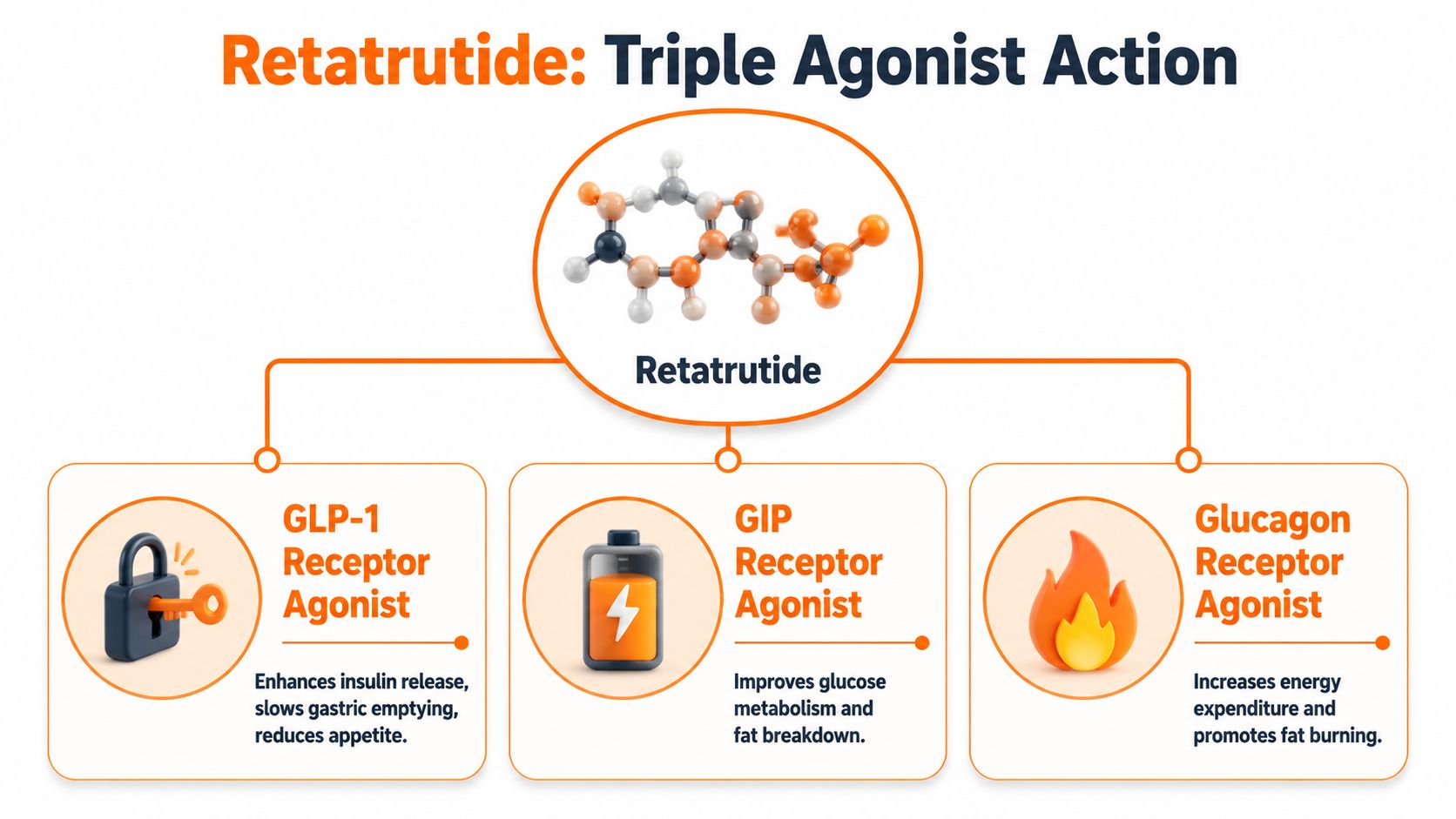
Retatrutide stands out because it's a triple agonist. That means it activates three receptor systems rather than one. Specifically, it targets GLP-1, GIP, and glucagon receptors [2].
A simple way to picture it
Think of appetite and weight control like a team with three managers:
- GLP-1 helps reduce appetite and slows how quickly food leaves the stomach.
- GIP helps with blood sugar control and works alongside GLP-1.
- Glucagon is thought to help increase energy expenditure.
When one medicine acts on all three, the goal is to coordinate hunger, blood sugar, and energy use at the same time. That helps explain why researchers are so interested in it.
A technical summary describes Retatrutide as an investigational triple-agonist incretin therapy. It reports human EC50 values of 0.0643 nM at GIPR, 0.775 nM at GLP-1R, and 5.79 nM at GCGR, which shows its three-part receptor profile [2].
Why three targets matter
The science sounds dense, so here's the patient version. GLP-1 and GIP activity are linked with appetite suppression and improved glycaemic control. Glucagon receptor activity is thought to raise energy expenditure [2].
That three-way action is why many people describe Retatrutide as a possible next step after single- or dual-agonist drugs.
Some medicines mainly reduce hunger. Retatrutide is being studied as a treatment that may reduce hunger and affect how the body uses energy.
If you'd like a broader background on metabolism, this guide to PPARs and metabolic switches helps explain why receptor targets matter.
Featured snippet answer
How does Retatrutide work?
Retatrutide activates GLP-1, GIP, and glucagon receptors. Together, these actions may reduce appetite, improve blood sugar control, and increase energy use [2].
Pharmacist's tip: When a medicine has a more complex mechanism, that doesn't automatically make it better for every person. It usually means doctors need clearer safety data and careful prescribing rules.
What the science says about retatrutide's effectiveness
The strongest early evidence comes from phase 2 trials. In adults with obesity, the highest weekly doses produced an average body-weight loss of about 24% over 48 weeks [1].

A later summary of pooled trial data also reported a mean reduction of about 14.33% versus placebo at 36 weeks [1]. That gives a more rounded view than the biggest headline alone.
What the headline result means in real life
The easiest way to understand the weight loss figure is to convert it into an example. A person starting at 100 kg could lose about 24 kg at the top studied doses, based on that phase 2 result [1].
Here are two realistic examples:
- A shift worker starts at 100 kg and struggles with meal timing, tiredness, and snacking after late shifts. In trial-style terms, a 24% reduction could mean moving to about 76 kg, although individual results always vary.
- A gym-goer starts at a higher weight and wants to know whether an injection replaces hard work. It doesn't. In studies, medicines like this sit alongside structured lifestyle support, not instead of it.
Who may benefit most if it is approved later
A 2024 review adds useful detail. It notes that Retatrutide has a half-life of nearly 6 days, which supports weekly dosing, and reports that weight reduction was greater in people with BMI above 35 than in those below 35 [4].
The same review reports waist circumference reductions up to 19.6 cm in one cited trial [4]. It also notes HbA1c reductions of about 1.2% and around 9 kg weight loss over 12 weeks in a phase 1 study of adults with type 2 diabetes [4].
That matters because some readers don't just want to lose weight. They also want better blood sugar control, lower metabolic risk, or both.
| What the evidence suggests | What it may mean for patients |
|---|---|
| Strong weight loss in obesity trials | Retatrutide could become a major obesity treatment if approved |
| Greater reduction in people with higher BMI | It may be especially relevant for people with more severe obesity |
| HbA1c improvement in early diabetes studies | It may matter for people with obesity plus type 2 diabetes |
| Weekly dosing supported by long half-life | It fits the same practical pattern as other weekly injections |
Trial results are encouraging. They are not a promise of the same outcome for every future patient.
Pharmacist's tip: Ignore “best case” social media claims. Ask what happened in a proper trial, over what time, and in which patient group.
Understanding the potential side effects of retatrutide
Promising medicines still come with downsides. With Retatrutide, the main concerns look similar to the side effects patients already know from other incretin-based injections.
What people may notice early on
The most commonly discussed problems are gut-related side effects, such as:
- Nausea that can make meals less appealing
- Vomiting especially after dose increases
- Diarrhoea or looser stools
- Constipation in some people instead of diarrhoea
- Reduced appetite that may feel stronger than expected
These effects often appear when treatment starts or when the dose rises. In medicines from the same broad family, clinicians usually reduce this burden by increasing doses slowly and checking in regularly.
Because Retatrutide is still investigational, the full long-term safety picture is still being built. That's one reason approval takes time.
If you've already read about similar side effects with licensed options, this guide to Mounjaro side effects gives useful context on the sort of gut symptoms people often ask about with weekly injections.
When to get urgent medical help
Seek urgent medical advice if you develop:
- Severe or persistent vomiting
- Signs of dehydration such as dizziness, very dark urine, or confusion
- Severe stomach pain
- Symptoms that stop you keeping fluids down
Those aren't specific to Retatrutide alone. They're general safety rules for injectable weight loss medicines and other medicines that can upset the gut.
Feeling a bit sick can happen with these treatments. Being unable to drink, stand, or function normally is different and needs medical advice.
Featured snippet answer
What are the likely side effects of Retatrutide?
The main expected side effects are likely to be gastrointestinal, such as nausea, vomiting, diarrhoea, constipation, and reduced appetite. Its full long-term safety profile is still under study.
Pharmacist's tip: If a treatment website talks only about weight loss and says little about side effects, monitoring, or follow-up, step back.
Why you cannot get retatrutide in the UK yet
The plain answer is simple. Retatrutide is still investigational, so it has not been approved by the MHRA in the UK and isn't available as a routine licensed medicine [3].

What investigational means in plain English
An investigational medicine is still being studied. Researchers are still checking how well it works, who it may suit best, how to dose it, and what side effects show up over time.
For patients, that usually means one thing. You can only access it through formal research pathways, if at all, rather than by routine prescription.
Lilly describes Retatrutide as investigational and notes that it has not been approved by regulators like the FDA. UK patients also can't obtain it as a routinely licensed medicine, and websites claiming to sell it outside a clinical trial are operating outside regulated healthcare channels [3].
Why buying it online is risky
This is the part people often underestimate. If a website offers to sell Retatrutide directly to you now, that does not make the product genuine, legal, or safe.
The risks include:
- Unknown contents because you can't confirm what is in the vial
- Wrong strength which raises the chance of overdose or treatment failure
- Poor storage or transport which can damage injectable medicines
- No proper prescribing review so important medical checks may be missed
- No follow-up if side effects hit hard
For UK patients, the safer route is to use a GPhC-regulated online pharmacy in the UK for licensed medicines that a prescriber can review properly.
A short explainer can help if you've seen confusing coverage online:
What to do instead right now
If you're interested in medical weight loss today, focus on what you can access safely and legally:
- Check whether you meet criteria for licensed treatment. A prescriber will look at your weight, health history, and current medicines.
- Use regulated channels only. That means a real prescriber, a registered pharmacy, and proper follow-up.
- Expect monitoring. Good care includes side effect advice, dose guidance, and review if things don't suit you.
- Treat “peptide” and “research use” sites with caution. Those are not the same as regulated prescribing.
Real-life example
A gym-goer finds a forum where users discuss importing “research peptides” and mixing them at home. That may sound cheaper or faster, but it removes all the safety layers that protect patients in real healthcare.
Featured snippet answer
Can I buy Retatrutide online in the UK?
No legitimate UK pharmacy can supply Retatrutide as a routine licensed medicine right now. If a site claims to sell it outside a clinical trial, that's a major warning sign [3].
Pharmacist's tip: Before using any online pharmacy, check that it is UK regulated, uses real prescribers, and clearly states how follow-up works.
How retatrutide compares to wegovy and mounjaro
Patients usually don't ask about Retatrutide in isolation. They ask whether it might be better than Wegovy or Mounjaro, and whether it's worth waiting for.

The cleanest way to compare them is by mechanism, weekly dosing pattern, and UK availability. Retatrutide is the only one of the three in this list that is still investigational.
Comparison of injectable weight loss medicines
| Feature | Retatrutide | Wegovy (Semaglutide) | Mounjaro (Tirzepatide) |
|---|---|---|---|
| Drug type | Triple agonist | GLP-1 receptor agonist | Dual agonist |
| Main targets | GLP-1, GIP, glucagon [2] | GLP-1 | GIP and GLP-1 |
| Dosing pattern | Weekly. Supported by a half-life of nearly 6 days [4] | Weekly | Weekly |
| Weight loss evidence discussed in this article | About 24% average body-weight loss over 48 weeks at highest weekly doses in an early phase 2 obesity trial [1] | Licensed option. No comparative figure cited here | Licensed option. No comparative figure cited here |
| UK routine availability | No. Investigational [3] | Yes, through licensed prescribing routes | Yes, through licensed prescribing routes |
A practical UK view
Retatrutide may prove to be a very important future option, especially because early data suggest stronger effects in people with BMI above 35 and useful reductions in HbA1c [4]. It also shares the convenience of weekly administration because of its nearly 6-day half-life [4].
For today's patient, though, the biggest difference is not scientific. It's practical. Wegovy and Mounjaro are part of current UK care pathways. Retatrutide is not.
If you're weighing up licensed treatments that already exist, this article on switching from Mounjaro to Wegovy explains some of the world-world decisions patients discuss with prescribers.
The best medicine on paper isn't helpful if you can't access it safely and legally.
Real-life example
A shift worker wants the “strongest” injection but also needs something they can start through a proper UK pathway now. In that case, the practical choice is to discuss licensed options rather than hold out for a medicine that hasn't been approved.
Frequently asked questions about retatrutide
When might Retatrutide be approved in the UK?
No firm UK approval date is available in the verified evidence here. Approval depends on trial results and regulator review, so timelines can change.
Is Retatrutide for weight loss or diabetes?
Research has looked at both obesity and type 2 diabetes. Early reports include weight loss and HbA1c improvements, but it remains investigational [4].
Is Retatrutide a GLP-1 drug?
Partly. It acts on GLP-1 receptors, but it also targets GIP and glucagon receptors, which is why it's called a triple agonist [2].
Can I ask my GP to prescribe Retatrutide now?
Routine prescribing isn't available because it isn't licensed in the UK [3].
Can I join a Retatrutide clinical trial?
Possibly, but access depends on study location, eligibility rules, and whether recruitment is open. A trial team, not a routine prescriber, decides who can take part.
Is it safe to buy Retatrutide from research chemical or peptide sites?
That's not a safe route for patients. Products sold outside regulated healthcare channels may be unreliable, incorrectly labelled, or unsuitable for human use [3].
Does Retatrutide need weekly injections?
Early evidence suggests weekly dosing is suitable, supported by a half-life of nearly 6 days [4].
Who may respond best if it becomes available?
Early review data suggest stronger weight reduction in people with BMI above 35, though future approval and prescribing guidance would need to define who it's for [4].
Summary
Retatrutide is one of the most closely watched weight loss medicines in development. Early studies suggest impressive weight loss, and its three-target action helps explain the excitement. But the key UK fact is simple. It is still investigational and not licensed for routine prescribing. That means you shouldn't try to buy it from unregulated websites or peptide sellers. If you want treatment now, the safest route is a regulated UK prescriber and a licensed medicine with proper follow-up.
Disclaimer: This article is for information only and isn't a substitute for personal medical advice.
Meta description: Retatrutide explained for UK patients. Learn how it works, what trial results show, why it isn't available yet, and how to choose safe licensed options.
Suggested internal links for medicalmojo.co.uk
- A guide to GLP-1 weight loss injections in the UK
- Wegovy side effects explained in plain English
- Mounjaro for weight loss and who it may suit
- How to choose a safe online pharmacy in the UK
- What to expect from a medical weight loss consultation
Visual guidance for the designer
Infographic idea
A three-branch “Retatrutide action” chart in lime green, pale yellow-green, and light grey with ornate brass plaque labels.
Alt text: Infographic showing Retatrutide acting on GLP-1, GIP, and glucagon receptors.UK safety pathway graphic
A steampunk-style decision path showing “licensed pharmacy” versus “unregulated peptide site”.
Alt text: UK patient pathway comparing regulated pharmacy care with unsafe unregulated online sellers.Comparison panel
Decorative vial comparison for Retatrutide, Wegovy, and Mounjaro with simple icons for mechanism and availability.
Alt text: Comparison graphic of Retatrutide, Wegovy, and Mounjaro by mechanism and UK access status.Weekly injection explainer
A vintage weekly calendar dial showing how long-acting injections fit into a routine.
Alt text: Weekly dosing illustration for long-acting injectable weight loss medicines.
Byline
Medically written by Medical Mojo Editorial Team
Clinical review
Clinically reviewed by UK-registered pharmacist
How this content was created
This article was drafted using the verified evidence provided, with a focus on patient-safe UK guidance and plain-English explanation. A clinician-style review process was used to check accuracy, safety language, and regulatory clarity before publication.
References
[1] Wikipedia (n.d.) Retatrutide. Available at: https://en.wikipedia.org/wiki/Retatrutide (Accessed: 15 May 2026).
[2] Echemi technical summary (2025) Retatrutide receptor activity summary. Available at: https://file.echemi.com/fileManage/upload/goodstds/20250919/7b6f480a8f3d469abea2960db41b6988.pdf (Accessed: 15 May 2026).
[3] Eli Lilly and Company (n.d.) What to know about retatrutide. Available at: https://www.lilly.com/news/stories/what-to-know-about-retatrutide (Accessed: 15 May 2026).
[4] PMC review article (2024) Retatrutide for obesity and type 2 diabetes review. Available at: https://pmc.ncbi.nlm.nih.gov/articles/PMC10844714/ (Accessed: 15 May 2026).
If you're looking for safe, legal help with weight loss now, Courier Pharmacy offers access to licensed UK treatments through regulated online prescribing. That means proper clinical review, monitored follow-up, and medicines supplied through legitimate healthcare channels rather than risky peptide sellers.


