Your Guide to the SIBO Breath Test UK
Struggling with gut issues? Our guide covers the SIBO breath test UK, including costs, NHS vs private options, and how to interpret your results.

In this article
- Five Key Takeaways for SIBO Breath Testing
- Understanding SIBO and Its Impact on Your Gut Health
- Common Symptoms and Triggers
- The Different Types of SIBO Gas
- Choosing The Right SIBO Test: Lactulose vs Glucose
- The Glucose Breath Test: A Focused Investigation
- The Lactulose Breath Test: A Complete Journey
- Lactulose vs Glucose SIBO Breath Test: A Quick Comparison
- How to Prepare for Your At-Home SIBO Test
- The Pre-Test Period: What to Stop Taking
- The 24-Hour Prep Diet
- Taking the Test Step-by-Step
- Making Sense of Your SIBO Test Results
- Reading the Gas Levels
- Understanding Methane and IMO
- Interpreting Different Result Patterns
- Accessing a SIBO Test: NHS vs Private Options in the UK
- The NHS Pathway
- The Private Healthcare Route
- What to Do After a SIBO Diagnosis
- Building Your Treatment Plan
- How to Stop It Coming Back
- Summary
- FAQs
If you're stuck in a frustrating cycle of bloating, gas, and unpredictable gut pain, you’re definitely not alone. A Small Intestinal Bacterial Overgrowth (SIBO) breath test, available across the UK, is a simple, non-invasive tool that measures the gases produced by bacteria in your small intestine. This test can finally help figure out if a bacterial overgrowth is the real reason behind your persistent digestive issues, which are all too often dismissed as "just IBS."
Five Key Takeaways for SIBO Breath Testing
It Finds a Hidden Cause: The whole point of a SIBO breath test is to see if too many bacteria are living in your small intestine—a place where they shouldn't be gathering in large numbers. This overgrowth often perfectly mimics IBS, causing symptoms like bloating, gas, abdominal pain, and diarrhoea or constipation. As a pharmacist, I see so many patients who feel like they've tried everything for their IBS. For them, this test can be a genuine breakthrough, finally giving them a concrete diagnosis to work with.
Lactulose vs. Glucose Really Matters: In the UK, you’ll come across two main types of tests. The glucose test is great for checking the upper part of the small intestine, but the lactulose test can assess the entire length. A good rule of thumb is to think about your main symptom: glucose is often the go-to for diarrhoea-dominant symptoms, while lactulose can be more revealing if you struggle with constipation or mixed symptoms.
Preparation is Everything: The accuracy of your test results hinges entirely on how well you prepare. This means following a specific low-fermentation diet for 24-48 hours and fasting for 12 hours right before the test. For instance, a patient named Mark recently did a test with us. He was incredibly diligent, eating only plain chicken and white rice the day before. His results were crystal clear, which allowed us to build a targeted treatment plan for him straight away.
UK Testing Options: Private vs. NHS: While you can get a SIBO test on the NHS, it usually requires a referral to a gastroenterologist and can come with a significant wait. Private options, including convenient at-home kits, offer a much faster and more direct route. This means you can get answers and start a treatment plan within weeks, not months.
Professional Interpretation is Non-Negotiable: A graph showing your gas levels isn’t a DIY diagnosis. It's absolutely essential to have a qualified practitioner interpret the results in the context of your symptoms and health history. For example, a flat-line result doesn't always mean the test failed. It could actually point towards hydrogen sulphide SIBO, which needs a completely different treatment approach.
Understanding SIBO and Its Impact on Your Gut Health
Ever feel like there’s an unruly party happening in your gut that you definitely didn’t authorise? It’s a surprisingly good way to picture Small Intestinal Bacterial Overgrowth (SIBO). Think of your digestive system as a well-organised house: your large intestine is built to host a huge, bustling community of bacteria, but your small intestine should be a much quieter, less crowded space.
SIBO is what happens when far too many of these bacterial "guests" migrate from the large intestine and decide to set up camp in the small intestine. Once they're there, they start fermenting the food you eat way too early in the digestive journey. This premature fermentation churns out a huge amount of excess gas, triggering a whole cascade of disruptive and uncomfortable symptoms.
Common Symptoms and Triggers
For many people, the daily reality of SIBO involves relentless bloating, embarrassing gas, abdominal pain, and unpredictable bowel habits that swing from diarrhoea to constipation. Because these symptoms look so much like Irritable Bowel Syndrome (IBS), SIBO is often misdiagnosed or completely missed. The connection is so strong that SIBO is now seen as a major underlying cause in a huge number of IBS cases.
The search for a reliable sibo breath test uk has shot up for a reason. Around 20% of people in the UK—that's roughly 13 million individuals—are thought to have IBS. What's staggering is that some studies suggest up to 80% of those with an IBS diagnosis could actually have SIBO. You can read more on this from the Hospital Times.
This really highlights why just managing IBS symptoms often doesn’t bring lasting relief. While our guide to managing IBS symptoms offers useful strategies, getting to the bottom of things and treating SIBO could be the key to finally resolving the root cause of your discomfort for good.
The Different Types of SIBO Gas
Not all SIBO is the same. The type of gas being produced by the overgrown bacteria determines the specific kind of SIBO you have, and it often dictates your main symptoms. A good SIBO breath test will measure these different gases to give a clear picture.
- Hydrogen-Dominant SIBO: This is the most common form. The bacteria mainly produce hydrogen gas, which tends to speed up gut transit and often leads to diarrhoea.
- Methane-Dominant SIBO: Here, different microorganisms called archaea feed on the hydrogen produced by other bacteria and generate methane instead. Methane is known to slow down gut motility, which is why it’s so strongly linked with constipation and severe bloating.
- Hydrogen Sulphide SIBO: This is a third type, although less commonly tested for. It involves bacteria that produce hydrogen sulphide gas, which is notorious for its distinct "rotten egg" smell and is often associated with diarrhoea and abdominal pain.
Certain things can make you more vulnerable to developing SIBO in the first place. For instance, a bad bout of food poisoning can damage the nerves that control gut movement, allowing bacteria to build up where they shouldn't. Likewise, long-term use of acid-blocking medications (like proton pump inhibitors) can lower stomach acid—a key defence against bacteria—creating the perfect environment for SIBO to flourish. Identifying the condition with a sibo breath test uk is the critical first step toward breaking this cycle.
Choosing The Right SIBO Test: Lactulose vs Glucose
When you start looking into a sibo breath test in the UK, you’ll soon find there are two main players on the field: the Lactulose Breath Test (LBT) and the Glucose Breath Test (GBT). It helps to think of them as two different detectives, each with a unique way of investigating your gut to figure out what's behind your symptoms.
Getting to grips with how they differ is key to picking the right one for you. One detective is brilliant at checking the 'front door' and 'hallway' of the house (the upper part of your small intestine), while the other takes a full tour, inspecting every single room from top to bottom.
The Glucose Breath Test: A Focused Investigation
The Glucose Breath Test (GBT) works by giving you a simple sugar, glucose, to drink. Our bodies are incredibly good at absorbing glucose, so this test really only has time to investigate the first parts of the small intestine—the duodenum and jejunum.
This makes it a highly specialised detective. If bacteria have set up camp in this upper area, they’ll quickly gobble up the glucose and produce a tell-tale spike in hydrogen or methane gas. It’s fantastic for pinpointing SIBO in the upper gut (proximal SIBO), which is often the culprit behind diarrhoea.
The catch? Its reach is limited. The glucose is usually absorbed long before it gets to the lower part of the small intestine (the ileum). This means it can completely miss bacterial overgrowth happening further down the line, which could lead to a frustrating false negative result.
The Lactulose Breath Test: A Complete Journey
On the other hand, the Lactulose Breath Test (LBT) uses a synthetic sugar that our own cells can't absorb. Because of this, the lactulose solution travels through the entire length of the small intestine, from one end to the other.
This gives you a much more thorough investigation, as it can detect bacterial overgrowth anywhere along the small intestine. It's often the go-to choice for people whose symptoms are more geared towards constipation or a mix of issues, which are frequently tied to overgrowth in the lower small intestine. The only trade-off is a slightly higher risk of a false positive if the solution moves into the large intestine a bit too quickly.
This decision tree helps visualise how the type of gas found—be it hydrogen, methane, or hydrogen sulphide—often points towards specific symptoms like diarrhoea or constipation.
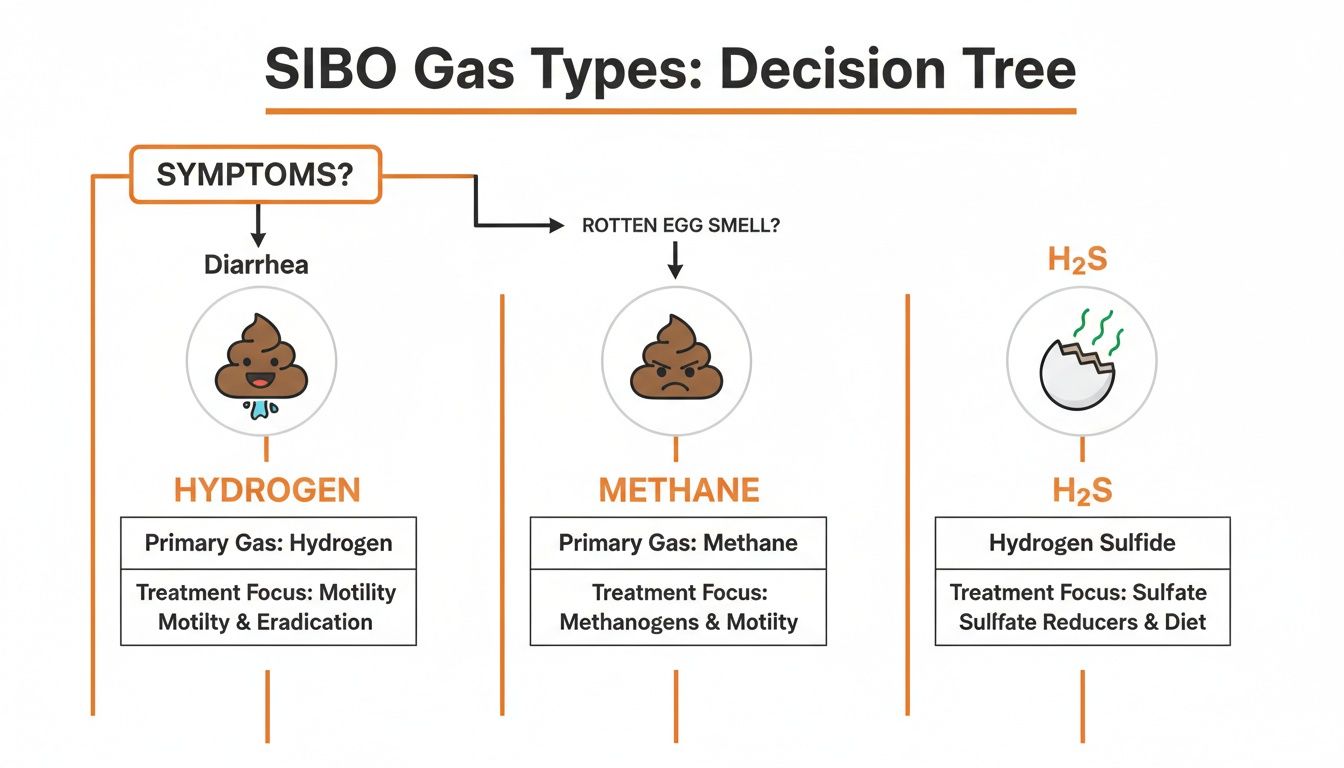
As you can see, measuring these gases is vital for connecting your test results to your real-world symptoms and steering you towards the right treatment.
Pharmacist’s Tip: From my experience, the choice often comes down to your primary symptoms. If you mainly struggle with diarrhoea, a glucose test can provide a very clear and specific answer. However, if your main issues are constipation, bloating, and gas, the lactulose test often gives a more complete picture of what's happening throughout your entire small intestine.
It’s also important to have realistic expectations about test accuracy. A major meta-analysis found the LBT has a sensitivity of 31–68% and specificity between 44–100%. The GBT shows a broader sensitivity of 20–93% and specificity of 30–86%, with accuracy really depending on the diagnostic criteria being used.
It's also worth noting that anything that changes your stomach acid levels can affect your gut environment. For instance, some people find that managing acid reflux with medications like Lansoprazole 30mg capsules is a piece of their broader gut health puzzle, but this should always be done under the guidance of a prescriber.
Lactulose vs Glucose SIBO Breath Test: A Quick Comparison
To make things clearer, here’s a simple breakdown of the key differences between the two tests.
| Feature | Lactulose Breath Test (LBT) | Glucose Breath Test (GBT) |
|---|---|---|
| Area Tested | Entire small intestine | Upper part of the small intestine |
| Best For Symptoms | Constipation, mixed IBS, bloating | Diarrhoea-dominant symptoms |
| Risk of False Positive | Slightly higher (fast transit) | Lower |
| Risk of False Negative | Lower | Higher (misses distal SIBO) |
Ultimately, choosing the right sibo breath test uk is a decision best made with your healthcare provider. This comparison gives you the knowledge to have a more informed discussion, ensuring you select the detective best equipped to solve your unique gut mystery.
How to Prepare for Your At-Home SIBO Test
Getting an accurate result from your at-home SIBO breath test kit really comes down to one thing: preparation. I often tell my patients to think of it like preparing a canvas before painting. If the canvas isn't perfectly clean, the final picture will be distorted. It’s exactly the same with your gut – if it isn’t properly prepped, your test results won't give a true reflection of what's happening inside.
This guide is your step-by-step playbook. It’s packed with practical, experience-based tips to make sure you complete the test correctly, giving you the clear, reliable data needed for a proper diagnosis.
The Pre-Test Period: What to Stop Taking
For your test to be accurate, we need to create a baseline state in your gut. This just means temporarily stopping anything that could alter your gut bacteria or the speed at which things move through your system.
- Antibiotics & Herbal Antimicrobials: You must stop taking any antibiotics or potent herbal antimicrobials for at least four weeks before your test. These are designed to kill bacteria and will completely skew your results.
- Probiotics & Prebiotics: It's important to pause all probiotic supplements and prebiotic fibres for one week beforehand. These directly influence your gut microbiome, and we need to measure its natural state without any help.
- Laxatives & Motility Agents: Avoid all laxatives for at least four days before the test. This includes natural ones like psyllium husk or other fibre supplements. It's also wise to check with your prescriber about any medications that might alter gut motility. While some people find that products like Fybogel Orange Sachets can help with regularity, they must be avoided during this crucial prep period.
The 24-Hour Prep Diet
The day before your test is the most critical part of your preparation. The goal here is to eat foods that are very easily absorbed by your body, leaving almost nothing behind for bacteria to ferment. This effectively 'starves' them, making sure that the only sugar they can react to is the one you drink for the test itself.
Your diet for the 24 hours leading up to the test should consist only of:
- Plain, cooked white meat (chicken or turkey) or white fish.
- Plain steamed or boiled white rice.
- Plain, cooked eggs.
- Clear chicken or beef broth (no vegetable pieces, bouillon, or stock cubes).
- Water, plain black coffee, or plain black tea (no milk, sugar, or sweeteners).
You must avoid all other foods, including vegetables, fruits, other grains, dairy, nuts, seeds, and any sugars or seasonings.
Pharmacist’s Tip: I always tell patients to cook all their food for the prep day the evening before. Having pre-portioned meals of plain chicken and rice ready to go in the fridge makes it so much easier to stick to the plan and resist temptation. Remember, even a small deviation can feed the bacteria and lead to an inaccurate result.
Taking the Test Step-by-Step
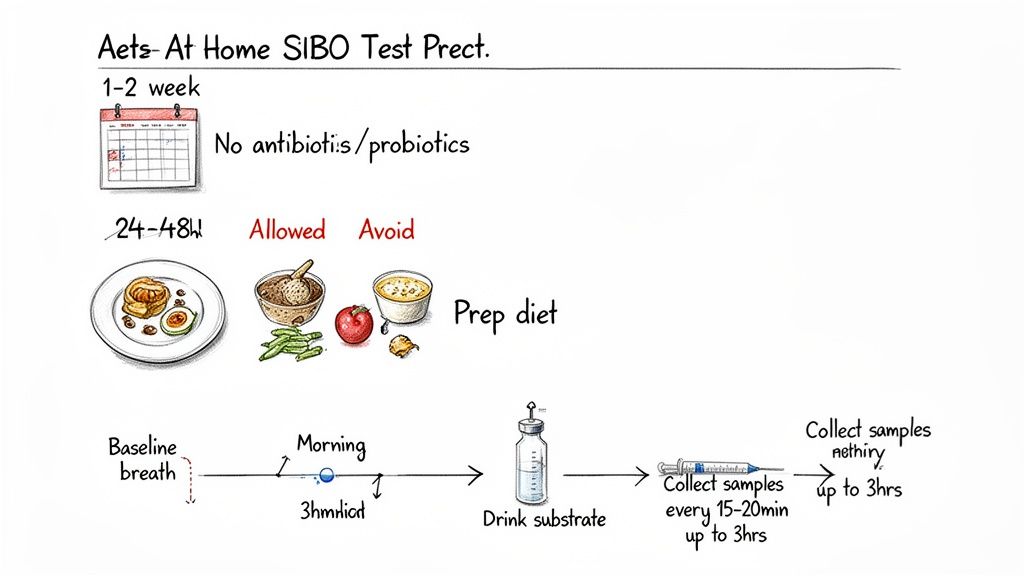
On the morning of your test, you'll need to fast for 12 hours (water is fine). Also, don't smoke, vape, or exercise before or during the test, as this can affect the composition of your breath.
Collect Your Baseline Sample: Before you eat or drink anything else, you'll collect your first breath sample. This is tube #1 and it provides your crucial baseline reading. Just follow the kit instructions carefully.
Drink the Substrate: Next, mix the lactulose or glucose powder with the specified amount of water and drink it all within five minutes.
Time Your Collections: The rest of the test is all about collecting breath samples at timed intervals—usually every 15-20 minutes for the next three hours. I highly recommend setting timers on your phone for each collection so you don't miss one.
It’s so important to understand why this diligence matters. For some people, particularly those with a history of digestive surgery, the risk of SIBO is significantly higher. A large analysis of glucose breath tests showed a 48% prevalence in patients with prior digestive surgery, compared to just 9% in those without.
What’s more, recurrence is a real issue. UK data shows that up to 44% of patients relapse within nine months of treatment, which makes accurate follow-up testing absolutely vital for long-term management. You can discover more insights about these findings on Wiley Online Library. This is exactly why getting a precise, well-prepared sibo breath test uk is so important.
Making Sense of Your SIBO Test Results
Getting a report back filled with graphs, numbers, and jargon can feel a bit overwhelming. After all the careful prep and doing the test itself, this is the moment of truth. Let's break down what those lines and figures are actually telling you about what's going on in your gut.
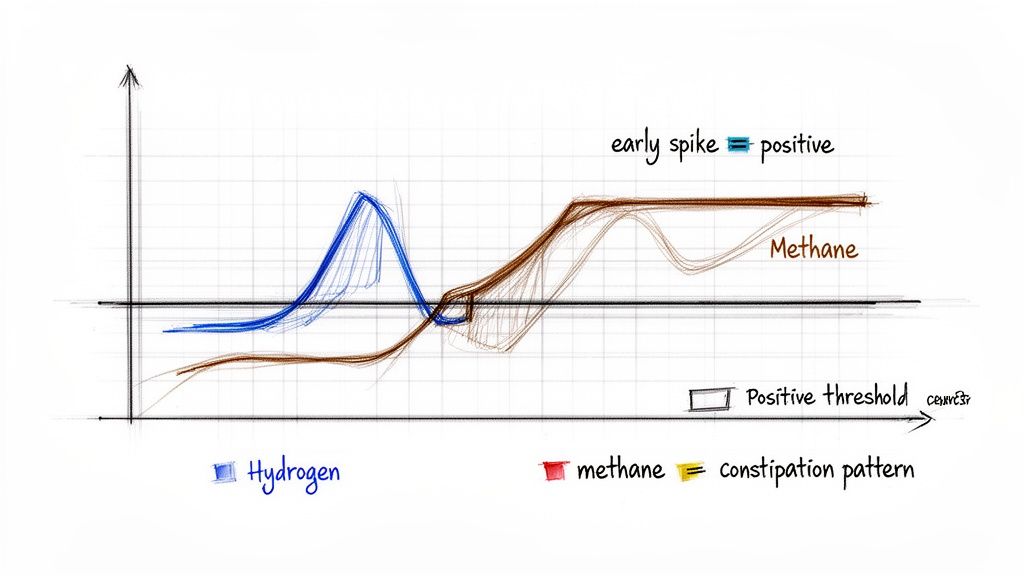
Think of the graph in your results as a story about gas production. We're looking for specific clues—how much gas is produced, and how quickly it shows up—to figure out if there’s a bacterial overgrowth in the wrong place.
Reading the Gas Levels
Your results will track two main gases, hydrogen (H2) and methane (CH4), measured in parts per million (ppm) for each breath sample. The most important thing we're looking for is a significant jump from your 'baseline'—that first sample you took right at the start.
For hydrogen-dominant SIBO, a positive result usually means:
- A rise of 20 ppm or more above your baseline within the first 90 minutes.
Why is that early spike so important? It’s a strong signal that bacteria in your small intestine got to the test sugar and started fermenting it way too soon, creating a burst of hydrogen. This particular pattern is often the culprit behind symptoms like diarrhoea and urgency.
Understanding Methane and IMO
Methane is a different kettle of fish. It's produced by different microbes—not bacteria, but archaea. When these are overgrown, we call it Intestinal Methanogen Overgrowth (IMO), which is a close cousin of SIBO.
For IMO, a positive result is typically:
- A methane level of 10 ppm or more at any point during the test.
That’s right, even a high reading right from your baseline sample can signal IMO. Methane is well-known for slowing everything down in the gut, which is why it’s so strongly linked with constipation, severe bloating, and that awful 'stuck' feeling.
A Pharmacist's Insight "Your test results are a vital piece of the puzzle, but they are not the entire picture. It is absolutely essential to review these numbers with a qualified practitioner. For example, a combined rise in both hydrogen and methane requires a different treatment strategy than a rise in just one gas. We must place the data in the context of your specific symptoms and health history to create an effective and safe plan."
Interpreting Different Result Patterns
Beyond a simple "positive" or "negative," the actual shape of your graph can tell us a lot more. Some people have a "double peak," where gas levels shoot up early and then rise again later. This might mean the overgrowth is further down the small intestine, or that the test solution moved into the large bowel very quickly.
It's also worth remembering that gut symptoms can be tricky. Bloating and tummy pain, for example, are common in SIBO but can also be signs of other conditions like Mast Cell Activation Syndrome. To understand more about this, have a read of our guide on Mast Cell Activation Syndrome and gastrointestinal symptoms.
Whatever you do, please don’t try to diagnose yourself or start a treatment plan based on your own reading of the report. This is data that needs a professional eye to make sure you get the right diagnosis and, ultimately, the right treatment. A proper consultation is where we connect the dots between the numbers on the page and the symptoms you've been living with.
Accessing a SIBO Test: NHS vs Private Options in the UK
So, you’ve decided a SIBO breath test is the right next step. What now? In the UK, you generally have two main routes to get one: through the National Health Service (NHS) or via a private provider. It’s worth taking a moment to understand how each path works, including the costs and timelines, so you can make the best choice for you.
Each option has its own pros and cons. One route follows the traditional healthcare pathway, which can be reassuring but often slow. The other offers speed and direct access, putting you firmly in control of your health journey.
The NHS Pathway
Getting a SIBO test on the NHS usually begins with a trip to your GP. You’ll need to have a detailed chat about your symptoms, and if your doctor suspects SIBO could be the culprit, they will typically refer you to a gastroenterologist at a local hospital.
This referral is the crucial first step, as SIBO testing isn’t something GPs can order directly. Once you finally get to see the specialist, they will be the one to decide if a breath test is clinically appropriate for your situation.
The biggest hurdle with the NHS route is often time. Waiting lists for gastroenterology appointments can be frustratingly long, sometimes stretching out for several months. On top of that, the availability and funding for SIBO breath tests can vary hugely between different NHS trusts, so it’s not a guarantee that it will be offered, even if the specialist agrees it’s needed.
The Private Healthcare Route
Opting for a private SIBO test is a much more direct and faster alternative. You can simply purchase an at-home sibo breath test uk kit yourself, either from a specialist clinic or an online pharmacy. This completely bypasses the need for a GP referral and the long waits to see a specialist.
The main advantages of going private are pretty clear:
- Speed: You can often order a test and have it delivered within a few days. From there, you could have your results back in just a couple of weeks.
- Convenience: At-home kits are a game-changer. You can do the test in the comfort and privacy of your own home, fitting it around your schedule without needing to take a day off for a hospital visit.
- Direct Access: You’re in the driver’s seat. You decide when to get tested without having to navigate the often complex NHS referral system.
The cost for private testing does vary, but you can generally expect to pay somewhere between £150 and £250 for the test kit. This price usually covers the kit itself, the lab analysis, and a report with your results. It’s important to factor in that you will also need a follow-up consultation with a qualified practitioner to properly interpret the results, which will be an additional cost.
Choosing a provider you can trust is absolutely vital. A regulated online pharmacy in the UK ensures your test is handled by an accredited lab and, crucially, that you have access to professional guidance to make sense of your results and figure out what to do next.
Ultimately, the choice between NHS and private testing comes down to what you value most. If you don't mind the wait and prefer to stay within the NHS system, that's a perfectly good option. But if speed, convenience, and taking direct control of your health are your priorities, a private at-home test is a reliable and highly effective way forward.
What to Do After a SIBO Diagnosis
Getting a positive result from your SIBO breath test UK isn't the final chapter; it’s the start of a proper recovery plan. A firm diagnosis is powerful. It turns guesswork into a clear strategy, setting you on a real path to a healthier gut. This next phase is all about treating the overgrowth and—just as crucial—figuring out why it happened in the first place.
The first job is to bring down the number of bacteria in your small intestine. Your practitioner will map out a plan based on the specific gases that showed up in your test.
Building Your Treatment Plan
In the UK, treatment usually involves one of two main approaches, almost always combined with specific dietary tweaks.
Specialist Antibiotics: For hydrogen-dominant SIBO, the go-to antibiotic is Rifaximin. It’s quite unique because it works almost entirely inside the gut and isn’t absorbed much into the bloodstream, which helps keep side effects to a minimum. If you have methane-dominant SIBO (now often called IMO), you’ll likely need a combination, pairing Rifaximin with another antibiotic like Neomycin or Metronidazole to properly deal with the stubborn methane-producing archaea.
Herbal Antimicrobials: Many people prefer to use evidence-backed herbal protocols. These use strong botanical ingredients like oregano oil, berberine, and allicin (the active component in garlic). Don’t be fooled into thinking ‘herbal’ means ‘weak’—these are potent substances and should only ever be used with professional guidance. A typical herbal course runs for about 4-6 weeks.
A Pharmacist’s Insight "One of the most common mistakes I see is people focusing only on killing off the bacteria. Real, lasting success isn’t just about clearing the current overgrowth. The single most important question is, 'What caused the SIBO?' If you don’t identify and manage the root cause—whether it’s slow gut motility, low stomach acid, or a structural issue—there’s a very high chance it will just come back."
How to Stop It Coming Back
Once the initial treatment is done, your focus has to shift to preventing a relapse. This is where tackling the underlying cause becomes everything.
Your long-term game plan might involve:
- Prokinetics: These are substances that help stimulate the migrating motor complex (MMC), which is your gut's natural "housekeeping" function that sweeps bacteria and debris down into the large intestine between meals.
- Dietary Management: A therapeutic diet, like the low FODMAP diet, is often used for a short time to calm symptoms and starve out any straggler bacteria. The ultimate aim, though, is always to get back to a diverse diet that feeds a healthy gut microbiome for the long term.
- Addressing Structural Issues: For some people, SIBO is triggered by things like adhesions from a past surgery or conditions such as endometriosis. These might need specialised physical therapy to resolve.
A positive SIBO breath test in the UK gives you the vital information you need to stop guessing and start treating your gut properly. By working with a practitioner who knows their stuff, you can put together a solid plan that not only clears the overgrowth but also paves the way for lasting gut health.
Summary
Ultimately, the SIBO breath test is a vital diagnostic tool for anyone in the UK battling with chronic, unexplained gut problems. It allows you to move beyond just managing symptoms to identifying a treatable, underlying condition. By understanding what the test is for, the different types available, the importance of preparation, your testing options, and the need for expert guidance, you're well-equipped to find a clear diagnosis and an effective path to relief.
FAQs
Is the SIBO breath test painful? Not at all. The test is non-invasive and completely painless. You simply breathe into a series of collection tubes over a three-hour period. Some people might feel a bit of temporary bloating or gas after drinking the test solution, but that can actually be a useful sign that bacteria are present and fermenting the sugar.
How accurate are SIBO breath tests? While no diagnostic test is 100% perfect, the SIBO breath test is considered the gold standard non-invasive method for diagnosis. When you follow the preparation instructions correctly, it’s a highly reliable tool that gives far more clarity than trying to diagnose based on symptoms alone.
Can I just treat my symptoms without a test? This is something I’d strongly advise against. Getting a proper diagnosis from a SIBO breath test in the UK is critical because the different types of SIBO require completely different treatments. Treating without a proper diagnosis is like guessing in the dark. You might use the wrong treatment for the type of gas being produced (hydrogen vs. methane), or you might not even have SIBO at all. That just delays you from getting the right care and prolongs your discomfort.
At Courier Pharmacy, we provide reliable at-home SIBO testing with the expert support you need to finally get to the bottom of your symptoms. Take control of your gut health by ordering your SIBO breath test today.


