Side Effects of Evorel Patches: Your Complete UK Guide
Starting HRT? Learn about the side effects of Evorel patches, from common skin reactions to rare risks. Get clear, practical UK advice on what to expect.

In this article
- How Evorel patches work and why side effects happen
- Why the patch route matters
- Why side effects often happen at the start
- Common side effects of Evorel patches and their timeline
- The first few weeks
- The first three months
- How long do Evorel patch side effects last
- What common side effects feel like in real life
- What usually helps you tell “common” from “concerning”
- Serious side effects and when to get urgent medical help
- Urgent medical advice when to act immediately
- Blood clots and cardiovascular risk in plain English
- The womb lining and why progestogen matters
- Featured snippet answer
- Your practical toolkit for managing Evorel patch side effects
- Start with the patch routine
- If your skin gets irritated
- If you feel sick, headachy, or emotionally off
- Why honesty with your prescriber matters
- Who should be cautious with Evorel patches?
- When extra caution is sensible
- Medicines and supplements can matter too
- Why personalised review matters
- How Courier Pharmacy supports your HRT journey safely
- Summary Your journey with Evorel patches
- Frequently asked questions about Evorel patches
- How long do side effects of Evorel patches last?
- Is skin irritation from Evorel patches normal?
- Do Evorel patches cause blood clots?
- Do I need progesterone with Evorel patches?
- What happens if I forget to change my Evorel patch?
- Can I cut an Evorel patch in half?
- Can I drink alcohol while using Evorel patches?
- Do Evorel patches cause weight gain?
- Can I exercise or swim with an Evorel patch on?
- What happens when you stop Evorel patches?
- Author and Reviewer Information
- How This Content Was Created
- References
- Disclaimer
SEO brief
- Primary keyword: side effects of Evorel patches
- Secondary keywords: Evorel patches side effects, Evorel patch side effects timeline, HRT patches side effects, Evorel Sequi side effects, when to seek help with Evorel patches
- Search intent: Informational. The reader wants a clear UK guide to what side effects are common, how long they last, what is serious, and what to do next.
- Target reader: UK adults using or starting Evorel patches for HRT
- Product/service mention: Courier Pharmacy support for HRT patients
- Internal links available: Assumed from the brief and included where requested
If you have just stuck on your first Evorel patch and now find yourself checking your skin, your mood, and every little twinge, you are not overthinking it. This is a very common moment. Most side effects of Evorel patches are mild and settle as your body gets used to the hormone, though a few symptoms need urgent attention.
Evorel patches are a form of HRT that release estradiol through the skin. That sounds technical, but the day-to-day questions are simple. Will I get headaches? Is sore skin normal? How long should this last? And when should I worry?
This guide gives you a calm, practical UK view. You’ll learn what side effects are common, what the timeline often looks like from week 1 to month 3, which symptoms are urgent, and how to make patches easier to live with.
Five key takeaways
- Most early side effects are mild: Skin irritation, headaches, nausea, mood swings, and breast tenderness are common in the first few weeks [1].
- Timing matters: Many symptoms settle as your body adjusts, especially if you change your patch on schedule [1][3].
- Patches have a safer clot profile than tablets: Transdermal HRT has a lower risk of blood clots than oral HRT, but the risk is not zero [2][3].
- If you have a womb, protection matters: Oestrogen-only patches without a progestogen can thicken the womb lining [2].
- Red-flag symptoms need fast action: One-sided leg swelling, chest pain, sudden breathlessness, or stroke-like symptoms need urgent medical help [1][3].
How Evorel patches work and why side effects happen
Evorel patches release estradiol through the skin and into the bloodstream. Estradiol is the main type of oestrogen used in many HRT products. Because the hormone is absorbed through the skin, it does not need to pass through the stomach and liver first.
A practical way to understand this is to think about what happens during menopause. As natural oestrogen levels fall, some tissues become more sensitive to that drop than others. The brain may respond with hot flushes and sleep disturbance. Breasts can feel tender when hormone levels shift. The skin under the patch can react because something is stuck to it for days at a time. So side effects are not all coming from one place. Some are caused by the hormone itself, some by the dose settling in, and some by the patch on the skin.
Hormones also affect the body gradually rather than like a light switch. In the early weeks, your system is adjusting to a new pattern of oestrogen exposure. That adjustment period is why people often notice mild symptoms before they notice the full benefit. It can feel frustrating, but it is a common part of starting HRT.
Why the patch route matters
The benefit of this route is that transdermal estradiol bypasses first-pass liver metabolism. In plain English, the medicine goes straight through the skin into the bloodstream rather than being processed through the liver first. That is one reason patches have a lower clot risk profile than oral HRT [3]. If you want a plain-English overview of how medicated patches deliver medicine through the skin, this guide to transdermal patches explains the basics clearly.
There are also different Evorel products, and that can affect both benefits and side effects. Some are oestrogen-only. Others, such as Evorel Sequi, include both oestrogen and progestogen at different stages of the cycle. If you still have a womb, that difference matters because oestrogen on its own can thicken the womb lining over time.
Why side effects often happen at the start
Early side effects usually reflect change, not damage. Your body has been running on lower or fluctuating hormone levels, and HRT starts to steady that. During that settling-in period, symptoms can briefly wobble before they calm down.
The pattern is often easier to understand if you group side effects by cause:
- Patch-on-skin effects: Itching, redness, or soreness where the patch sits
- Hormone adjustment effects: Headaches, nausea, breast tenderness, low mood, anxiety, or sleep changes
- Digestive effects: Stomach pain or diarrhoea in some people [1]
That distinction helps in real life. A red, itchy square where the patch has been is more likely to be a local skin reaction. Breast tenderness or nausea is more likely to be related to the hormone shift. If a symptom starts after each new patch, keeps following the same pattern, and then eases, that gives your prescriber useful clues about what is going on.
Key takeaway: Side effects at the start are often part of the adjustment phase. What matters most is whether symptoms stay mild and start settling, or become severe, persistent, or clearly worse over time.
This is also why ongoing support matters. Starting HRT is rarely a one-off event where the prescription is written and everything is sorted. Sometimes the dose needs reviewing, the patch routine needs tweaking, or the skin site needs changing. Good follow-up helps you tell the difference between a normal settling-in symptom and a sign that your treatment needs adjusting.
Common side effects of Evorel patches and their timeline
In the UK, common side effects of Evorel patches affect between 1 in 10 and 1 in 100 women and include skin irritation, mood swings, nausea, headaches, and breast tenderness. These are most likely in the first few weeks and often subside as the body adjusts [1].
That range sounds broad, and it is. The practical message is clearer. These symptoms are common enough that you should not feel shocked by them, but not everyone gets them.
The first few weeks
The first few weeks are when people most often start second-guessing the patch. “Is this normal?” is the question I hear most.
Common symptoms listed in UK guidance include [1]:
- Skin irritation at the patch site: Itchy, inflamed, or sore skin
- Mood changes: Feeling low, anxious, or more emotional than usual
- Sleep changes: Trouble falling asleep or staying asleep
- Headaches: Often mild, but worth watching if they become severe
- Nausea: Usually mild, sometimes worse at first
- Breast tenderness: A very common “hormone shift” symptom
- Stomach upset: Stomach pain or diarrhoea
- Aches and pains: Muscle pain or joint pain
For many readers, the confusing bit is this. Menopause itself can also cause headaches, poor sleep, and mood changes. So when you start HRT, it can be hard to tell whether a symptom comes from the patch, the menopause, or plain old life.
A simple rule helps. If a symptom starts soon after the patch, stays mild, and then starts easing, it often fits the expected adjustment pattern.
The first three months
By the three-month mark, you should have a better sense of whether things are settling.
Some issues become more obvious over time:
- Patch-site irritation from the adhesive
- Mood dips linked to inconsistent patch changes
- Breast discomfort that lingers
- Breakthrough symptoms if patches peel off early or are changed late
The patch schedule matters here. Evorel patches are designed for twice-weekly application to help maintain steady hormone levels and reduce fluctuations that can trigger breakthrough bleeding or mood destabilisation [3].
If your skin is sore or itchy where the patch sits, managing the adhesive side can help. If you deal with eczema-prone or reactive skin, this UK guide on finding the best cream for dermatitis may help you think about gentle skincare around, but not directly under, the patch.
How long do Evorel patch side effects last
Mini answer: Many common side effects are most noticeable in the first few weeks and often improve as your body adjusts [1].
If symptoms stay mild but annoying, keep a brief diary for a few patch changes. That often reveals patterns, such as skin reactions only on one site or headaches after a late patch change.
What common side effects feel like in real life
A few examples make this easier.
Busy parent example
A busy mum starts Evorel and feels sickly for a few mornings, with tender breasts and a bit of a headache. She worries the patch is not suiting her. In many cases, that pattern fits the expected early adjustment phase, especially if symptoms are mild and start easing over the next patch cycles.
Shift worker example
A nurse on rotating shifts feels teary and tired, then realises she changed her patch late twice in one fortnight. Hormone swings can feel more noticeable when the routine slips.
What usually helps you tell “common” from “concerning”
Use this quick check:
| Symptom | More likely to be a common early side effect | Needs faster review |
|---|---|---|
| Mild headache | Starts early, comes and goes | Sudden severe migraine or neurological symptoms |
| Skin irritation | Limited to patch site, mild itch or redness | Severe rash, swelling, or signs of allergy |
| Nausea | Mild, short-lived, early on | Persistent vomiting or jaundice symptoms |
| Breast tenderness | Mild to moderate, settles with time | Severe or new concerning breast changes |
| Mood swings | Mild fluctuation, early phase | Severe low mood, distress, or symptoms that feel unsafe |
Pharmacist’s view: Common does not mean you must just put up with it. If a side effect affects sleep, work, or daily life, ask for a review.
Serious side effects and when to get urgent medical help
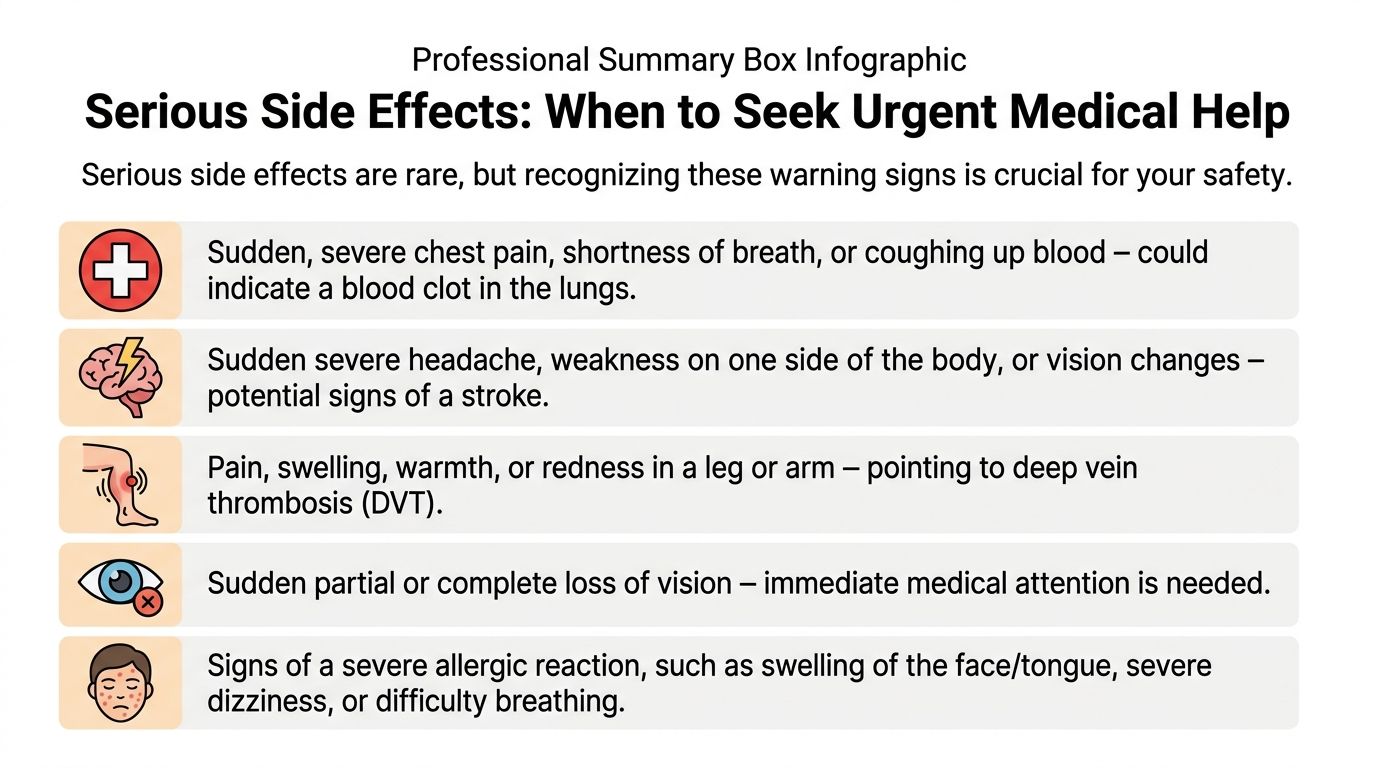
Serious side effects are very uncommon, occurring in between 1 in 100 and 1 in 10,000 women, and may include migraine, vertigo, hypersensitivity reactions, liver function disturbances, increased blood pressure, and blood clots [1].
Evorel patches have a significantly reduced risk of venous thromboembolism compared with oral HRT, and standard-dose transdermal use does not increase clot risk above baseline in the same way as oral oestrogen [2]. Even so, reduced risk is not the same as no risk.
Urgent medical advice when to act immediately
| Symptom(s) | What it could be a sign of | Action to take |
|---|---|---|
| Painful swelling, redness, or warmth in one leg | Deep vein thrombosis | Seek urgent medical help. Call 111 urgently or 999 if severe or you also feel unwell [1][3] |
| Sudden chest pain with breathlessness | Pulmonary embolism | Call 999 or go to A&E [3] |
| Sudden severe headache, weakness on one side, trouble speaking, or sudden vision change | Stroke-like symptoms | Call 999 or go to A&E [1] |
| Yellowing of the skin or eyes | Liver problem or jaundice | Get urgent medical advice the same day [1] |
| Severe dizziness, swelling, or allergic-type reaction | Hypersensitivity reaction | Get urgent help. Call 999 if breathing is affected [1] |
| Marked rise in blood pressure symptoms such as headache, tiredness, dizziness | High blood pressure | Contact a clinician promptly for assessment [1] |
Blood clots and cardiovascular risk in plain English
People often hear “HRT” and think “blood clots”. The route matters a lot.
With oral oestrogen, the hormone passes through the liver first and can increase clotting factors. With transdermal estradiol, that first liver pass is avoided. That is why patches like Evorel have a lower clot risk profile than tablets [2][3].
Still, if you get one-sided leg pain, swelling, redness, chest pain, or sudden breathlessness, do not wait to see if it passes.
Pharmacist’s tip: If you are due major surgery or expect a period of being very immobile, tell your prescriber that you use HRT. Your clot risk needs individual review.
The womb lining and why progestogen matters
If you have a womb and use oestrogen-only patches, there is a risk of endometrial hyperplasia, which means abnormal thickening of the womb lining [2].
That is why many people need a progestogen as well. Combined regimens, such as sequential HRT, help protect the lining. The risk also matters with sequential HRT used beyond 5 years [2].
This is one of the biggest areas of confusion. Some people assume all patches are the same. They are not. Whether you need added progestogen depends mainly on whether you still have your womb.
Featured snippet answer
Are serious side effects of Evorel patches common?
No. Serious side effects are very uncommon, but symptoms that suggest a clot, stroke, liver problem, or severe allergic reaction need urgent medical help [1][2][3].
Your practical toolkit for managing Evorel patch side effects
Most patch problems are manageable. A few small changes often make a big difference.
Start with the patch routine
Evorel is designed for twice-weekly use, and that schedule helps keep hormone levels steady [3]. If patch changes drift, some people notice more mood swings or breakthrough symptoms.
Practical checklist
- Pick fixed days: Many people choose the same two days each week
- Set a phone reminder: Especially useful if life is busy or your shifts change
- Press firmly onto dry skin: This helps the patch stay put
- Rotate sites: Give one area time to recover before you use it again
Pharmacist’s tip: If your patch always goes on in a rush after moisturiser, sweat, or body oil, adhesion problems are much more likely.
If your skin gets irritated
Patch-site irritation is one of the most common complaints.
Try this:
- Use clean, dry skin: No lotion, oil, or talc under the patch
- Choose the right area: Follow product advice and rotate between suitable sites
- Avoid freshly shaved or already sore skin
- Let the old site rest: Don’t stick the next patch on the same spot
- Ask before using barrier products: Some creams can affect sticking or absorption
Real life matters here.
Sarah, a busy mum and shift worker in Manchester, found her patch kept peeling at the corners during long shifts. Her pharmacist suggested reviewing her application routine, changing the patch only onto fully dry skin, and using a suitable medical tape over the edge if advised locally.
Priya from London, a keen gym-goer, noticed more irritation after sweaty workouts. She got on better when she applied the patch after her shower, once the skin had cooled and dried fully.
You may also find this video helpful if you prefer a visual walkthrough of HRT patch use and troubleshooting.
If you feel sick, headachy, or emotionally off
These symptoms often improve with time, but you still want practical ways to cope.
- For nausea: Eat small, plain meals and keep hydration up
- For headaches: Check whether they line up with late patch changes
- For mood swings: Keep your patch days regular and track how you feel
- For poor sleep: Note whether symptoms are strongest just after a fresh patch or after a delayed one
A simple symptom diary helps more than people expect. Note the day you change the patch, where you put it, and any side effects. After a few weeks, patterns often jump out.
Pharmacist’s tip: If you are struggling to judge whether your symptoms are hormonal or caused by something else, write down timing before changing anything. Good notes save a lot of guesswork.
Why honesty with your prescriber matters
Do not downplay your history to “get through” an HRT review. Full disclosure protects you.
Tell your prescriber if you have had clotting problems, unexplained vaginal bleeding, liver disease, migraine, or hormone-sensitive cancer concerns. Also mention every medicine and supplement you use. Even a home testing plan can matter if side effects are unclear, and a guide to using a home blood test kit in the UK can help you understand what that process involves.
Who should be cautious with Evorel patches?
Evorel is not a one-size-fits-all treatment. Some people need closer review before they start, and others may need a different option altogether.
When extra caution is sensible
You should speak openly with a prescriber if you have, or have had:
- A history of blood clots
- A personal or strong family history of oestrogen-sensitive cancer
- Severe liver problems
- Unexplained vaginal bleeding
- Migraine that changes or becomes more severe
- High blood pressure symptoms
- Past problems tolerating HRT
This does not automatically mean you cannot use HRT. It means the balance of benefit and risk needs proper review.
Medicines and supplements can matter too
Some medicines can affect how hormones work in the body. The same goes for some herbal products. If you take treatment for epilepsy, long-term other prescribed medicines, or herbal remedies such as St John’s Wort, mention them before starting or changing HRT.
Keep the list simple and complete:
- Prescribed medicines
- Over-the-counter products
- Herbal supplements
- Any creams, gels, sprays, or patches you already use
People often assume only tablets count. They all count.
Why personalised review matters
The side effects we talked about earlier do not exist in a vacuum. Your age, your symptom pattern, your womb status, your medical history, and your medicines all shape what “safe and suitable” looks like.
That is why a proper HRT assessment matters more than generic internet advice. If you want a broader overview of treatment options and suitability, this page on HRT treatment support gives a useful UK starting point.
Pharmacist’s tip: Bring your full medicine list to any HRT review. Memory is brilliant until it isn’t.
How Courier Pharmacy supports your HRT journey safely
Starting HRT is one thing. Staying on the right treatment, with the right follow-up, is where people often need help.
Courier Pharmacy works as a UK-regulated online pharmacy. Patients complete a secure questionnaire, and human prescribers review the information before treatment is supplied. That matters because side effects, clot history, bleeding patterns, and other risk factors need proper screening.
Support should not stop when the box arrives. Ongoing care can make the first few months much less stressful. If a patient is coping with early patch irritation, unclear symptom changes, or questions about timing, follow-up contact gives them a way to flag problems before they snowball.
Courier Pharmacy also offers home and venous blood testing options. That can help when symptoms are not settling as expected or when a clinician wants a clearer picture. Some patients prefer a home option because it feels more convenient and less daunting.
Another practical point is formulation choice. Not everyone gets on with every patch adhesive or every standard product. For people with allergies, intolerances, or specific formulation needs, customised options may be worth discussing.
If you want to explore how a modern online pharmacy in the UK can support ongoing treatment safely, it helps to look for regulated prescribing, clear follow-up, and responsive patient support.
Summary Your journey with Evorel patches
Most side effects of Evorel patches are mild and happen early. Skin irritation, headaches, nausea, breast tenderness, and mood changes are the usual culprits.
Many of these settle in the first few weeks as your body adjusts [1].
Patches have a lower clot risk than oral HRT, but urgent symptoms still need fast action [2][3].
If you have a womb, make sure your HRT plan protects the womb lining [2].
Good patch habits help. Change them on time, rotate sites, and track symptoms.
If something feels severe, unusual, or not right, ask for a proper review.
Frequently asked questions about Evorel patches
How long do side effects of Evorel patches last?
Many common side effects are most noticeable in the first few weeks and often improve as your body adjusts [1]. If they are still troublesome by the three-month mark, ask your prescriber to review your treatment.
Is skin irritation from Evorel patches normal?
Yes. Mild itching, redness, or irritation at the application site is a common side effect [1]. Rotating sites and applying the patch to clean, dry skin often helps.
Do Evorel patches cause blood clots?
Evorel patches have a lower risk of venous thromboembolism than oral HRT [2][3]. However, the risk is not completely absent, so symptoms such as one-sided leg swelling, chest pain, or sudden breathlessness need urgent assessment.
Do I need progesterone with Evorel patches?
If you have a womb and use oestrogen-only patches, you usually need a progestogen to protect the womb lining [2]. Without it, there is a risk of endometrial hyperplasia.
What happens if I forget to change my Evorel patch?
A late patch change can lead to hormone fluctuations, and some people notice mood changes or breakthrough symptoms when that happens [3]. Follow the product instructions and ask your prescriber or pharmacist what to do if you miss a change.
Can I cut an Evorel patch in half?
Only follow the manufacturer’s instructions and your prescriber’s advice. Do not cut a patch unless you have been specifically told it is safe and appropriate for your product.
Can I drink alcohol while using Evorel patches?
There is no general rule in this guide that says alcohol is prohibited. The safer approach is to check with your prescriber if you have migraines, liver concerns, troublesome side effects, or take other medicines.
Do Evorel patches cause weight gain?
Some people worry about weight changes on HRT, but weight can also shift during menopause for many reasons. If you notice a persistent change that concerns you, discuss it with your prescriber rather than assuming the patch is the only cause.
Can I exercise or swim with an Evorel patch on?
Many people can. The main issue is whether the patch stays well attached. Sweat, friction, and rubbing clothing can make peeling more likely, so good application technique matters.
What happens when you stop Evorel patches?
If you stop, your menopause symptoms may return. Do not stop suddenly without checking with your prescriber, especially if you are stopping because of side effects or bleeding.
Author and Reviewer Information
Author: Medical Mojo Editorial Team
Credentials: UK health writers and pharmacy-led content team
Clinical review: Clinically reviewed by a UK-registered prescribing clinician and pharmacy reviewer
How This Content Was Created
This article was written using current UK patient information and menopause resources, with facts limited to the verified sources cited below. A clinical reviewer checked the content for safety, clarity, and UK relevance. The writing aims to translate HRT guidance into plain English without overstating benefits or risks.
References
[1] The Independent Pharmacy (n.d.) Evorel Sequi side effects. Available at: https://www.theindependentpharmacy.co.uk/menopause-hrt/guides/evorel-sequi-side-effects
[2] My Menopause Centre (n.d.) HRT patches side effects Evorel. Available at: https://www.mymenopausecentre.com/hormone-replacement-therapy/hrt-and-menopause-symptom-relief/hrt-patches-side-effects-evorel/
[3] Menopause Care (n.d.) Medication Evorel. Available at: https://www.menopausecare.co.uk/medication-evorel
Disclaimer
This article is for information only and is not a substitute for personal medical advice, diagnosis, or treatment. If you have severe symptoms, new bleeding, chest pain, one-sided leg swelling, sudden breathlessness, or stroke-like symptoms, seek urgent medical help.
Meta description: Side effects of Evorel patches explained in a clear UK guide. Learn common symptoms, timeline, red flags, and practical tips for safer HRT use.
Suggested internal links
- HRT treatment options and suitability
- Guide to transdermal patches
- Home blood test kit guide
- Dermatitis and sensitive skin advice
- Online pharmacy support for repeat treatment
Visual guidance for the designer
Infographic idea: Evorel side effects timeline from week 1 to month 3
Alt text: Timeline showing common Evorel patch side effects in the first few weeks and how they may settle by month 3Infographic idea: Where to place and rotate Evorel patches
Alt text: Diagram of suitable patch rotation areas with simple skin-care tips for Evorel patchesIllustration idea: Red-flag warning signs for urgent medical help
Alt text: Safety illustration showing chest pain, leg swelling, severe headache, and jaundice as urgent warning signsIllustration idea: Pharmacist toolkit for patch problems
Alt text: Friendly pharmacist-style checklist for skin irritation, patch peeling, nausea, and headache with Evorel patches
If you want regulated UK support with HRT, prescriptions, follow-up, and testing options, Courier Pharmacy offers a patient-centred online service with prescriber review and ongoing care.


