Signs of Pancreatitis: Acute, Chronic and When to Act
Learn the signs of pancreatitis, from sudden upper-belly pain to chronic weight loss, and when to seek urgent UK medical help.
You're doubled over after a meal, searching your phone with one hand while the pain in your upper belly won't ease. The most important signs of pancreatitis are sudden, severe upper abdominal pain, often with nausea, vomiting, fever or a fast pulse, and that pattern needs urgent assessment. Chronic pancreatitis looks different. It can cause recurring pain after eating, weight loss and pale, oily stools over months. You'll learn how to tell an emergency from a slow building problem, how doctors confirm the diagnosis, and what action fits each pattern. Keep it simple. Match the pattern, then act at the right speed.
Red flags that need urgent medical care
Start with triage, not with a diagnosis. Sudden severe upper abdominal pain, especially with vomiting, fever or a fast pulse, needs urgent assessment because pancreatitis can worsen fast. Don't wait to see whether it passes. Pancreatitis isn't the only possible cause, and gallbladder disease, a stomach ulcer and heart problems can mimic it. A clinician needs to judge which condition fits.
Use this checklist first, then read the table for the exact action.
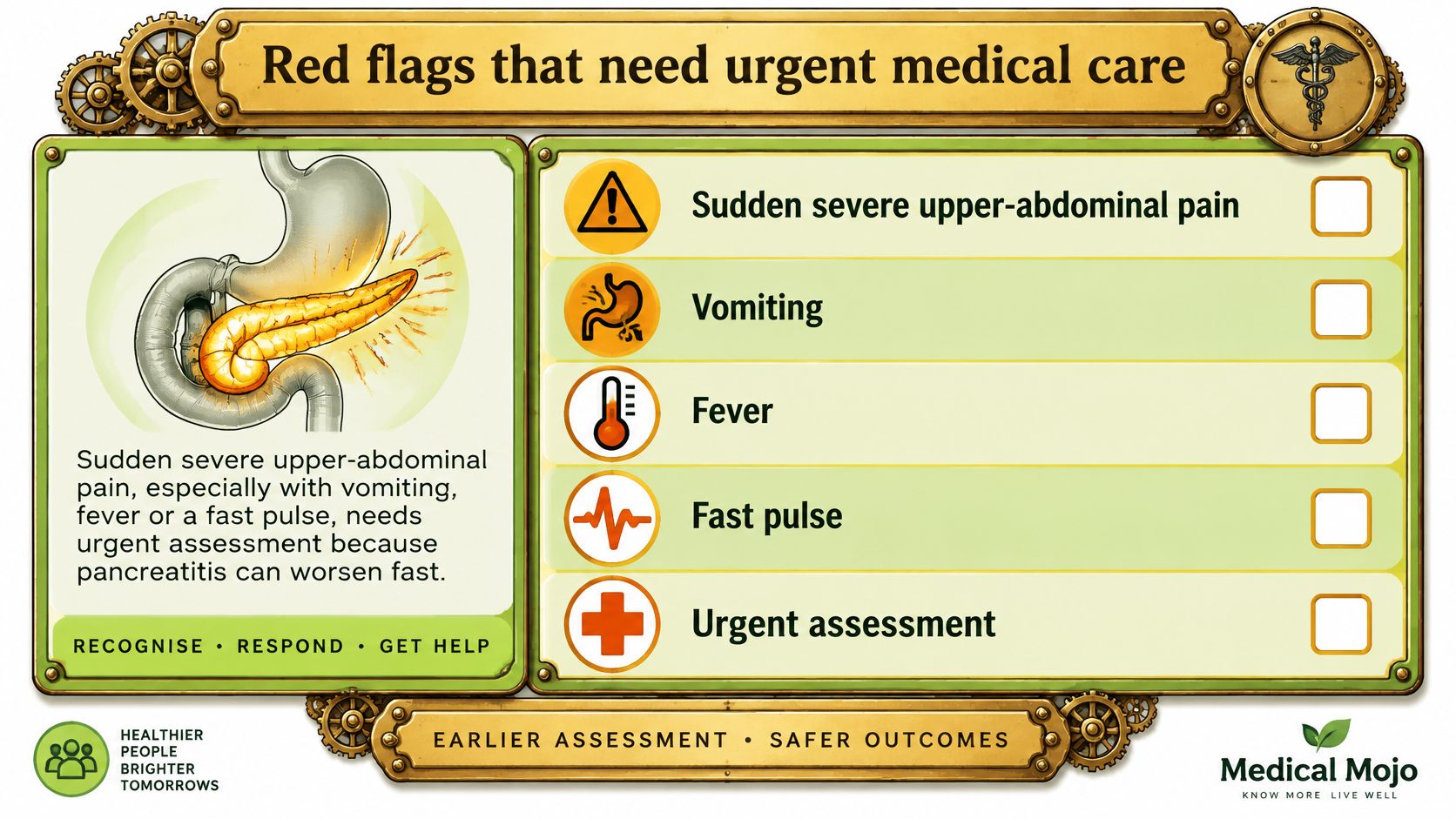
Pancreatitis red flags and the action to take
| Sign | What it may mean | What to do |
|---|---|---|
| Sudden severe upper belly pain that does not ease | Possible acute pancreatitis | Go to A&E now, do not wait for the pain to pass |
| Severe pain spreading to the back with vomiting | Possible acute pancreatitis | Go to A&E now |
| Fever with belly pain | Serious infection or inflammation | Urgent same day assessment |
| Fast heartbeat, dizziness or confusion | Severe illness | Call 999 now |
| Breathlessness or very little urine | Strain on organs in severe disease | Call 999 now |
| Yellow skin or eyes | Jaundice, possible blockage | Same day urgent review |
| Chest pain | Could be a heart attack instead | Call 999 now |
| Recurring pain after eating with weight loss | Possible chronic pancreatitis | Book a GP appointment within days |
| Pale, oily, floating, foul stools | Possible poor fat absorption | Book a GP appointment |
Call 999 for collapse, confusion, chest pain or severe breathing difficulty. Go to A&E for severe pain with repeated vomiting. Use NHS 111 when you're unsure and need advice quickly. Book a GP appointment for the slower pattern in the last two rows.
Practical rule: Severe new belly pain is not a wait and see problem.
Don't treat severe pain with leftover tablets from a drawer. They can hide how ill you're becoming. They also won't treat inflammation inside the pancreas. If vomiting is your main worry once a clinician has excluded an emergency, read about nausea and vomiting care and treatment options for general guidance. That advice doesn't replace urgent assessment for red flags.
Acute and chronic signs side by side
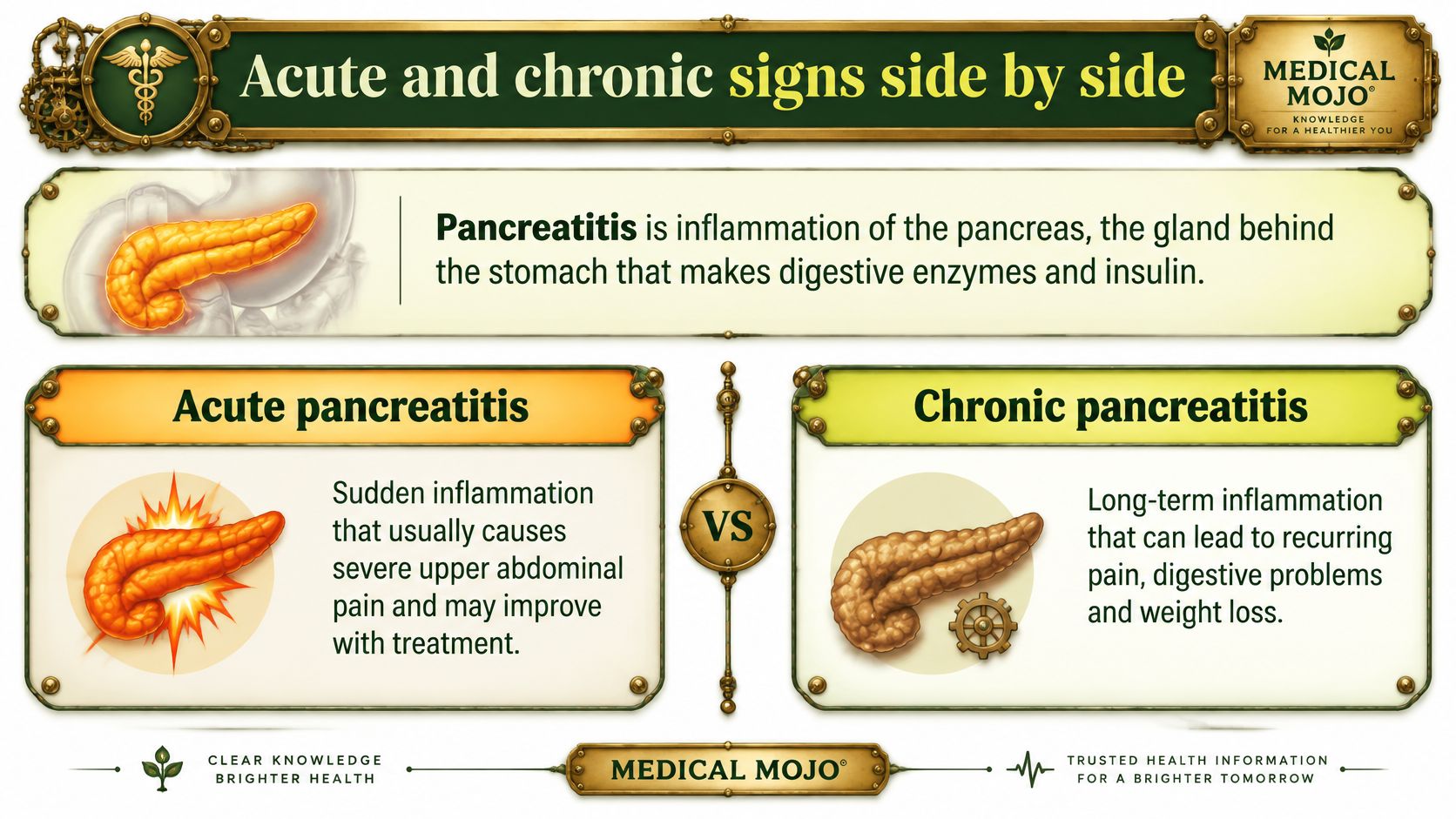
Pancreatitis is inflammation of the pancreas, the gland behind your stomach that makes digestive enzymes and insulin. Acute pancreatitis starts suddenly and usually causes severe pain. Chronic pancreatitis develops over time and damages digestion. That simple split explains most of the confusion.
This comparison shows the two patterns at a glance.
Acute pain usually sits in the upper belly between your ribs. It may spread to your back and worsen after eating, moving or lying flat. Many people feel a little better leaning forward or drawing their knees to their chest. Nausea, vomiting, loss of appetite, fever, sweating and a fast heart rate often come with it. Jaundice, which means yellow skin or eyes, occurs occasionally.
The NICE pancreatitis guideline estimates acute pancreatitis affects approximately 56 cases per 100,000 people each year in the UK. It also estimates gallstones account for about 50% of UK cases, alcohol for 25%, and other causes for the remaining 25%. Those figures explain why doctors ask about gallstones and drinking early.
Signs of acute and chronic pancreatitis compared
| Sign | Acute pancreatitis | Chronic pancreatitis |
|---|---|---|
| Abdominal pain | Sudden, severe, upper belly, often spreads to the back | Recurring or constant, often worse after eating |
| Pain relief | Often eased by leaning forward or drawing knees to chest | Sometimes eased by sitting forward |
| Nausea and vomiting | Common | Less prominent |
| Fever | Common | Not typical |
| Jaundice | Occasional | Uncommon, can occur if a bile duct is narrowed |
| Stools | Diarrhoea can occur | Pale, oily, floating, foul smelling, hard to flush |
| Weight loss | Not usually a main feature | Unintended weight loss |
| Onset | Within hours, sudden | Gradual or on and off over months or years |
| Urgency | Emergency assessment | Urgent routine GP review |
Read the table by pattern, not by one symptom. Sudden severe pain plus whole body illness points to acute disease. Slow digestive change plus weight loss points to chronic disease. Indigestion alone doesn't prove either one, and our guide to acid reflux and indigestion helps you separate common reflux symptoms from this pain pattern.
This short video adds a visual summary before you compare your own symptoms.
Note three details before you seek help. Write down when the pain started, what happened just before it, and what eased or worsened it. Add your temperature, vomiting and any yellow colour in your eyes. Those notes help a clinician triage you faster.
Symptoms can point doctors in the right direction, but they can't confirm pancreatitis on their own.
That limit matters. You can't rule pancreatitis in or out at home. If your pattern matches the acute column, get assessed today.
Chronic pancreatitis signs that build slowly
Can pancreatitis cause ongoing digestive symptoms without an emergency style attack? Yes. Chronic pancreatitis often develops over months or years, so you may not link your symptoms to your pancreas. That's the gap many symptom lists miss.
The main pattern is recurring or persistent upper abdominal pain. Eating often makes it worse. Sitting forward sometimes eases it a little. Bloating, diarrhoea and unintended weight loss can follow as digestion weakens.
The stool clue people overlook
Look at your stools, even if it feels awkward. In chronic pancreatitis they may look pale and oily, float, smell very foul and prove hard to flush away. That pattern can mean your body isn't absorbing fat well. Your pancreas isn't supplying enough digestive enzymes, so fat passes through instead.
- Pain after meals: Recurring upper belly pain, especially after fatty food
- Weight change: Clothes loosening without you trying to lose weight
- Bowel change: Diarrhoea, bloating or greasy stools that keep returning
People miss these signs for understandable reasons. They blame wind, diet, stress or a stomach bug. Pain that comes and goes can seem unimportant between episodes. A busy gym goer might blame a new protein shake. A parent might blame rushed meals and poor sleep.
Repeated heavy alcohol use is a common long term cause. Repeated acute attacks can also damage the pancreas over time. If drinking is part of your picture, honest support for alcohol addiction can sit alongside medical assessment, not replace it.
The NHS chronic pancreatitis guidance notes there's no single diagnostic test, so clinicians may need blood and stool tests plus ultrasound, CT, MRI or endoscopy to exclude other causes. Don't diagnose yourself from stools or pain alone. Other gut conditions can look similar.
Book a GP appointment within days if this pattern sounds familiar. Bring notes on pain, meals, weight and bowel changes. Ongoing digestive change deserves assessment even when you've never had a sudden attack.
How doctors confirm pancreatitis
Doctors don't confirm pancreatitis with one test. They combine your story, an examination, blood results and scans. That combination stops one abnormal result from misleading everyone.
The two of three rule
The Royal Cornwall Hospitals NHS Trust acute pancreatitis guideline describes diagnosis as supported by at least two of three findings, characteristic abdominal pain, a serum amylase level greater than three times the laboratory's upper limit of normal, or characteristic findings on imaging. It also notes serum lipase may be requested when illness has been present for more than three days. Timing matters because enzyme levels rise and fall.
Raised enzymes aren't specific to pancreatitis. Other conditions can raise them too. A normal result also doesn't always settle the question. Doctors interpret every result against your symptoms and examination.
Tests used to diagnose pancreatitis
| Test | What it shows | Limits |
|---|---|---|
| Blood lipase | Raised in acute pancreatitis, more specific than amylase | Can rise in other conditions, timing matters |
| Blood amylase | Raised, often over three times the upper limit | Less specific, can rise in other conditions |
| CRP blood test | Inflammation level, used to judge severity | Rises over the first 48 hours, not diagnostic alone |
| Abdominal ultrasound | Gallstones and fluid around the pancreas | Gas in the bowel can hide the pancreas |
| CT scan | Inflammation and complications | Uses radiation, used when enzymes are not raised but suspicion is strong |
| MRI | Detailed view of the pancreas and bile ducts | Less available urgently, used to clarify |
| Endoscopic ultrasound | Detailed views, mainly for chronic disease | Specialist test, usually needs sedation |
| Stool tests | Signs of poor fat digestion | Mainly used for chronic disease |
Ultrasound often comes early because gallstones are a common cause. CT helps when doctors suspect pancreatitis but enzymes aren't raised. MRI and endoscopic ultrasound clarify detail when the first tests leave doubt.
Don't rely on a single private blood test without clinical interpretation. Ask the clinician what each result means for you, what it can't prove, and what happens next. Clear answers beat a printout you have to decode alone.
Mild and severe pancreatitis compared
A severe attack is defined by its effects on the body, not only by how painful it feels. Mild acute pancreatitis causes no lasting organ failure and often settles within about a week with supportive care. Severe disease involves organs such as the kidneys, lungs or circulation, and may require intensive care.
Mild and severe acute pancreatitis compared
| Marker | Mild acute pancreatitis | Severe acute pancreatitis |
|---|---|---|
| Organ failure | None | Single or multiple organ failure lasting more than 48 hours |
| CRP level | Below 150 mg/L at about 48 hours | 150 mg/L or above at about 48 hours |
| Typical course | Often settles within about a week | Longer stay, may need intensive care |
| Hospital care | Ward care with fluids and pain relief | Intensive care, with possible drainage or surgery |
CRP is a blood marker of inflammation. A CRP concentration of at least 150 mg/L around 48 hours after symptom onset is a marker associated with severe disease. The UK clinical guidelines for operations on acute pancreatitis define severe disease by persistent organ failure lasting more than 48 hours. These are clinical guides, not a personal forecast.
Two UK scenarios
A busy parent in Leeds develops sudden abdominal pain after a takeaway. She vomits repeatedly, cannot keep fluids down and feels feverish. Going to A&E that night is the right response, so clinicians can assess her and monitor for signs of severe disease.
A shift worker in Manchester has pain after meals that has continued for months. He is losing weight and has greasy stools that float. If he is stable, he may not need 999, but he should arrange a prompt GP appointment and assessment.
Watch for change: A fast pulse, reduced urine, confusion, breathlessness or inability to keep fluids down may signal worsening illness.
These warning signs need urgent medical assessment. Do not delay care to arrange a routine blood test first.
How pancreatitis is treated in hospital
Treatment depends on the cause and severity. Most acute care supports your body while inflammation settles. There's no single tablet that switches pancreatitis off.
This pathway shows the usual order of hospital care.
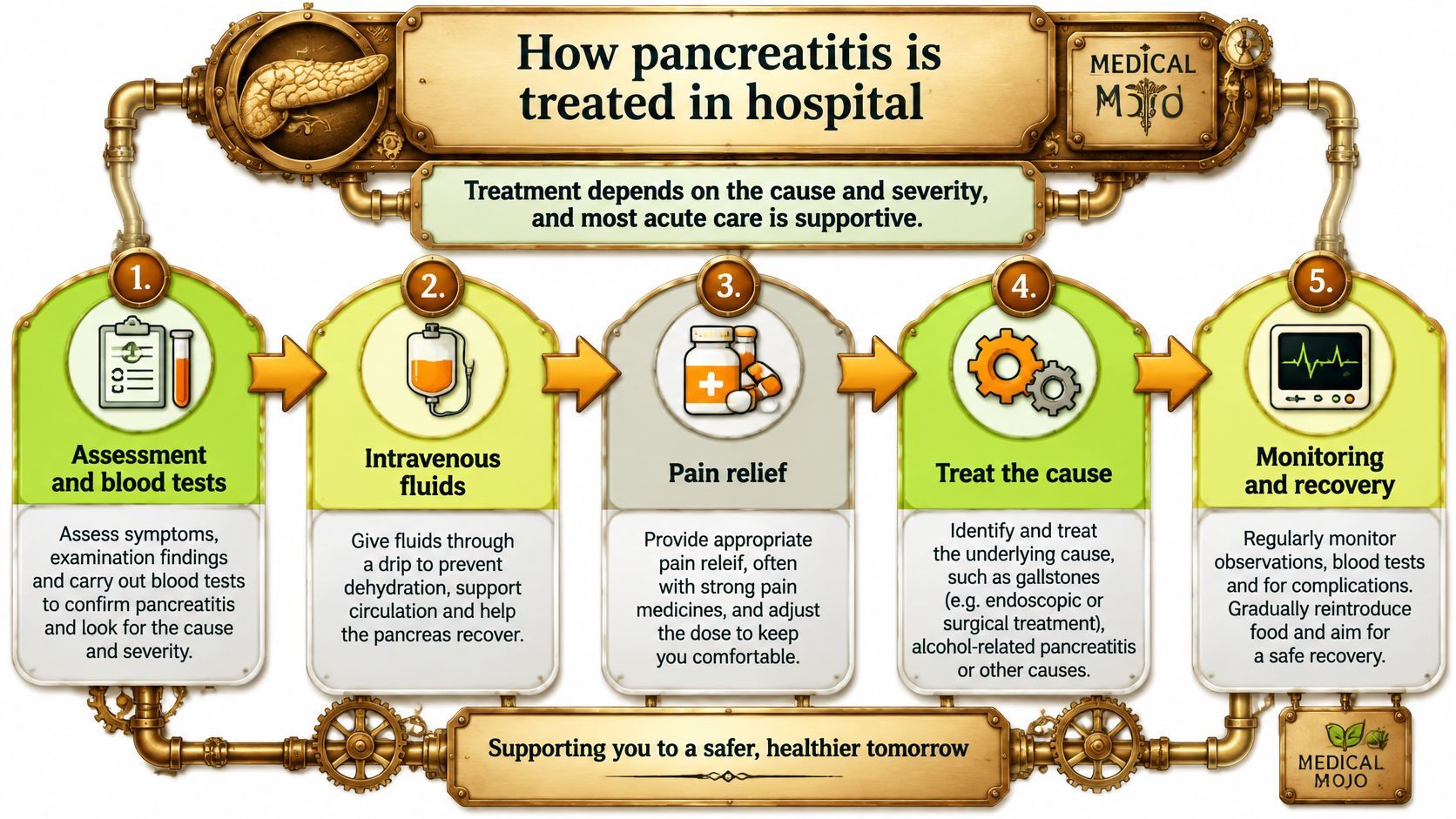
The hospital pathway
- Assessment and blood tests: Staff check your pain, observations, enzymes and inflammation markers
- Intravenous fluids: A drip supports your circulation and kidneys
- Pain relief: The clinical team chooses medicines and reviews them often
- Monitoring: Staff track oxygen levels, urine output and blood results
- Feeding: You restart food early when you tolerate it, or pause eating briefly if needed
- Treat the cause: Gallstone treatment may follow once the attack settles
- Treat complications: Drainage or surgery only for fluid collections or infected dead tissue
Fluids come early because vomiting and inflammation lower circulating fluid. Monitoring spots organ strain before you feel much worse. Pain relief needs medical supervision because severe pain often needs stronger medicines than home options.
Chronic pancreatitis needs longer term care. Doctors focus on pain management and nutrition advice. They may prescribe pancreatic enzyme replacement with meals when fat absorption is poor. They check blood sugar because diabetes can develop if insulin production falls. Stopping alcohol protects remaining pancreatic tissue.
Take medicines exactly as prescribed. Don't stop or start medicines because your pain changes. Ask your team what each medicine does and when you'll review it.
Choose your next step after spotting the signs
You finish a meal and a new pain across the upper belly is so severe you cannot settle. That is an emergency, not a message to leave with a prescriber. Go to A&E or call 999 now. Tell your prescriber once you have been assessed, and read our Mounjaro side effects guidance so you know which symptoms need urgent review.
Severe pain does not wait for office hours.
A quieter pattern needs a different route. Pain that returns after meals, stools that look greasy, or weight that falls without a clear reason can build over weeks. People often put this down to diet or stress. Book a GP appointment within days, and take a short diary of pain timing, meals, bowel changes and alcohol intake.
Tell your GP, prescriber or pharmacist about every medicine you take, including weight loss injections from any source. The NHS Dorset medicines guidance advises GLP-1 and GLP-1/GIP treatment should be discontinued immediately if pancreatitis is suspected and not restarted if pancreatitis is confirmed. Stopping that medicine does not replace emergency care when the pain is severe and new.
Keep a current medicine list on your phone, with doses and start dates. Mention heavy alcohol use, because it changes the advice your pharmacist gives. Do not rely on leftover painkillers for severe belly pain. Get assessed first.
This article gives information only. It is not a substitute for medical advice, diagnosis or treatment.
If you already use medically supervised weight loss treatment, the order stays the same: A&E or 999 for new severe abdominal pain, then your prescriber after assessment. Courier Pharmacy is a GPhC-registered online pharmacy. Human prescribers review secure online questionnaires and can discuss suitable treatment and testing options where clinically appropriate. Visit Courier Pharmacy to start a consultation or ask the team about your medicines.


