Sleep Medication Prescription UK Guide
Need a sleep medication prescription? Discover UK prescribing rules, safe pathways via your GP or Courier Pharmacy, and non-drug alternatives for better rest.
You're awake again, watching the clock and wondering whether tomorrow will be another foggy day. A sleep medication prescription can sometimes provide short-term relief, but UK prescribing rules treat sleeping pills as a carefully managed medical option, not a simple overnight fix. Your clinician should first consider the cause of your insomnia, other treatments, and whether medicine is safe for you.
This guide explains how prescriptions work, which medicines may be considered, how online prescribing fits into UK care, and what to do when sleep problems continue.
Five key takeaways
- Sleeping pills usually suit short courses, not open-ended repeat use.
- NICE limits hypnotics to severe, disabling insomnia after non-drug measures fail [1].
- Tolerance and dependence matter, especially with benzodiazepines and Z-drugs.
- Persistent insomnia needs a wider plan, often including CBT-I and a search for underlying causes.
- Use only a regulated prescriber or pharmacy, and ask about reviews, stopping plans, alcohol, and driving.
Understanding sleep medication prescriptions
At three in the morning, a tablet can seem like the obvious answer. By daylight, the reason for poor sleep may be less straightforward. Stress, pain, menopause, anxiety, shift work, other medicines, breathing problems, or an unsettled routine can all contribute.
A sleep medication prescription is legal authorisation from an appropriate prescriber for a prescription-only medicine. In the UK, it normally follows a health assessment. The prescriber reviews your symptoms, medical history, current medicines, allergies, alcohol use, and possible causes of insomnia. This is like checking why a warning light has appeared before replacing a part. The medicine may help, but the underlying problem still needs attention.

Prescription sleeping pills differ from pharmacy sleep remedies. A pharmacy product may contain an ingredient that causes drowsiness, yet still be unsuitable with your health conditions, alcohol intake, or other medicines. Prescription treatment involves a clinical decision and a plan to review its effect and safety.
What the prescription aims to do
UK guidance supports hypnotics when insomnia is severe, disabling, or causing extreme distress, and non-drug measures have not worked [1]. Their usual purpose is short-term relief while the cause of worsening sleep is addressed.
For example, a busy parent might develop acute insomnia during a stressful period. A clinician could discuss a short course while asking about caffeine, anxiety, depression, pain, snoring, and a child waking at night. Those questions help distinguish a temporary sleep disruption from a problem needing different treatment.
Practical rule: A sleeping tablet may help during a difficult patch, but it should not conceal a condition that needs proper care.
Persistent insomnia calls for a fresh review rather than automatic repeats. The Courier Pharmacy sleep information page can help you prepare questions for a consultation, while a prescriber decides whether treatment is suitable.
Types of prescription sleeping pills
A person who wakes repeatedly may need a different medicine from someone who cannot fall asleep. The choice depends on the sleep pattern, other health conditions, current medicines, and local prescribing practice. Prescription treatment is also usually linked to a review, rather than an open-ended repeat.
| Medication type | Common examples | Typical use case |
|---|---|---|
| Z-drugs | Zopiclone, zolpidem, zaleplon | Short-term insomnia when non-drug measures fail and symptoms cause severe distress [1] |
| Benzodiazepines | Specific medicines in this class | Carefully limited use because dependence and tolerance can develop |
| Melatonin | Melatonin products, including prolonged-release preparations | Selected sleep-onset or sleep-timing problems, depending on the clinical situation |
| Newer orexin medicines | Daridorexant, also known as Quviviq | Chronic insomnia pathways where the person meets local and clinical criteria |
| Other sedating medicines | Some antidepressants or antihistamines | Sometimes considered for another medical reason, but not automatically suitable for insomnia |
Z-drugs and older hypnotics
Zopiclone and zolpidem make you sleepy by reducing alertness. That same effect can cause next-day drowsiness, poor concentration, falls, unusual behaviour, or memory problems. A doctor or pharmacist should explain these risks before treatment starts, including whether driving or other activities could be unsafe.
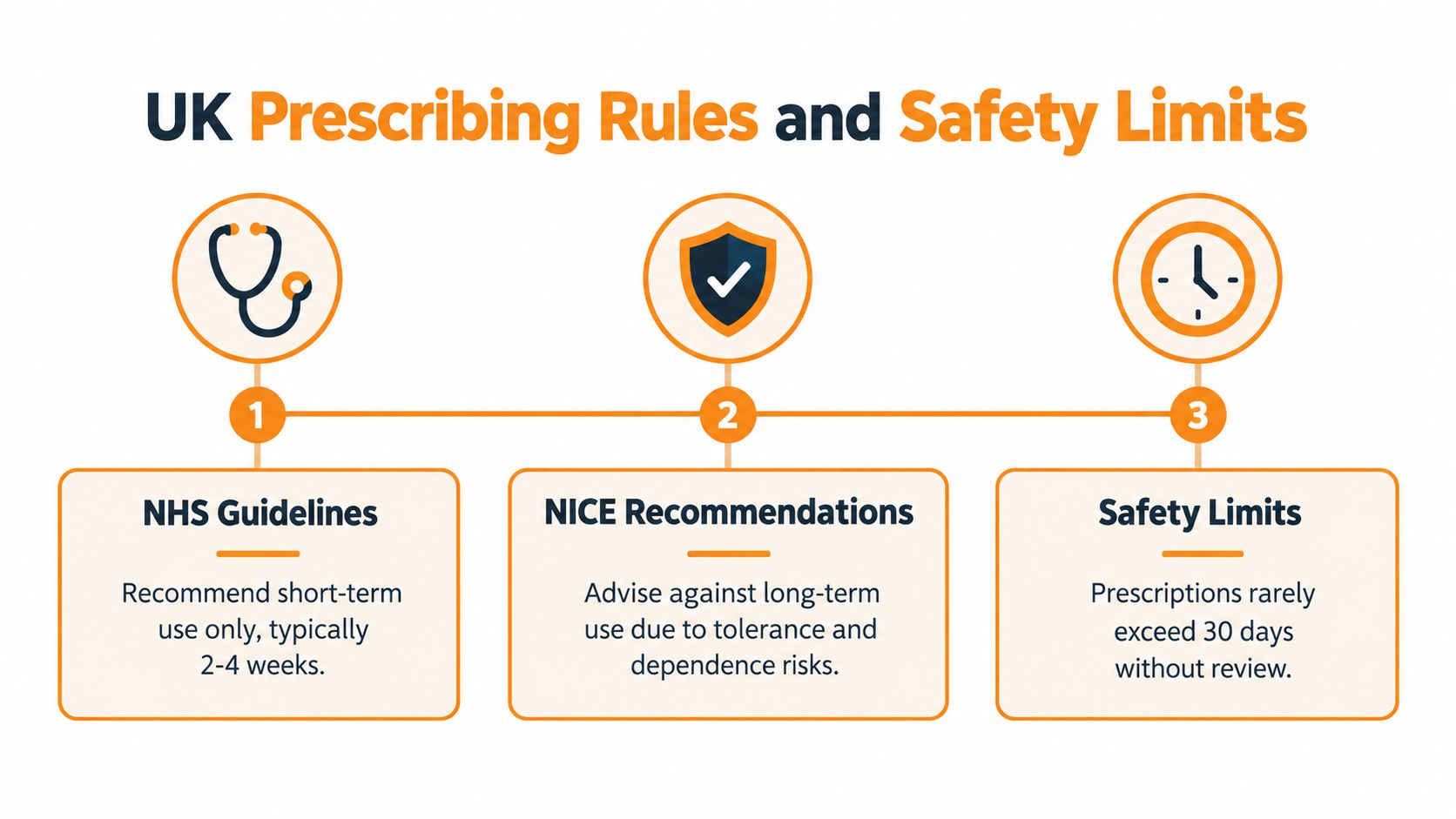
NICE says zaleplon, zolpidem, and zopiclone should normally be prescribed for only a few days to two weeks, with a maximum of four weeks including tapering, where appropriate [1]. The NHS gives similar advice for zopiclone because tolerance can develop. In simple terms, the medicine may gradually have less effect, while dependence can make stopping difficult [2].
Benzodiazepines require particular care. Repeated use can lead to dependence, and stopping suddenly may cause problems. Do not change the dose or stop a regular medicine without advice.
Melatonin and other options
Melatonin is not a universal sleeping tablet. It helps regulate the body clock, so it may suit some sleep-onset or sleep-timing problems more than others. Age, health conditions, interactions, and local pathways all affect the decision.
Sedating antihistamines can leave you groggy and may be unsuitable for some people. An antidepressant may be considered when depression or anxiety also needs treatment, but that does not make it a general insomnia medicine.
Daridorexant, sold as Quviviq, works through the orexin system involved in wakefulness. It may provide a newer option for persistent insomnia when a person meets the relevant clinical and local criteria, rather than extending a short course of an older hypnotic. Compare Quviviq with zopiclone and zolpidem to understand how these choices differ.
UK prescribing rules and safety limits
A person may have weeks of broken sleep yet receive only a short hypnotic course. UK clinicians keep these medicines brief because the body can adapt. Tolerance means the same dose may work less well. Dependence means reducing or stopping can become difficult, so a repeat request needs a fresh safety review.
NICE-linked guidance recommends benzodiazepines and Z-drugs only for severe, disabling insomnia when non-drug measures have not helped. Treatment should usually finish within two weeks. Some NHS guidance allows two to four weeks including tapering [3]. These limits are a safety boundary, not a judgement about how real the sleeplessness feels.
What prescribing data shows
In England during 2022/23, general practice issued 13.8 million hypnotic and anxiolytic items, with around 1.9 million identified patients receiving at least one item [4]. The NHS Business Services Authority recorded a 1.95% fall in items and a 1.78% fall in identified patients compared with 2021/22. Its dataset also recorded 42.0 million items prescribed between March 2020 and March 2023 to identified patients with known age and gender [4].
Longer-term figures show a changing pattern. Hypnotic prescriptions fell from 9.8 million in 2010 to 5.8 million in 2023, a 41% reduction. Temazepam prescriptions fell by 88%, from 2.8 million to 333,000. Zopiclone still accounted for 4.5 million prescriptions in 2023, while zolpidem fell by 14% to 630,000 [5].
Insomnia has not disappeared. Older hypnotics have declined, while prescribing remains substantial. A clinician who questions a repeat request is applying a safety check, not dismissing the sleep problem.
Watch this overview of safe prescribing considerations.
Melatonin follows separate rules. Read this guide to melatonin prescribing in the UK before assuming it is freely available or suitable for everyone.
How to get a legitimate prescription
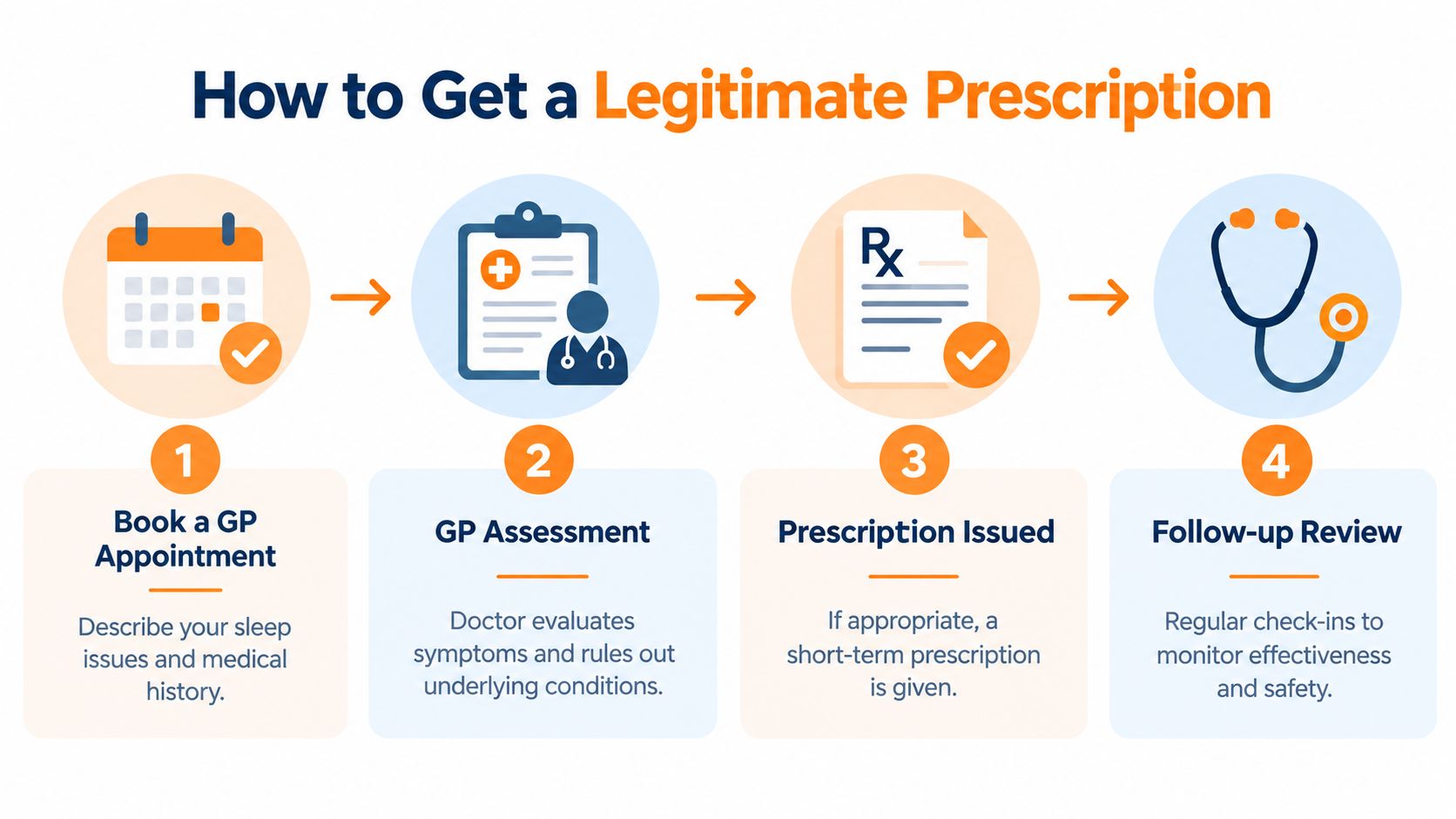
If insomnia is affecting work, concentration, or safety, begin with a proper assessment rather than buying tablets from an unverified website. You can speak with your GP, another NHS clinician, or a regulated online prescribing service. The appointment may be in person or remote, but the safety checks should be comparable.
The usual pathway
- Describe the pattern. Record your bedtime, how long you take to fall asleep, night waking, early waking, naps, and how you feel the following day.
- Share the full picture. Tell the prescriber about pain, anxiety, menopause symptoms, snoring, restless legs, alcohol, caffeine, recreational drugs, and every medicine or supplement.
- Let the prescriber assess risk. They may look for another cause, identify an interaction, or recommend treatment that does not involve sleeping tablets.
- Agree the review plan. Ask how long the prescription is intended to last, when to stop, and what to do if sleep remains poor.
- Take it exactly as directed. Never add extra doses after a difficult night.
A shift worker who cannot attend a daytime appointment may find a secure online consultation more practical. It remains suitable healthcare only when a qualified prescriber reviews the answers and can refuse treatment if the risks are too high.
Checking an online pharmacy
A legitimate UK service should clearly display its identity. Check for General Pharmaceutical Council, or GPhC, registration, and confirm that both the prescriber and pharmacy operate within UK rules. Avoid websites offering prescription medicines without asking about your health.
A safe questionnaire should cover relevant symptoms, existing conditions, current medicines, and possible risks. A prescriber should review the information, confirm whether treatment is suitable, and provide clear instructions. The pharmacy should supply licensed medicines through lawful channels and explain how to ask follow-up questions or report a problem.
You can read more about choosing an online pharmacy in the UK. A remote service should make assessment easier to access, not remove it.
Newer alternatives and non-drug options
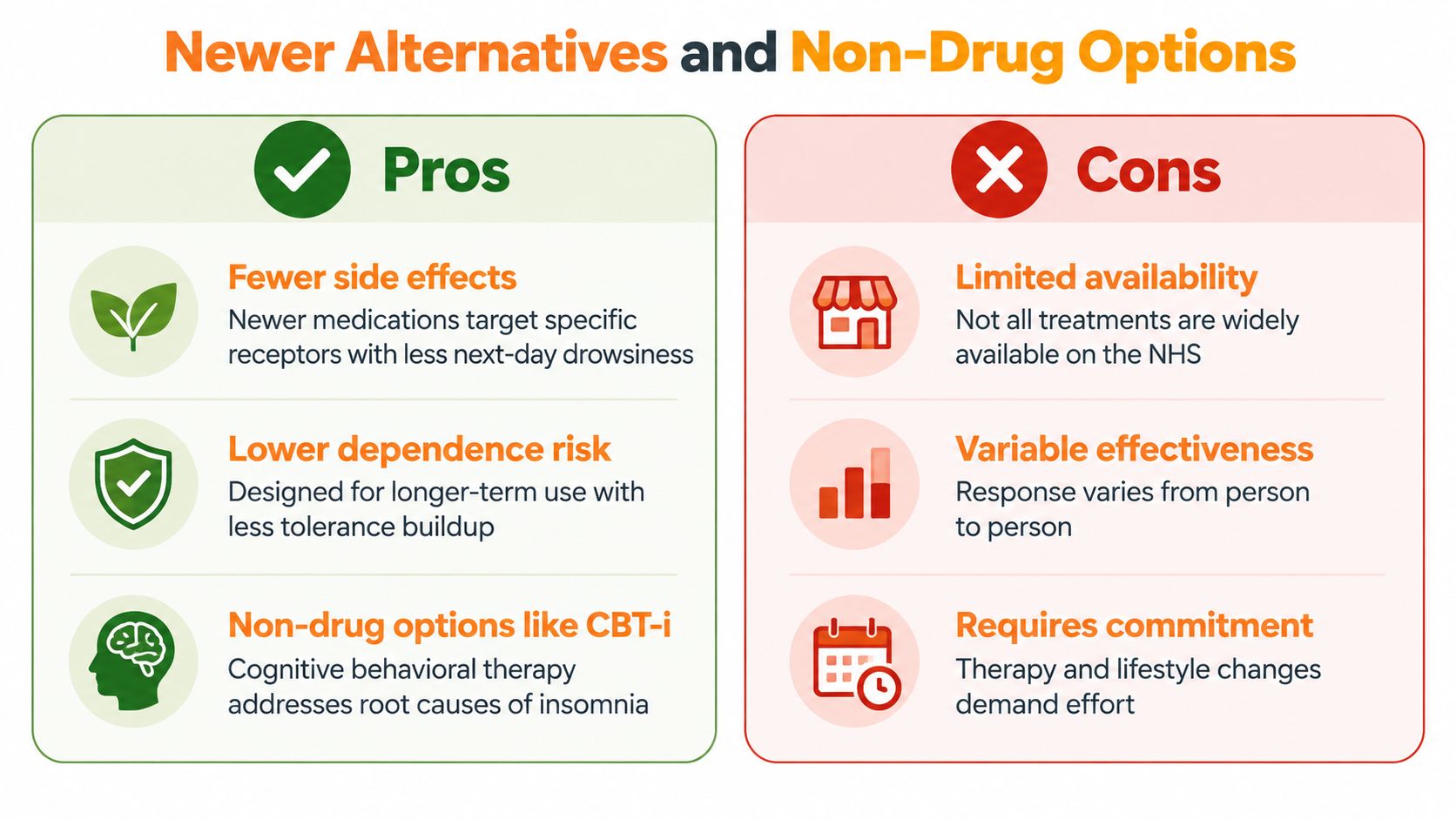
A short prescription may not resolve persistent insomnia. Repeating the same tablet can increase risk while leaving the underlying cause untreated, so longer-term support needs a wider plan.
Daridorexant is a newer medicine acting on the orexin system, which helps regulate wakefulness. UK reporting in September 2025 said it had been prescribed 67,000 times since November 2023, with an estimated NHS cost of £2.6 million. Zopiclone had been issued more than 7 million times over the same period [6].
NHS access is uneven. Local pathways may offer daridorexant or melatonin alongside short-course prescribing, a sleep diary, and specific eligibility criteria. Your area, medical history, and previous treatment can affect which options are available. A legitimate online pharmacy may provide a practical route to a qualified assessment when local access is difficult, but it should not bypass clinical checks.
CBT-I and everyday sleep support
CBT-I, or cognitive behavioural therapy for insomnia, addresses the habits and thoughts that keep poor sleep going. It can include a regular wake time, stimulus control, changes to time in bed, and support with worry about sleep.
Useful steps include:
- Keep one wake time: Get up consistently, even after a poor night.
- Protect the bedroom: Keep it dark, quiet, and comfortable.
- Reduce evening stimulation: Limit phones, work, and demanding tasks near bedtime.
- Watch substances: Caffeine, nicotine, and alcohol can disturb sleep or increase medicine-related drowsiness.
- Leave the clock alone: Repeated checking can increase sleep anxiety.
A late-training gym-goer may need to change workout timing rather than add a tablet. Menopause symptoms may need targeted support for hot flushes and hormonal changes. Persistent pain may require pain management instead of sedation.
For more detail, read about taking melatonin every night, then discuss regular use with a clinician.
Monitoring your progress and staying safe
Starting treatment should also start a review plan. Keep a simple sleep diary covering your bedtime, estimated sleep, awakenings, wake time, naps, medicine timing, and how alert you feel the next day. Exact figures are not needed. A steady record helps your prescriber spot patterns and judge whether the medicine is helping.
What to review
Arrange a review if sleep has not improved, you are taking the medicine more often, or you feel confused, unsteady, unusually low, or excessively sleepy. Loud snoring, waking gasping, or falling asleep during the day may suggest another sleep problem, so tell your clinician.
Regularly used hypnotics should not usually be stopped suddenly without advice. Your prescriber may suggest a gradual reduction, especially where dependence has developed. Agree a stop date and tapering plan when treatment begins, rather than waiting until you run out.
Pharmacist's tip: Keep the packet and leaflet nearby. They give the exact dose, timing, warnings, and missed-dose instructions for your medicine.
Patient checklist for a consultation
Take these questions to your GP, prescriber, or online pharmacy clinician:
- What might be causing my insomnia?
- How long should I take this medicine?
- What should I do if it does not help?
- When will we review the treatment?
- Can I drive the next morning?
- Should I avoid alcohol or other medicines that cause drowsiness?
- How will I stop safely?
- Could CBT-I or another treatment suit me better?
If you use an online service, check how to contact the pharmacy after prescribing. Follow-up contact can help identify side effects and answer treatment questions. It does not replace urgent medical care, and persistent insomnia still needs an agreed review plan rather than indefinite repeat prescribing.
Frequently asked questions
Can I drive the next day after taking a sleeping tablet?
Possibly not. Drowsiness, dizziness, slower reactions, and reduced concentration can last into the morning, even if you feel awake. Check the leaflet and ask a pharmacist before driving, cycling, using tools, or operating machinery. If you feel sleepy or unsteady, do not drive.
Can I drink alcohol with prescription sleeping pills?
Avoid alcohol unless your prescriber or pharmacist has specifically confirmed that it is safe with your medicine. Alcohol can increase sedation and affect coordination. Together with a sleeping medicine, it may also worsen breathing problems, particularly if you already have a breathing condition or take other medicines that cause drowsiness.
What should I do if I miss a dose?
Read the instructions for your particular medicine. Do not take an extra tablet to replace a missed dose, especially during the day. Some sleeping medicines should only be taken when you have enough time left for sleep, so ask a pharmacist if the instructions are unclear.
Are online prescriptions legal in the UK?
Yes, an online prescription can be lawful when an appropriate prescriber assesses your health and a registered pharmacy supplies the medicine. A genuine service should ask relevant health questions, check whether treatment is suitable, and explain how to contact the prescriber or pharmacy.
Check that the pharmacy is registered with the General Pharmaceutical Council, or GPhC. Be cautious of websites offering prescription medicines without a clinical assessment, selling medicines with no prescription, or hiding their business and contact details. An online consultation is still a medical consultation, not a shortcut around prescribing rules.
Can my GP refuse a repeat prescription?
Yes. UK guidance generally restricts hypnotics to short-term treatment because regular use can lead to tolerance, dependence, withdrawal symptoms, or rebound insomnia. Your clinician may recommend a review, gradual reduction, CBT-I, treatment for an underlying problem, or a different medicine instead.
A refused repeat prescription does not mean your insomnia is being dismissed. It may mean that continuing the same tablet without checking the cause and risks is no longer considered safe. Persistent insomnia needs a plan that extends beyond repeated short courses.
When should I seek urgent help?
Seek urgent help if you develop severe breathing difficulty, collapse, extreme confusion, serious allergic symptoms, or cannot stay awake. Call 999 in an emergency. For an urgent concern that is not immediately life-threatening, contact NHS 111.
If you have taken more than prescribed, ask for advice promptly. Keep the medicine packet available, as the name, strength, and amount taken will help the clinician assess what to do.
Is daridorexant available everywhere?
No. NHS access to daridorexant can vary between regions, and clinicians apply eligibility rules before prescribing it. Local availability may therefore affect the options discussed with you. Ask your prescriber whether it is suitable for your circumstances and whether it can be supplied through your local NHS pathway.
Private access may follow a different process, but a prescriber must still decide that treatment is clinically appropriate. A regulated online pharmacy may provide a consultation and prescription supply where suitable, but it cannot guarantee that a medicine will be appropriate or available for every patient.
Can I stop a sleeping tablet suddenly?
Do not stop a regular hypnotic without professional advice. The safest approach depends on the medicine, dose, length of treatment, and your individual circumstances. A prescriber may reduce the dose gradually to lower the chance of withdrawal symptoms or rebound insomnia.
Ask for a stopping plan before the medicine runs out. If you are moving from a short-term sleeping tablet to another approach, your prescriber can explain how the change should happen and when to arrange a review.
Summary
A prescription sleeping tablet can provide short-term help when insomnia is severe, but it is not usually a complete answer to persistent sleep problems. UK guidance generally limits hypnotics to short courses, while tolerance and dependence can make repeated prescribing unsafe.
Ongoing insomnia deserves a wider assessment. CBT-I, regular sleep habits, and treatment of problems such as pain or menopause symptoms may offer more suitable longer-term support. If you use an online service, choose a GPhC-registered pharmacy, provide accurate health information, and ask how follow-up, monitoring, and safe stopping will be managed.
Byline: Medical Mojo editorial team, UK health education writers.
Clinical review: Content should be reviewed by a UK-registered pharmacist before publication.
How this content was created: This article uses NHS, NICE, NHS Business Services Authority, NHS prescribing guidance, peer-reviewed prescribing analysis, and UK reporting. A UK pharmacist should check the clinical wording, medicine information, and safety advice before publication.
Disclaimer: This article is for general information only. It isn't a substitute for personal medical advice, diagnosis, or treatment.
Meta description
Sleep medication prescription UK guide covering safe access, NHS limits, Z-drugs, daridorexant, CBT-I, online pharmacies, reviews and stopping advice.
References
[1] National Institute for Health and Care Excellence (NICE) (2004) Guidance on the use of zaleplon, zolpidem and zopiclone for the short-term management of insomnia. Available at: NICE guidance on hypnotics.
[2] NHS (n.d.) Zopiclone. Available at: NHS zopiclone information.
[3] Greater Manchester Medicines Management Group (2021) Benzodiazepine and Z-drug Resource Pack. Available at: NHS benzodiazepine and Z-drug guidance.
[4] NHS Business Services Authority (2023) Mental health medicines annual statistical snapshot 2022/23. Available at: NHSBSA prescribing dataset.
[5] Historical prescribing analysis (2026) England general practice hypnotic prescribing, 2010 to 2023. Available at: Peer-reviewed prescribing analysis.
[6] The Guardian (2025) Non-addictive sleeping pill daridorexant has patchy NHS access. Available at: UK reporting on daridorexant access.
[7] NHS (n.d.) Insomnia. Available at: NHS insomnia guidance.
[8] Somerset NHS Foundation Trust (n.d.) Appropriate and cost-effective prescribing of hypnotics and anxiolytics. Available at: NHS prescribing guide.
Courier Pharmacy offers secure online consultations for selected sleep treatments, with human prescriber review and prescription supply where clinically suitable. Visit Courier Pharmacy to discuss your options through a regulated UK pharmacy pathway.


