Specialist Compounding Pharmacy Explained for UK Patients
What a specialist compounding pharmacy does, how UK regulation works, and how to choose a safe provider for tailored medicines and allergen-free formulations.
You're looking at a medicine that doesn't come in the right strength, contains an ingredient you can't tolerate, or is impossible to swallow. Your prescriber mentions a specialist compounding pharmacy, and suddenly the familiar world of standard medicines feels rather less familiar.
A specialist compounding pharmacy prepares a bespoke medicine for an individual patient when no licensed product meets that person's clinical needs. This article explains what “specials” are, why UK law allows them, how quality controls work, and what you should check before using a provider.
Five key takeaways
- Compounding solves a specific clinical problem, not a general preference.
- UK “specials” sit within a regulated legal framework under Regulation 167.
- A suitable provider should show clear GPhC, MHRA and GMP credentials.
- Bespoke medicines can help with dosage, swallowing and excipient problems, but they also have limitations.
- Expect a prescription, pharmacist review, careful labelling and a little more waiting time.
What a Specialist Compounding Pharmacy Actually Does
A child may need a liquid because capsules cannot be swallowed. An adult may develop a problem with a dye, preservative or filler in a standard tablet. In each case, the treatment may be suitable, while the available product is not.
A specialist compounding pharmacy prepares a medicine to match an individual prescription. Depending on the clinical need, the pharmacist may use a different strength, liquid base, cream, gel, lozenge or another dosage form. The purpose is to address a specific patient need, rather than provide a product because it is more convenient.
In UK law, these preparations are known as “specials”. Regulation 167 of the Human Medicines Regulations 2012 permits an unlicensed medicine to be supplied when no licensed medicine can meet an individual patient's needs. An authorised prescriber must order it for that patient.
A special is prepared for one prescription, not taken from a standard production line. The pharmacy sources suitable pharmaceutical ingredients, reviews the prescription, selects the formulation, and records what was made. If the work falls under a Specials Manufacturing Authorisation, designated production and quality staff oversee it using the relevant manufacturing controls.
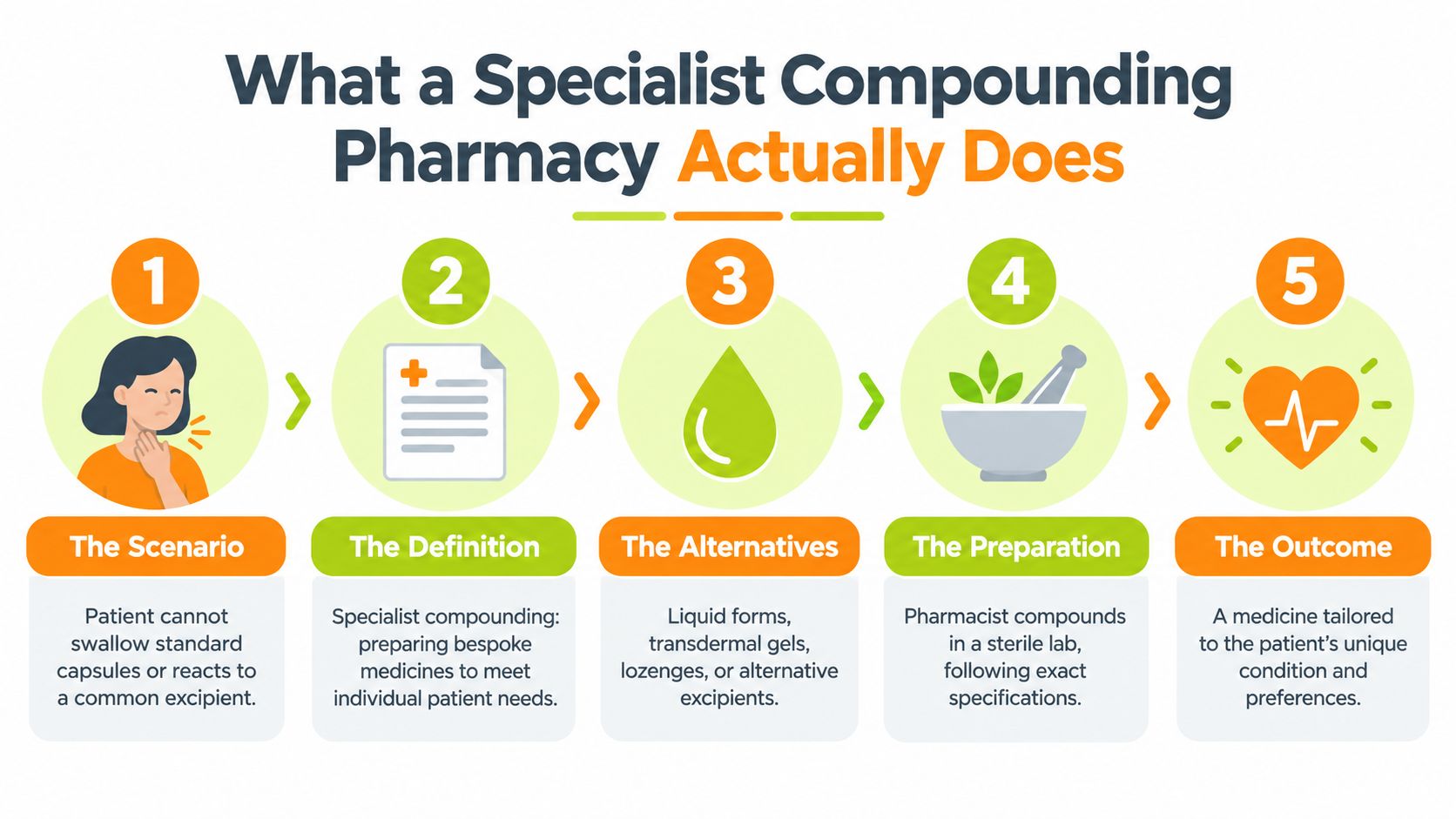
Bespoke preparation versus mass manufacture
Mass-produced medicines follow fixed formulas and large production runs. Compounding works on a patient-specific scale, so the pharmacist must assess the ingredients, calculations, container, storage requirements and labelling for that preparation.
The process usually follows five stages:
- The prescriber identifies the clinical gap.
- The pharmacist checks whether a licensed option can meet the need.
- The team agrees the strength, form and ingredients.
- Staff prepare and check the medicine under the relevant standards.
- The pharmacy supplies it with clear directions for use.
The Courier Pharmacy compounding service describes how this type of consultation-led process may work in practice.
Pharmacist's tip: Tell the prescriber exactly what happened with previous medicines. “I can't take tablets” helps. “I gag with capsules and reacted to the red colouring” gives the pharmacist information that can guide the formulation.
When Patients Genuinely Need a Customised Medicine
A child may need a very small dose even though every licensed option comes as a tablet. Crushing one can give an unsuitable dose or change how the medicine behaves. If the prescriber confirms that a liquid is clinically appropriate, a pharmacist may prepare that form for the individual patient.
An adult working shifts may develop symptoms after taking a tablet containing an excipient they cannot tolerate. The active ingredient may be suitable, while lactose, a colouring, preservative or another inactive ingredient causes the difficulty. If a suitable alternative can be sourced and prepared, the formulation may exclude the specific excipient.
These are clinical gaps, rather than requests for a product because it seems attractive. UK guidance says a special should address an individual patient's special needs when no licensed medicine can meet them. The order must also come from an authorised prescriber, such as a doctor, dentist or registered pharmacist. The NHS Specialist Pharmacy Service explains this distinction.
Common clinical gaps
A prescriber may consider compounding when a patient needs:
- A liquid or lower strength, particularly for a child or older person.
- A different route, such as a topical, sublingual or rectal preparation.
- An excipient-free formulation, after a confirmed allergy or intolerance.
- A dermatology preparation, when a standard cream does not suit the skin or treatment plan.
- A hormone or pain preparation, where the prescriber has identified a specific clinical need.
- Access to a medicine that is not commercially available, provided the legal requirements are met.
For example, someone with a persistent skin problem may need a topical preparation combining ingredients at a strength not sold as a licensed product. A person with a rare condition may require a small dose or unusual form because manufacturers do not produce a standard version for limited demand.
The prescribing clinician decides whether treatment is appropriate. The compounding pharmacist then assesses whether the formula can be prepared safely and consistently, within the relevant UK legal and manufacturing requirements.
For wider context on how patients can assess providers, read this UK guide to finding a compounding pharmacy, including the questions to ask about the pharmacy's process and capabilities.
How UK Regulation Keeps Specialised Compounding Safe
A patient may need a medicine in a form that manufacturers do not produce. The preparation can still be made within a controlled legal system, provided the prescriber, pharmacy and, where relevant, manufacturer each meet defined responsibilities.
“Unlicensed” describes the product's marketing-authorisation status. It does not mean that the preparation is made without professional oversight. Under the UK specials framework, a prescriber must identify an individual patient's clinical need and issue the appropriate prescription. The product must then be obtained through an authorised route. The MHRA's specials guidance sets out this framework.
The main layers of oversight
A registered pharmacy operates under the General Pharmaceutical Council. Its Responsible Pharmacist accepts professional responsibility for the pharmacy's safe operation and the supply of medicines.
The legal route depends on the work being carried out. A pharmacy may prepare a medicine under the relevant medicines legislation. More complex or larger-scale manufacture may require an MHRA Specials Manufacturing Authorisation, commonly called an MS licence. An authorised manufacturing site must meet applicable Good Manufacturing Practice standards and undergo inspection. UK guidance on purchasing specials explains this requirement.
| Body | Role in compounding | What it oversees |
|---|---|---|
| General Pharmaceutical Council | Regulates pharmacy premises and pharmacy professionals | Professional standards, safe pharmacy practice and governance |
| Medicines and Healthcare products Regulatory Agency | Licences and inspects eligible manufacturing sites | Specials manufacture and GMP compliance |
| Prescriber | Identifies the patient's clinical need | The prescription, suitability and treatment plan |
| Pharmacy quality team | Checks the preparation and records | Materials, calculations, batch documents and release decisions |
Quality controls continue after the formula has been agreed. Suitably qualified staff must carry out defined production and quality roles. Written manufacturing and supply records document the ingredients, calculations, packaging and release decision. Traceability codes and retention rules allow a concern to be investigated later. Records are kept for at least one year after expiry or five years after release, whichever is longer. The MHRA's guidance for specials manufacturers describes these controls.
Courier Pharmacy's compounding capability therefore sits within this wider framework, rather than outside it. Patients can also use this guide to online pharmacies in the UK to understand how a regulated service should operate and what questions to ask before ordering.
Benefits and Risks of Bespoke Pharmacy Preparations
A child who cannot swallow tablets may need a measurable liquid. An older patient may manage a cream more easily, while someone with an excipient problem may need a preparation without a particular ingredient. These are practical reasons a prescriber might consider a bespoke medicine.
The benefit depends on the formulation and the patient. A pharmacist cannot promise that every preparation will work better, taste better or suit every person.
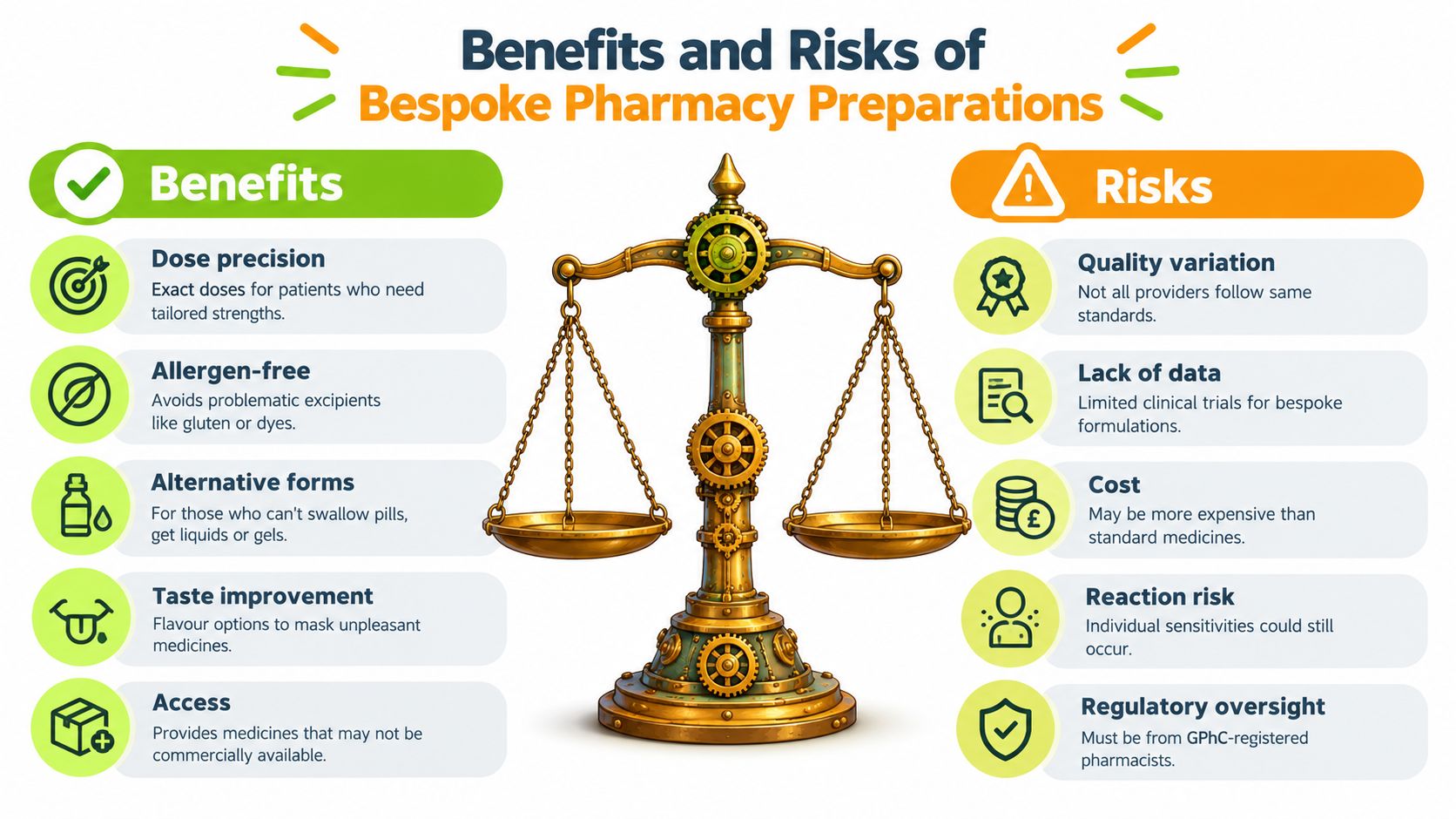
What a special may offer
- Dose precision: The prescriber can request a strength that fits the clinical plan.
- A different dosage form: Liquids, creams, gels or lozenges can help when swallowing is difficult.
- Ingredient selection: The pharmacy may exclude a known problematic excipient.
- Access: A special can address a gap when a licensed product is unavailable or unsuitable.
- Practical support: Advice on administration and storage can make a difficult routine easier.
The trade-off is uncertainty. A special is supplied under the UK framework for unlicensed medicines, rather than through the same marketing-authorisation process as a licensed product. Its exact formulation may therefore have less clinical evidence, with no formal bioequivalence testing against a commercial medicine. Stability limits, batch-to-batch variation and labelling errors remain possible risks. The prescriber's reason for using the special, and the pharmacy's controls, both matter.
Cost reflects the work involved. A peer-reviewed analysis using England and Wales data found that, in Quarter 1 of 2014/15, the top 500 special-order items averaged £104.47 per item. Examples ranged from £14.42 for colecalciferol 20,000-unit capsules to £807.19 for sodium benzoate tablets. The analysis is available through the peer-reviewed article on special-order medicines.
These figures do not predict the price of an individual prescription. They show why low-volume, bespoke manufacture can cost more than mass-produced generics. NHS reimbursement arrangements vary, so ask the prescriber or pharmacy about cost before preparation begins.
Ask one simple question before agreeing: “Why is this special needed instead of a licensed medicine?”
How to Choose a Safe and Reputable Compounding Provider
If a child needs a dye-free liquid, or a patient cannot use a standard strength, the provider's checks matter as much as its formulation skills. Start with regulation rather than photographs or delivery promises. A UK pharmacy should display its GPhC registration, identify the Responsible Pharmacist and explain who prepares the medicine.
Ask whether the work is carried out under an MHRA Specials Manufacturing Authorisation. This is particularly relevant to aseptic preparation and more complex production. Hospital aseptic services may operate through a legal exemption or an MHRA specials manufacturing licence, with recognised GMP standards applying to both routes. The parliamentary answer on UK aseptic services explains this position.
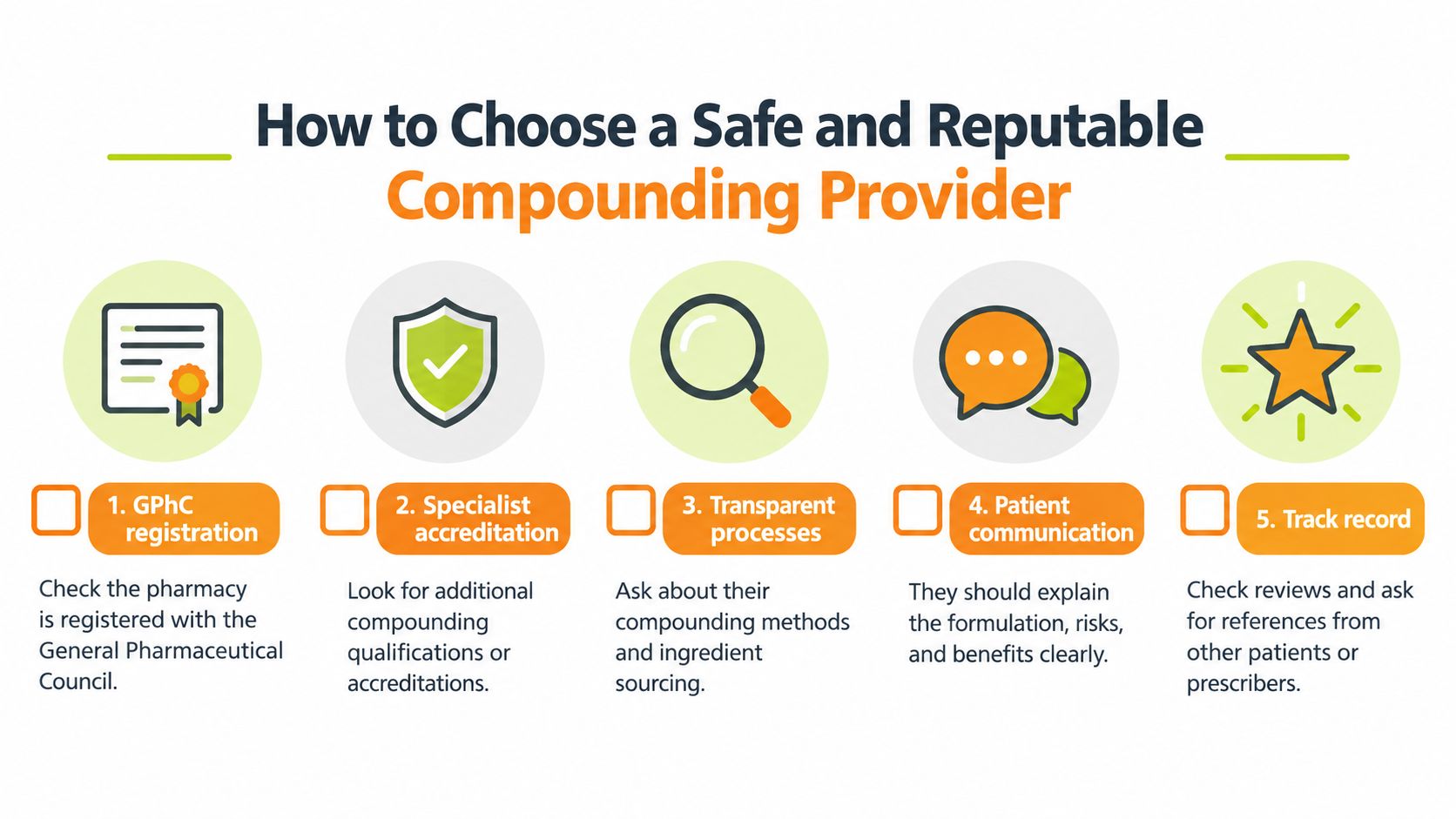
A patient-friendly checking list
A reputable provider should be able to explain:
- Registration: Is the pharmacy registered with the GPhC?
- Manufacturing status: Does the preparation require an MS licence, and which regulatory route applies?
- Ingredient controls: Are suitable pharmaceutical-grade materials used, with supplier details retained?
- Traceability: Can the finished medicine be linked to its ingredients, packaging and batch records?
- Stability: Does the label state storage instructions and an appropriate expiry or use-by date?
- Communication: Will a pharmacist explain how to measure, apply, store and dispose of it?
- Complaints: Is there a clear way to report a problem?
These details work like a chain of custody. Each record helps show what was made, with which ingredients, and for whom.
Pause if a provider will not share basic registration information. Treat instant preparation promises cautiously if there is no prescription review, formulation discussion or clear documentation.
Questions worth asking
Before proceeding, ask:
- Why is a special clinically needed?
- Which ingredients will the formulation contain?
- Can known allergies or intolerances be excluded?
- How should the medicine be stored and measured?
- Who should be contacted about a reaction or other concern?
Pharmacist's tip: Keep the original label and leaflet until the medicine is finished. The batch reference gives the pharmacy a useful starting point when investigating a concern.
A Real Patient Journey With Courier Pharmacy
A child may need a dye-free liquid because several licensed products contain ingredients the family wishes to avoid. The parent provides prescription details, allergy history and previous difficulties with medicines through an online consultation. These details give the prescriber and pharmacist a clearer clinical starting point.
The prescriber reviews the information and decides whether the treatment is appropriate. If so, the prescription reaches the compounding team. A pharmacist then checks whether the requested liquid can meet the child's needs, confirms the ingredients and contacts the parent if anything remains unclear.
What happens behind the scenes
The pharmacist and prescriber may discuss the strength, liquid base, flavour, container and directions. The pharmacy prepares the medicine within the arrangements that apply to its work, whether those involve GPhC oversight or an MHRA licence. Staff check the finished preparation, label it for the named patient and record relevant preparation details.
The parent receives instructions on measuring the dose, storage and use-by date. If the medicine needs particular delivery conditions, the pharmacy chooses packaging suited to it. Tracking and contact details help the family follow the parcel and ask questions after dispatch.
Preparation is not necessarily same-day. A bespoke medicine may need extra checks, so the pharmacy should give a realistic dispensing or dispatch estimate instead of guessing.
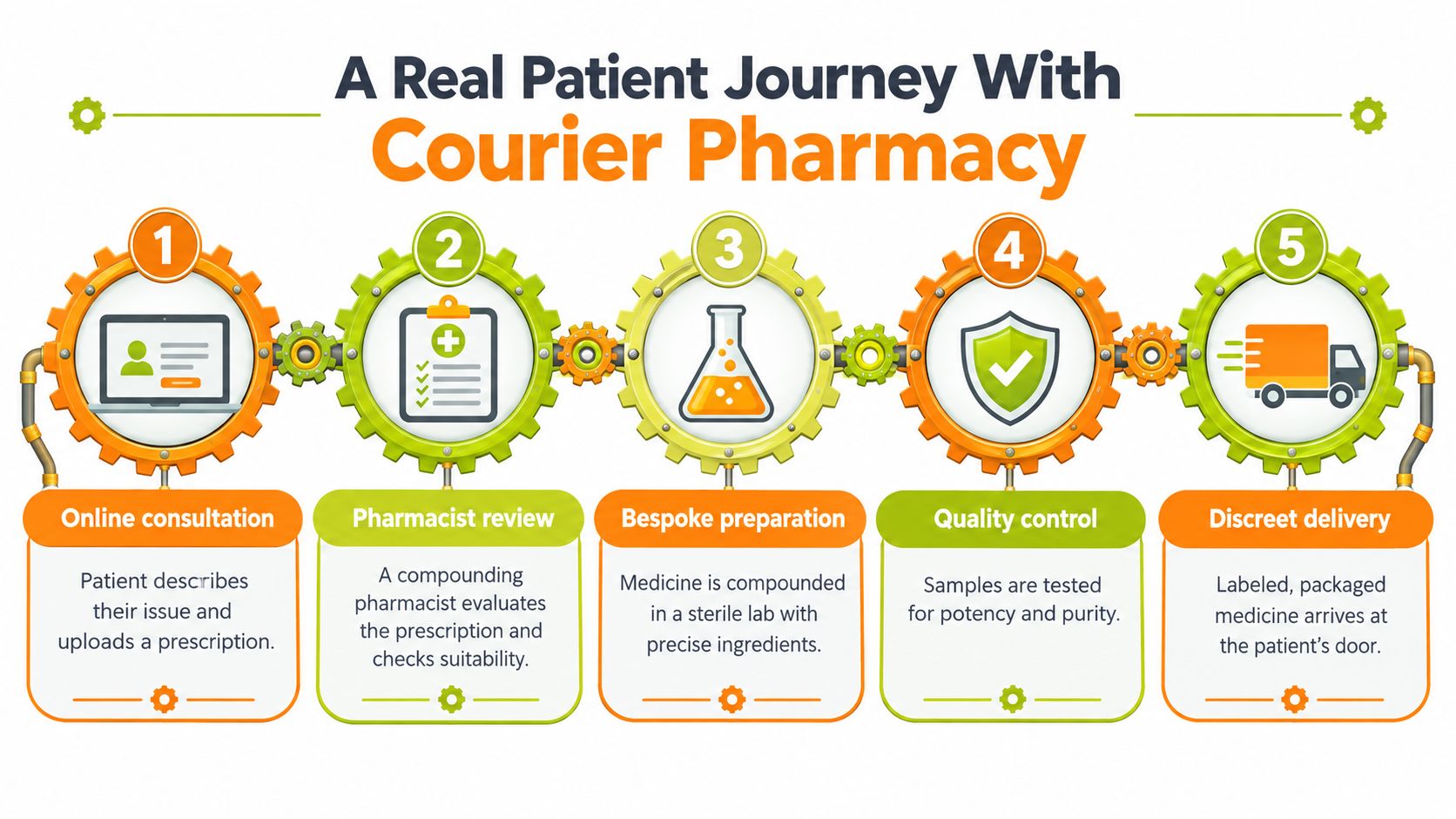
An adult might follow a similar route when a topical medicine is needed at a strength unavailable commercially. The prescriber identifies the clinical gap, the pharmacist checks the formulation, and the patient receives a labelled preparation with administration guidance.
For a closer explanation of the stages, read how ordering treatment works at Courier Pharmacy.
Practical rule: Treat a pharmacist's follow-up question as a safety check. It helps confirm that the preparation is suitable for the person who will use it.
The Key Takeaways in Plain English
A specialist compounding pharmacy prepares a medicine for a named patient when a licensed product does not fit the clinical need. That may be because the patient cannot use the available form, needs a different strength or route, or cannot take an ingredient. The prescriber must decide that a special is appropriate, while the pharmacist confirms that the proposed preparation can be made and used safely.
The legal position can feel confusing. A special is unlicensed, but that does not mean it is unregulated. UK law provides a route for supplying patient-specific specials, and manufacturing activity may sit within the MHRA's licensing and GMP framework described earlier. The level of oversight depends on what the pharmacy is doing, so patients should ask how their preparation is made and checked.
The practical question is whether the medicine solves a genuine gap and whether its limits have been explained. A bespoke preparation may offer a usable option where a standard product does not, but it may also have less supporting evidence, a shorter shelf life or a higher cost. Those points belong in the prescribing discussion, not after the medicine arrives.
Before ordering, have the prescription or clinical assessment ready and give accurate information about allergies, previous reactions and how the medicine will be used. Read the label when it arrives, follow the instructions, and keep the pharmacy's contact details. Courier Pharmacy's compounding service operates within the same need for patient-specific assessment, suitable preparation and documented checks.
If you are unsure whether a special is suitable, ask the prescriber or pharmacist to explain the reason for choosing it, the expected benefit, and what to do if it causes problems. Stop and seek advice for unexpected symptoms. Severe breathing difficulty, facial swelling or collapse requires urgent help.
Frequently Asked Questions About Specialist Compounding
Can a normal GP prescribe a special?
Yes. A GP can prescribe an unlicensed special for an individual patient when a licensed medicine does not meet a specific clinical need. The prescription must be patient-specific and clinically justified, rather than written for general supply. The prescriber remains responsible for deciding whether the preparation is suitable.
Are compounded medicines legal in the UK?
Yes. Regulation 167 of the Human Medicines Regulations 2012 provides a legal route for supplying specials made for an individual patient. The word “unlicensed” describes the medicine's authorisation status. It does not mean that the pharmacy can prepare or supply it without professional oversight. The exact controls depend on the type of preparation and the work carried out by the pharmacy or manufacturer. MHRA guidance on unlicensed medicines explains the UK requirements.
How can the pharmacy account for my allergies?
Tell the prescriber and pharmacist about confirmed allergies, suspected reactions and known sensitivities to excipients, such as dyes, preservatives, lactose or certain oils. The pharmacist can review the proposed ingredients and decide whether the formulation needs changing. Some reactions are difficult to distinguish from intolerance, so give a clear account of what happened and when.
Check the finished label before using the medicine. If an ingredient is unclear, contact the pharmacy rather than guessing.
Is a specials manufacturer the same as a high-street pharmacy?
No. A registered pharmacy may prepare certain patient-specific medicines under the relevant legal exemption. A site carrying out manufacturing activity that falls within the MHRA requirements may need a Specials Manufacturing Authorisation and must follow appropriate Good Manufacturing Practice, or GMP controls. MHRA guidance for specials manufacturers describes how those responsibilities apply.
Ask the provider who makes the preparation, where it is made and what quality checks are completed.
How long does a compounded medicine take?
There is no universal waiting time. The pharmacy may need to confirm the prescription, agree the formula, source suitable ingredients and complete checks before the medicine can be released. A preparation made from readily available ingredients may take less time than one requiring a new formulation or specialist equipment.
Ask for an estimated preparation and dispatch date before payment or treatment begins. Tell the pharmacy if the medicine is needed by a particular date, but do not stop an existing treatment while waiting unless your prescriber tells you to.
Why can compounded medicines cost more?
A special is prepared in small quantities for a particular patient, rather than produced in large batches for a licensed product. The price can reflect formulation work, ingredients, equipment, quality checks, documentation, packaging and the time required from pharmacy staff. Some ingredients may also need to be sourced specifically for one preparation.
The prescriber or pharmacist should explain the expected cost before the medicine is prepared. Ask whether the quoted price includes consultation, preparation, delivery and any repeat supply.
What happens during an online consultation?
You provide information about your symptoms or treatment goal, existing diagnoses, current medicines, allergies and previous reactions. A qualified prescriber reviews that information and decides whether treatment is appropriate. If a special may be suitable, the formulation still needs pharmacist review.
The prescriber may request more information, suggest a licensed alternative or decline to prescribe. A pharmacist may contact you to clarify the strength, dosage form, ingredients or directions. This is part of safe prescribing, not an indication that something has gone wrong.
What should arrive with my medicine?
The package should be addressed to you and include a label showing the medicine name, strength, directions, storage instructions, preparation date where relevant and use-by date. It should also provide information about administration and a way to contact the supplying pharmacy.
Before taking the medicine, compare the label with the instructions you were given. Check the container for damage and confirm that the product has been stored as directed. Contact the pharmacy if the medicine looks different from what you expected, arrives warm when it requires refrigeration, or has missing information.
For a concise explanation of the service, read what a compounding pharmacy is and how it prepares tailored medicines.
Courier Pharmacy provides consultation-led prescribing, pharmacist-reviewed bespoke formulations and delivery of labelled medicines for suitable UK patients. A consultation can establish whether a licensed treatment is unsuitable and whether a special has a reasonable role.
Disclaimer: This article is for information only. It is not a substitute for advice from your doctor, pharmacist or another qualified healthcare professional.
References
- Medicines and Healthcare products Regulatory Agency. (2021–2025) Supply unlicensed medicinal products, specials. Available at: GOV.UK guidance on unlicensed medicinal products
- Tordoff, J. et al. (2015) ‘Special-order medicines in England and Wales', Journal of Pharmaceutical Health Services Research. Available at: Peer-reviewed analysis of special-order medicines
- Medicines and Healthcare products Regulatory Agency. (2024) Guidance for specials manufacturers. Available at: MHRA guidance for specials manufacturers
- Medicines and Healthcare products Regulatory Agency. (2024) Good manufacturing practice and good distribution practice. Available at: UK GMP and GDP guidance
- NHS Specialist Pharmacy Service. (2024) Understanding unlicensed medicines. Available at: NHS guidance on unlicensed medicines
- NHS Specialist Pharmacy Service. (2024) Purchasing specials. Available at: NHS guidance on purchasing specials
- UK Parliament. (2019) Written question on aseptic pharmacy services. Available at: Parliamentary information on UK aseptic services


