Spironolactone for Acne: Dosing, Timeline and Safety
Read about spironolactone for acne: how it works, typical UK dosing, when results appear, blood tests and safety checks. Get clear answers before you start.
Spironolactone for acne works by dampening the androgen signals that push oil glands into overdrive, and in the UK it's prescribed off-label to adult women whose persistent acne hasn't settled with standard treatment. It isn't a fast fix. The strongest UK trial found real benefit took months to separate from placebo, and it comes with checks on your kidneys, potassium, blood pressure and pregnancy plans. This guide walks you through the dose steps a prescriber usually follows, what the SAFA trial did and didn't show, who should avoid it, how the blood test schedule flexes with your risk level, and how to plan around pregnancy. Everything here is general information, so your prescriber makes the final call on your treatment.
Five things worth knowing before you start
- Off-label, not experimental: the MHRA licence doesn't cover acne, but UK dermatology guidance does list spironolactone as an option for selected adult women.
- Slow burn: judge it at around 12 weeks, and expect the fuller picture at six months rather than six weeks.
- Monitoring is personal: a healthy woman under 45 with no kidney or heart risk may need very little repeat testing. Over 45, or with diabetes, kidney or heart disease, needs considerably more.
- Pregnancy comes first: pregnancy is excluded before the first tablet, reliable contraception is part of the plan, and you stop at least a month before trying to conceive.
- Report dizziness and heartbeat changes: those are the symptoms that need a prompt call rather than a wait-and-see approach.
Spironolactone dosing and timeline at a glance
A typical starting dose is 50 mg once daily, rising to 100 mg after about two weeks if tolerated, according to NHS Scotland's guidance on spironolactone for women with acne[2]. Some local protocols allow further 50 mg increases, up to 150 to 200 mg daily. Dose changes should follow your prescriber's advice.
What the trial actually did
In the UK SAFA trial, adult women with acne received spironolactone or a placebo alongside their usual topical treatment. The trial began at 50 mg daily and increased to 100 mg after six weeks, a slower step than the two-week increase in some guidelines (SAFA trial in the BMJ, 2023)[1].
At week 12, 72% of participants taking spironolactone reported improvement, compared with 68% taking placebo. By week 24, the figures were 71% versus 43%. Investigator-rated success was 19% with spironolactone versus 6% with placebo at week 12. Headache was reported by 20% of the spironolactone group and 12% of the placebo group; the trial reported no serious adverse reactions[1].
These results use different measures. Patient-reported improvement captures how participants felt about their acne, while investigator ratings assess visible changes. The benefits took time to become clearer, so a review at around 12 weeks is an early checkpoint, not always the final verdict.
The review points that matter
Some NHS protocols advise stopping at six months if there has been no meaningful benefit[2]. If your acne is improving but has not cleared, discuss the response and dose with your prescriber before deciding whether to continue.
| Stage | Dose | When it happens | What to expect |
|---|---|---|---|
| Starting dose | 50 mg once daily | Day 1 | A lower starting dose may help limit dizziness and headache |
| Increased dose | 100 mg once daily | After 1 to 2 weeks if tolerated; the SAFA trial increased it at week 6 | Your prescriber decides the timing |
| Higher dose where protocol allows | Further 50 mg steps, maximum 150 to 200 mg daily | According to local guidance | Considered after review, and not suitable for everyone |
| First review | Current dose | About 12 weeks | Patient-reported improvement was 72% with spironolactone and 68% with placebo |
| Continue or stop review | Current dose | Around 6 months | Some UK protocols advise stopping if there is no meaningful benefit |
Keep a dated record of dose changes and bring it to your review. A simple note can make it easier to compare how your skin has changed over time.
If you use a topical retinoid as well, its progress may follow a different timeline. Read about how long tretinoin takes to work. Spironolactone works gradually on oil production, while a retinoid acts at the skin surface.
Your prescriber should guide every dose change. If improvement seems slow, discuss the next step at a review rather than adjusting the dose yourself.
Spironolactone for acne and how it works
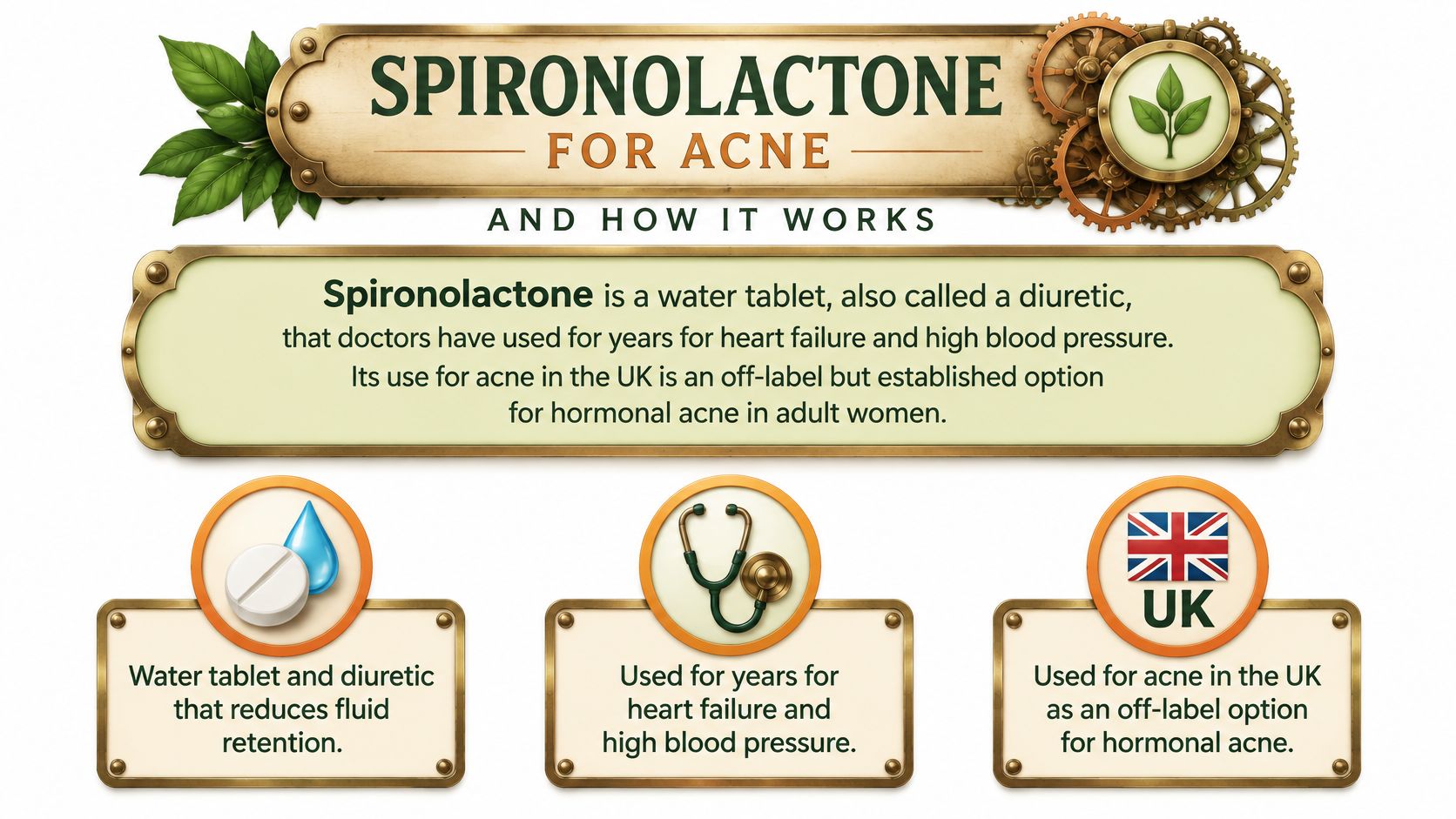
Could a medicine known as a water tablet also help with acne? Spironolactone is a diuretic prescribed for conditions including heart failure and high blood pressure. In the UK, its use for acne is off-label: it is not licensed for this purpose, so your prescriber weighs whether it is appropriate for you.
Why a water tablet calms spots
Androgens, including testosterone, can stimulate the oil glands in your pores. More oil can contribute to blocked pores and inflamed spots. Some women's follicles are more sensitive to androgens, even when hormone levels are within the normal range.
Spironolactone reduces the effects of androgens at the follicle. With less stimulation of the oil glands, acne may improve, particularly around the jawline and chin, where breakouts can be associated with hormonal changes.
What the UK evidence shows
The SAFA trial was a randomised, placebo-controlled study conducted in England and Wales. It enrolled 410 adult women with persistent acne, many of whom had experienced it for at least two years (Health Research Authority summary of the SAFA trial)[3].
At week 12, patient-reported improvement was similar in the spironolactone and placebo groups: 72% versus 68%. By week 24, the results had separated: 82% of women taking spironolactone reported improvement, compared with 63% taking placebo. The odds of reporting improvement were higher with spironolactone at that point[3].
Different trial measures can produce different success rates. Patient-reported improvement, clinician assessments and spot counts measure different things, so their results should not be treated as interchangeable.
The trial included adult women, so its findings do not establish how well spironolactone works for men or teenagers. It compared the medicine with placebo, not with every other acne treatment. For an overview of treatment options, see our guide to acne treatments.
Who can take it and who should avoid it
Three women arrive at the same clinic with the same complaint and three different sets of circumstances.
- The busy parent: jawline acne for 18 months, two topical treatments and one course of oral antibiotics behind her, no patience left for a nine step routine. She's a reasonable candidate for an assessment.
- The shift worker: takes her tablets at unpredictable hours. She needs a fixed daily time, a morning slot works well for most, and a low threshold for reporting dizziness.
- The gym-goer: trains hard in a hot studio. Sweating plus a blood-pressure-lowering medicine can leave her light-headed on standing, so she should hydrate and rise slowly.

None of these women gets a prescription on the spot. Each needs a conversation about history, medicines and plans.
The profile that fits
UK guidance places spironolactone within a structured pathway, not at the front of the queue. It suits adult women whose acne has lasted more than six months and hasn't settled with a topical treatment plus a systemic option such as an oral antibiotic or a combined pill.
Reasons to avoid it, or to pause
The British Association of Dermatologists is clear that spironolactone should not be used in significant kidney disease or Addison's disease, and that pregnancy avoidance is part of safe prescribing (BAD acne patient information)[4]. Medicines that raise potassium, such as ACE inhibitors, need flagging before your first tablet rather than after. Dose-related dizziness, postural hypotension, menstrual irregularity and breast tenderness are all things to discuss up front[4].
Your prescriber will also want a baseline set of bloods and a clear picture of your pregnancy plans. Both of those get their own detail further on.
The decision rests on your history, your medicines and your plans, not on how severe the spots look on a bad day. Bring the whole list, including anything you buy without a prescription.
Blood tests, potassium and blood pressure checks
| Patient group | Baseline checks | Repeat checks | Approach |
|---|---|---|---|
| Women under 45 with no kidney or heart risk | Kidney function and potassium | Routine repeats generally unnecessary | Lower-risk |
| Women over 45, or with diabetes, high blood pressure, kidney or liver disease, or potassium-raising medicines | Kidney function, potassium, blood pressure | One week after starting or increasing the dose, monthly for 3 months, every 3 months for 1 year, then every 6 months | Higher-risk |
| Patients following the Tayside approach | Kidney function and potassium | Within 2 weeks of starting or increasing the dose, then annually | Universal |
| Anyone with dizziness or fainting | Blood pressure check | Contact prescriber promptly | Symptom-led |
Why NHS protocols can differ
Monitoring depends on your age, health and medicines. That is why one person may need repeat blood tests while another does not.
NHS Dorset advises checking kidney function and potassium before treatment. For women under 45 without kidney-disease risk factors, it says routine ongoing monitoring is generally unnecessary. It recommends monitoring for people over 45, or with diabetes, high blood pressure, kidney disease, or medicines that affect the kidneys (NHS Dorset GP guidance on spironolactone and female acne.pdf?boxtype=pdf&g=false&s=true&s2=false&r=wide))[5]. Other local protocols use a more routine schedule, so ask your prescriber which guidance applies to you.
How risk affects the schedule
Nottinghamshire's acne protocol asks for baseline urea and electrolytes, plus a blood-pressure reading. It specifies serum potassium below 5 mmol/L before starting. For patients over 45, or with kidney, heart or liver disease, or taking medicines that can raise potassium, it recommends potassium and creatinine tests one week after starting or increasing the dose, monthly for three months, every three months for a year, then every six months. Younger patients at lower risk may not need routine potassium checks; the prescriber decides (Nottinghamshire APC acne guidance)[6].
A 2025 survey of UK and Irish clinicians reported that 70% checked baseline bloods and 60% monitored bloods, with wide variation in dosing and follow-up practices.
What dizziness can mean
Spironolactone can lower blood pressure. Standing quickly, hot weather or skipping a meal may leave you light-headed. If you feel faint or pass out, contact your prescriber promptly so they can assess whether your blood pressure or treatment needs reviewing.
Ask at your first appointment: “Which monitoring group am I in, and when are my next tests?” Save the dates so you know when to arrange them.
Ask your prescriber whether blood tests can be taken at home or need to be done at a clinic. A structured questionnaire can also help identify medicines that may raise potassium before your case is reviewed.
Pregnancy, contraception and stopping treatment
What if your acne has settled on spironolactone, but you want to try for a pregnancy? The next step depends on your plans, so discuss timing with your prescriber before changing contraception or stopping treatment.
Spironolactone should not be used during pregnancy because of potential effects on fetal development. Pregnancy should be ruled out before treatment starts, and contraception should be discussed with your prescriber (NHS medicines information on spironolactone)[7].
If you're planning a pregnancy
NHS Dorset guidance advises stopping spironolactone at least one month before trying to conceive (NHS Dorset acne guidance)[5]. Talk to your prescriber early so you can agree when to stop and what to use for acne afterwards.
If a period is late
Stop taking the tablets and contact your prescriber promptly. Periods can become irregular on spironolactone, so a late period does not necessarily mean pregnancy. Report it either way, so they can advise you on what to do next.
If you want to stop for other reasons
There is no single stopping plan for everyone. Some people reduce their dose gradually; others stop at their current dose. Your prescriber can advise based on your dose, response, side effects and circumstances (NHS medicines information on spironolactone)[7].
Acne may return after stopping because the medicine's anti-androgen effect is no longer there. Agree a follow-on plan with your prescriber, such as a topical retinoid, a combined pill or another maintenance approach.
What clinicians are still unsure about
The best treatment duration, whether tapering is helpful and long-term safety are not fully settled. If you have questions about fertility or stopping, raise them at a review so your prescriber can answer in light of your treatment and plans.
Before starting, ask: “What should I do if I become pregnant, and how should I stop if I want to try?”
Side effects and when to get urgent help
Patients often get through the first few months with nothing worse than an annoying headache. Effects tend to be mild and often ease as your body adjusts.
- Headache. The one effect reported more often on spironolactone than placebo in the UK trial. Keep fluids up and mention it at review if it drags on.
- Light-headedness on standing. Rise from a chair in two stages, drink enough through the day, and don't skip meals.
- Breast tenderness. Usually settles within a few weeks. Tell your prescriber if it doesn't.
- Menstrual changes. Periods may become lighter, heavier, irregular or stop altogether. Any change is worth reporting.
- More trips to the loo. Common early on and usually settles within the first month.
The symptom pattern that needs a blood test
Raised potassium is uncommon in healthy younger women, but it's the reason monitoring exists. Watch for muscle weakness, tingling in the hands or feet, or a heartbeat that feels irregular. Those three together deserve same-day advice.
Call 999 or go to A&E for
- Fainting
- Chest pain
- A racing or irregular heartbeat that doesn't settle
- Severe muscle weakness
- A seizure
Contact your prescriber or call 111 for
- Persistent dizziness
- A headache that won't shift
- Breast tenderness that bothers you
- Any change to your periods
One more habit: if you start a new medicine or supplement, check with your pharmacist before your next dose. Potassium supplements, potassium-containing salt substitutes and some blood pressure medicines are the ones people forget to mention. If you're also using a topical antibiotic combination, what is Treclin and its common side effects covers the skin-level reactions worth knowing about.
Pharmacist's tip: bring your full medicine list to every review, including anything bought over the counter. Half the safety questions we answer come down to one supplement nobody thought to mention.
If you're unsure whether a symptom matters, get advice early. A ten minute call is cheaper than a night in A&E.
Spironolactone compared with other acne treatments
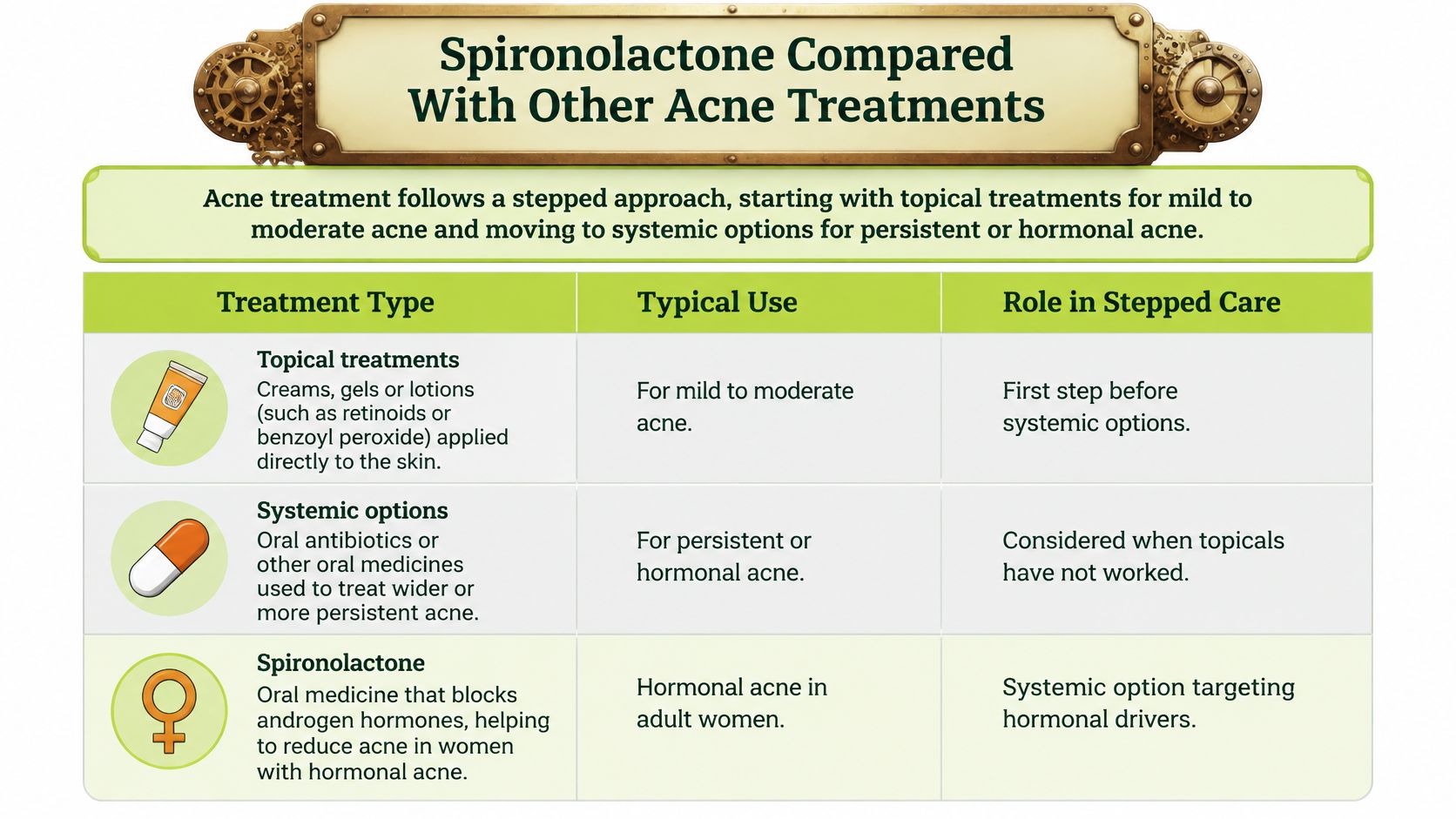
Acne treatment follows a stepped approach. Topical treatments come first for mild to moderate acne, and systemic options come in when topicals haven't done the job or when hormones are clearly driving the problem.
| Treatment | Typical use | Main advantage | Main drawback |
|---|---|---|---|
| Spironolactone | Adult women with persistent hormonal acne not responding to standard care | Non-antibiotic option; benefit builds over months | Pregnancy avoidance and blood or blood pressure checks |
| Oral antibiotics (doxycycline or lymecycline) | Short-term control of inflammatory acne | Often a faster early effect | Antibiotic resistance limits long-term use |
| Combined oral contraceptive | Hormone-related acne in women who want contraception | Provides contraception as well as acne control | Not suitable for everyone |
| Isotretinoin | Severe or scarring acne under specialist care | Strong, long-lasting results for many people | Strict pregnancy prevention and specialist monitoring |
| Topical retinoids or benzoyl peroxide | Mild to moderate acne | Low risk and easy to use | Slow results; may not treat hormonal flares |
Where each option fits
Spironolactone earns its place in the middle of that list. It suits adult women with persistent hormonal acne who've already tried standard care, and it works without adding to antibiotic resistance. The trade-off is time plus monitoring.
Oral antibiotics still have a role for inflamed acne that needs settling quickly, usually for a limited course. They aren't a long-term answer, and dermatologists are deliberately moving away from open-ended courses.
The combined pill does two jobs at once for women who want contraception anyway. It isn't suitable for everyone, particularly smokers over 35 or people with certain clotting risks, and that's a conversation rather than a tick box.
Isotretinoin remains the heavy option, reserved for severe or scarring acne with specialist oversight and strict pregnancy prevention. Nobody arrives there by accident.
Topical retinoids and benzoyl peroxide stay the sensible starting point for most mild acne. They're low risk and easy to use, though they take weeks to show benefit and often can't control hormonal flares on their own. Our guide to choosing a tretinoin strength for acne covers how that choice is made in practice.
Bring your history, your goals and your pregnancy plans to the conversation. Your prescriber weighs those against the table above, and the right answer is rarely the same for two people.
Confirm your suitability before you order online

The key question isn't whether spironolactone works. It's whether it's right for you, and whether you can comfortably follow the checks that come with it.
A proper online consultation asks for your full medicine list, including supplements, potassium-containing salt substitutes and anything from a health shop. It asks about pregnancy plans and contraception, kidney and heart conditions, diabetes, blood pressure, and which acne treatments you've already tried. If those questions aren't there, the consultation is too thin.
Our own questionnaire is reviewed by a human prescriber, and we can arrange home or venous blood draws if baseline tests are needed. That matters more here than for most medicines, because the monitoring is what makes this drug safe. You can read more about how a UK online pharmacy works before you begin.
- Confirm your history. Note how long the acne has lasted and every treatment you've tried, including doses and how long you stuck with each one.
- Arrange baseline checks. Kidney function, potassium and blood pressure, as your prescriber advises.
- Agree the dose plan. Write down the starting dose, the increase date and the 12 week review.
- Book the six month review. That's the point where you and your prescriber decide whether to continue.
- Keep a dated diary. Dose changes, symptoms, and any new medicines or supplements.
Plan in months rather than weeks before you judge the result. The trial's own numbers show why: at 12 weeks the two arms looked nearly identical on patient-reported improvement, and only by week 24 did the gap open up.
If you get a symptom from the urgent-help list, act on it rather than waiting for a review appointment.
Disclaimer: this guide is informational only and is not a substitute for medical advice. Speak to your prescriber, GP or pharmacist before you start, change or stop any medicine.
Summary
Spironolactone is an established off-label option for persistent acne in adult women, supported by a UK trial of 410 women.
Most prescribers start at 50 mg daily and move to 100 mg after a week or two, with a proper review at around 12 weeks.
Patient-reported improvement separated from placebo by week 24, not week 12, so patience is part of the treatment.
Monitoring isn't one-size-fits-all. Younger women with no kidney, heart or diabetes risk often need little repeat testing, while higher-risk groups need a defined schedule.
Pregnancy must be excluded before you start, contraception needs discussing, and you stop at least a month before trying to conceive.
Headache and light-headedness are the common annoyances. Fainting, chest pain or an irregular heartbeat need urgent help.
Your prescriber decides the dose and the checks, so bring your full medicine list and your plans to every review.
Frequently asked questions
How long does spironolactone take to work for acne?
Give it around 12 weeks before you judge it, and up to six months for the full picture. In the UK trial, patient-reported improvement at week 12 was similar to placebo, and the difference appeared by week 24. That's why most protocols build in a review at 12 weeks and a continue-or-stop decision around six months.
Is spironolactone licensed for acne in the UK?
No. The MHRA hasn't authorised it for acne, so any prescription is off-label. That doesn't make it experimental. The British Association of Dermatologists notes that the evidence supports its effectiveness and safety when a prescriber judges it appropriate, and off-label prescribing is routine in dermatology.
Will I need blood tests while I take it?
Almost certainly at baseline, for kidney function and potassium. Repeat testing depends on your age and risk factors. Women under 45 with no kidney or heart problems often need very little, while anyone over 45, or with diabetes, high blood pressure, kidney or liver disease, or potassium-raising medicines, follows a tighter schedule. Ask your prescriber which group you're in.
Can I take spironolactone if I want to get pregnant?
Not while you're trying. Stop at least one month before you start trying to conceive, and use reliable contraception in the meantime. If you miss a period or get a positive test, stop the tablets and contact your prescriber promptly.
Will my acne come back if I stop?
Often, yes. The drug works while you take it, and the hormonal drive returns once it clears. That's why a plan for what happens next is worth agreeing before you stop, whether that's a topical treatment, a combined pill or a maintenance dose.
Can men take spironolactone for acne?
It's not a routine option. The UK trial studied adult women, and the drug's hormone-blocking action brings effects that most men want to avoid, including breast tenderness and reduced libido. If you're male and struggling with persistent acne, ask about oral antibiotics, topical retinoids or a specialist referral instead.
Is 50 mg enough, or will I need a higher dose?
Some women respond well at 50 mg. Many prescribers step up to 100 mg after a week or two if the first dose is tolerated and the response is partial. Local protocols differ on how far to go, and the ceiling is usually 150 to 200 mg daily. Your prescriber sets the number, not the internet.
What if I miss a dose?
Take it when you remember, unless you're close to the next one, in which case skip it rather than doubling up. Keep your dosing time consistent, because a regular slot makes dizziness easier to spot and easier to manage.
Does spironolactone interact with other medicines?
Yes, mainly with anything that raises potassium or affects blood pressure, such as ACE inhibitors, angiotensin receptor blockers and potassium supplements. Some over-the-counter salt substitutes are potassium-based. Tell your prescriber and pharmacist about everything you take, including supplements.
About the author and clinical review
Courier Pharmacy is a GPhC-registered online pharmacy whose secure online questionnaires are reviewed by human prescribers.
How this content was created
This article draws on the UK SAFA randomised controlled trial published in the BMJ, the Health Research Authority's summary of that trial, NHS Dorset and NHS Scotland prescribing guidance, Nottinghamshire Area Prescribing Committee guidance, the British Association of Dermatologists patient information and NHS medicines information. A GPhC-registered prescriber reviewed the draft for clinical accuracy before publication. It's general information, not personal medical advice.
References
- Santer, M., Lawrence, M., Renz, S. et al. (2023) ‘Effectiveness of spironolactone for women with acne vulgaris (SAFA) in England and Wales: pragmatic, multicentre, phase 3, double blind, randomised controlled trial', BMJ 2023;381:e074349.
- NHS Scotland Right Decisions (no date) Spironolactone for acne in women.
- Health Research Authority (no date) Spironolactone for adult female acne: research summary.
- British Association of Dermatologists (no date) Acne: patient information leaflet.
- Nottinghamshire Area Prescribing Committee (no date) Acne vulgaris: primary care guidance.
- NHS (no date) Spironolactone.
Meta description: Spironolactone for acne explained by a UK pharmacist: dosing, the 12 and 24 week timeline, blood tests, pregnancy planning and when to get urgent help.
Courier Pharmacy is a GPhC-registered online pharmacy operating since 2014. Secure online questionnaires are reviewed by human prescribers, and home or venous blood draws can be arranged when baseline tests are needed. Visit Courier Pharmacy to start a consultation or ask the team a question before you decide.


