How to Manage Temperature Controlled Storage for Medicines
Learn how temperature controlled storage for medicines works, UK guidelines, equipment, transport best practices and SOPs to keep your medications safe.
SEO brief
- Primary keyword: temperature controlled storage
- Secondary keywords: medicine storage temperature, cold chain medicines, pharmacy fridge temperature, refrigerated medicines, last-mile medicine delivery
- Search intent: Informational. The reader wants to understand safe medicine storage, UK rules, and what to do during delivery or temperature problems.
- Target reader: UK adults, patients, carers, and prescribers
- Product/service mention (if any): Neutral educational content with a brief CTA for Courier Pharmacy at the end
- Internal links available: Assumed from the pages supplied
How to Manage Temperature Controlled Storage for Medicines
You open the front door after work and spot your insulin parcel on the floor by the radiator. The box feels warm. Your first thought is simple and stressful: can I still use this?
Temperature controlled storage means keeping medicines within the right temperature range from pharmacy shelf to patient hand. If that range slips, a medicine may stop working as intended, even when it still looks normal. This guide explains the key temperature ranges, UK rules, equipment checks, delivery risks, and the practical steps patients and carers can take to stay safe.
Five key takeaways
- Know the range: Many refrigerated medicines must stay between 2°C and 8°C [1].
- Aim for stability: Small swings matter. A fridge that warms up and cools down repeatedly can be as risky as obvious heat exposure.
- Don't trust guesswork: A cool-feeling box or ice pack doesn't prove the medicine stayed safe in transit.
- Use records, not memory: Good monitoring depends on logs, alarms, and clear actions when temperatures drift.
- Act early if unsure: If a medicine may have overheated or frozen, stop and ask a pharmacist before using it.
Introduction
A medicine can look perfectly fine and still be unsafe after poor storage. That catches many people out. A busy parent might accept a vaccine delivery while juggling school pick-up, then realise it sat in a warm hallway. A shift worker might collect a parcel late and wonder how long it spent in the van.
That's why temperature controlled storage matters. It protects how a medicine works, not just how it looks. If you're new to the topic, learn more about Courier Pharmacy as one example of a UK-regulated online pharmacy service. In the sections below, you'll find plain-English explanations, practical checks, and calm steps for those moments when storage conditions don't seem right.
Understanding temperature controlled storage
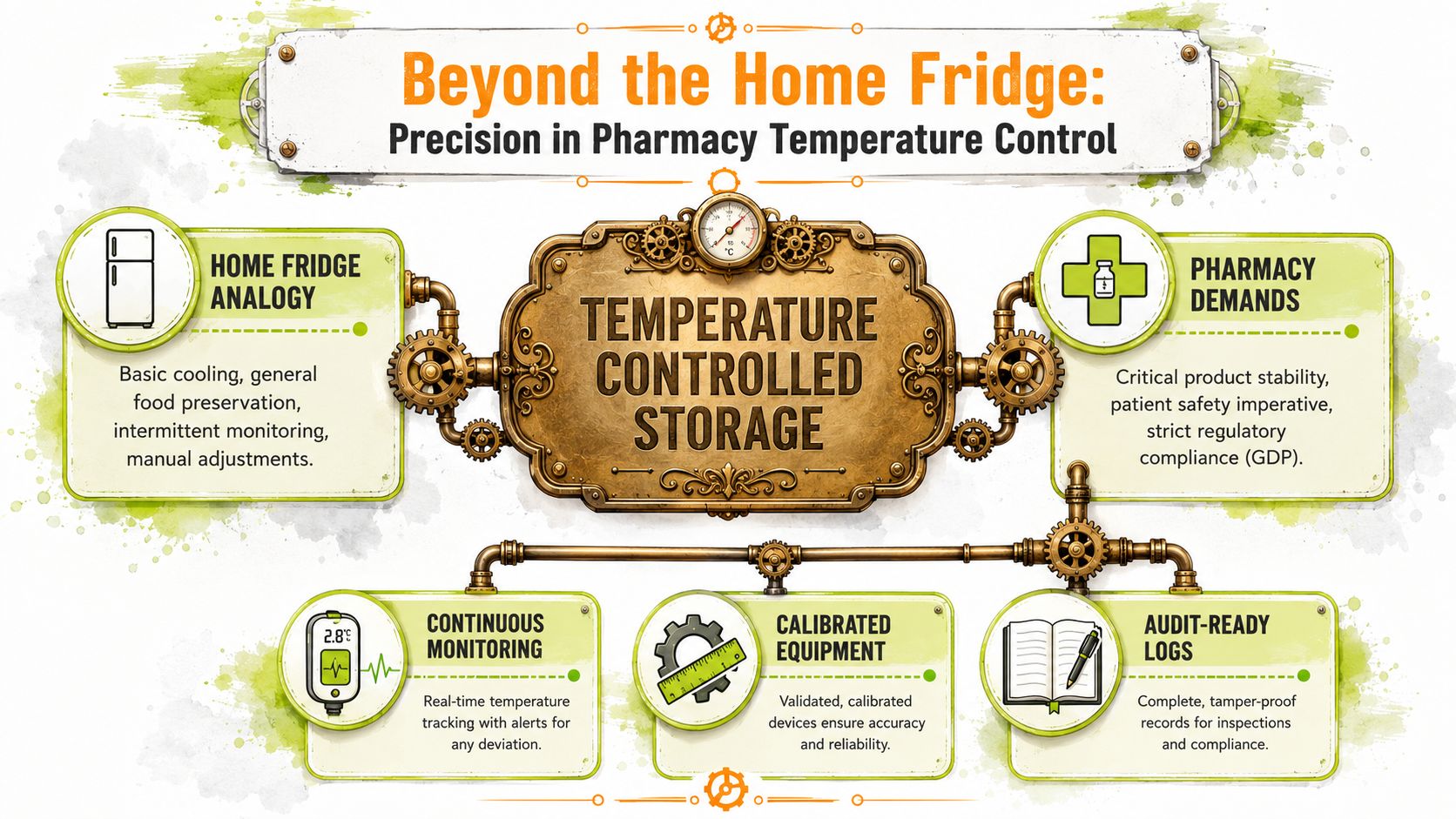
Temperature controlled storage means more than “keep it somewhere cool”. In pharmacy practice, it means using the right environment, the right equipment, and the right records so the medicine stays within its approved range the whole time.
A home fridge is a useful comparison. It cools milk and leftovers well enough, but the temperature often changes when the door opens, when food blocks airflow, or when the back wall gets icy. Medicines can be less forgiving.
Why medicines need tighter control than food
Food law in the UK allows chilled food up to 8°C, while the Food Standards Agency recommends aiming for 5°C or below for a safety margin [5]. Medicines often need tighter control than that. For example, GDP guidelines mandate 0°C to 5°C environments for biologics and vaccines, with strict bans on temperature fluctuations that could harm product efficacy [2].
That difference matters. A yoghurt that warms slightly may spoil faster. A biologic medicine may lose potency in a way you can't see, smell, or taste.
Practical rule: If a medicine says “store in a refrigerator”, think “stable and measured”, not just “cold”.
What counts as proper control
Good temperature controlled storage has three parts:
- Stable equipment: A pharmacy-grade fridge or validated cold room holds temperature more evenly than a domestic unit.
- Calibrated monitoring: The reading should come from a device you can trust, not guesswork.
- Clear records: If something goes wrong, staff need a written trail of what happened and what they did next.
If you want a simple explanation of customized medicines that may also need careful storage, what compounding pharmacy means is a useful starting point.
A simple ice pack usually isn't enough for sensitive medicines. It may cool one side of a package while leaving another side too warm, or even freeze the product by direct contact.
Terminology and temperature ranges
Medicine labels can sound technical, but the core categories are straightforward. Most patients only need to recognise whether a product belongs at room temperature, in the fridge, or in specialist frozen storage.
Quick temperature guide
| Storage Type | Temperature Range |
|---|---|
| Controlled room temperature | 15°C to 25°C for many NHS ambient medicine storage areas [1] |
| Refrigerated medicines | 2°C to 8°C [1] |
| Pharmacy ambient limit in some regulated settings | 8°C to 25°C, with medicines not exceeding 25°C or dropping below 0°C in those environments [3] |
| Frozen goods | -18°C or below under UK food cold storage rules [5] |
NHS guidance says refrigerated medicines should stay between 2°C and 8°C, and if an excursion goes more than 5°C above the upper limit, affected stock should be quarantined [1]. In plain English, if a fridge medicine gets too warm, you don't just put it back and hope for the best.
Why labels matter
The storage line on the pack is there for a reason. “Store in a refrigerator” is not the same as “keep cool”. “Do not freeze” is especially important for products like insulin and some liquid medicines, because freezing can damage them even after they thaw.
A gym-goer using a weight-loss injection may think a chilled bottle in a sports bag is fine for the journey home. It may be. But leaving that same bag in a parked car is a different story. Cars heat up fast, and medicine packaging rarely tells you exactly how long a product can tolerate that kind of exposure.
Medicines don't become safer because they still look clear or sealed. Temperature damage is often invisible.
Featured snippet answer
What is the safe fridge range for medicines?
For many refrigerated medicines in the UK, the usual safe range is 2°C to 8°C [1].
Regulatory and professional requirements in the UK
UK storage rules depend on what's being stored. Food businesses follow one legal framework. Pharmacies, wholesalers, and clinical services also work under medicine-specific standards such as GDP and NHS guidance.
What UK rules expect
For food-related cold storage, the legal framework in the UK sets chilled storage at or below 8°C and frozen storage at or below -18°C. It also requires recorded checks and supports due diligence under food law [5]. That helps people understand where the broad cold-chain rules come from, but pharmacy practice goes further.
In medicine settings, NHS guidance sets 2°C to 8°C for pharmaceutical refrigerators used for temperature-sensitive medicines such as vaccines and insulin, and requires continuous electronic monitoring with ±0.5°C accuracy in the NHS Health Building Note [3]. In regulated pharmacy environments, ambient storage also has clear upper limits, with risk assessment needed if temperatures exceed the set range [3].
Since 1 January 2006, all instruments used for monitoring chilled goods must comply with BS EN 13486:2002, which supports traceable and accurate records [2]. That matters because a reading is only useful if the device itself is reliable.
If you're comparing service models, online pharmacy services in the UK still need proper systems behind the scenes, even when patients only see a parcel at the doorstep.
What inspections often focus on
Inspectors and auditors usually look for ordinary things done well. They want to see whether staff checked temperatures consistently, whether they investigated alarms, and whether they documented what happened after a problem.
A common weak spot is the “it was only a short blip” mindset. In food settings there may be allowances in some circumstances, but medicines often need immediate action, especially when the product range is narrow and the risk to patients is higher.
A realistic example helps. A prescriber working in a busy clinic notices the medicines fridge reads high first thing on a Monday. If no one logged the weekend temperatures and no alarm trail exists, the team may have stock they can't confidently use.
Pharmacist's tip: Keep temperature logs where staff actually use them. A perfect form hidden in a drawer won't protect patients.
Featured snippet answer
Who checks medicine storage standards in the UK?
Different bodies may be involved, including NHS governance teams, pharmacy regulators, and inspectors linked to medicine distribution and workplace safety requirements.
Equipment selection monitoring and record keeping
The right system should make safe storage easier, not harder. If the fridge warms up every time staff load new stock, or if the display can't be checked without opening the door, the set-up invites mistakes.
Choose the right set-up
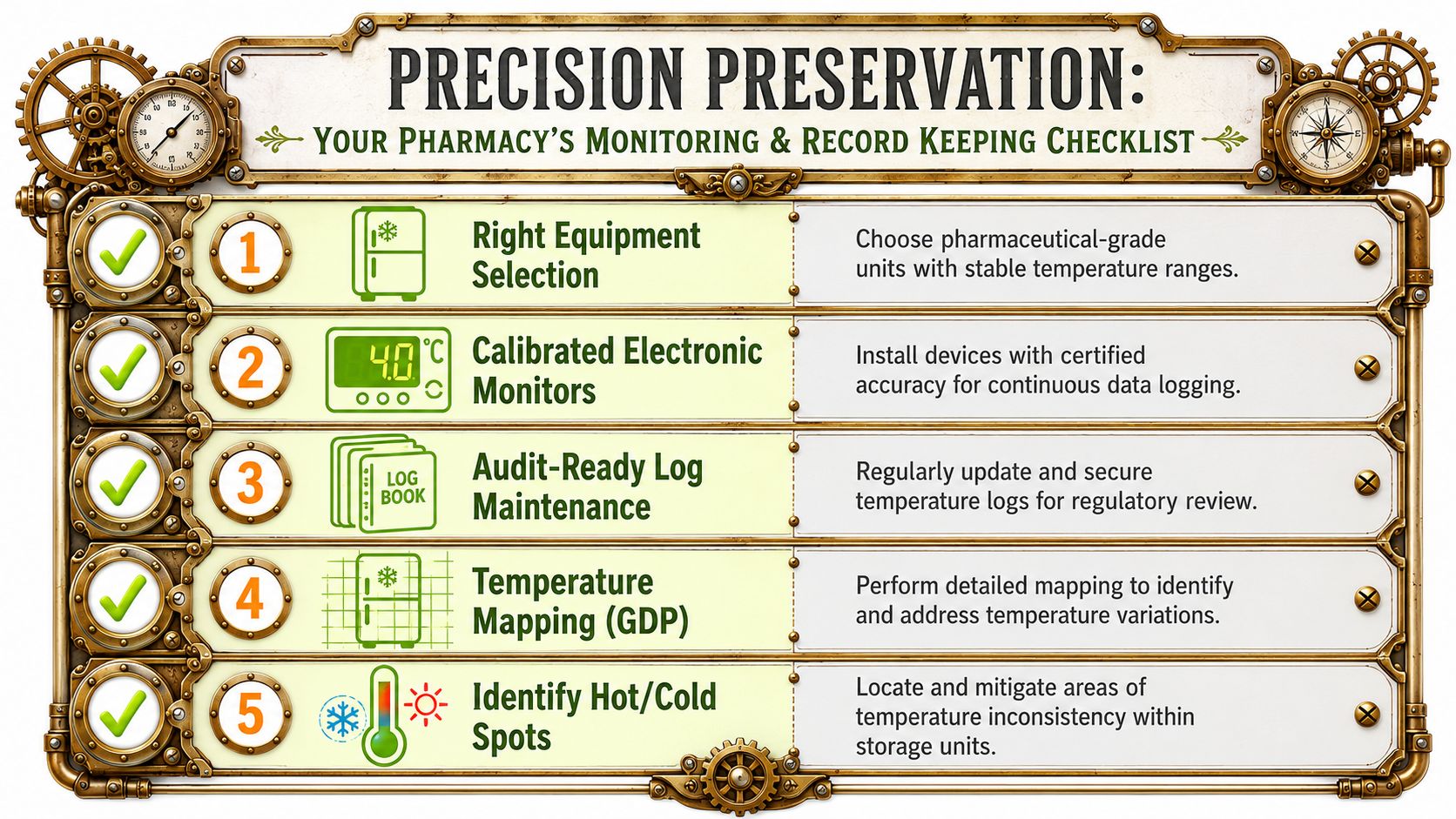
Start with equipment designed for medicines, not snacks. A pharmacy fridge should hold a narrow range reliably and allow staff to read temperatures without standing with the door open.
GDP also requires temperature mapping of storage areas every 2–3 years or after major site changes, so teams can identify hot and cold spots and decide where stock should sit [4]. That's especially useful in larger rooms and walk-in units, where one shelf may not match another.
- Fridges: Best for medicines labelled 2°C to 8°C. Fan-assisted models help reduce uneven cooling [3].
- Data loggers: Useful for continuous records and alarm trails.
- External displays: Easier to check quickly during a busy shift.
- Calibrated max/min thermometers: Helpful for spotting overnight highs and lows [4].
Here's a practical overview of the monitoring mindset:
Build an audit-ready routine
A good routine is boring in the best way. Staff should know exactly when they check temperatures, where they record them, and what to do if readings drift.
For medicines needing fridge storage, many services use daily max/min reviews with calibrated devices, then reset the monitor after recording [4]. If the reading sits outside range, the stock should be held and assessed before use.
- Record daily: Log actual readings, not “OK”.
- Act on alarms: Don't mute and move on.
- Check placement: Keep medicines away from the fridge wall, vents, and door shelves.
- Review after changes: A new fridge, relocated shelving, or building work can alter airflow [4].
A small practice can still do this well. A surgery nurse may keep vaccines in the middle shelves, use an external display for quick checks, and quarantine stock immediately if the maximum reading is too high. That's simple, practical, and safe.
If your service includes home-use devices or related products, medical supplies guidance can help patients understand that storage instructions matter just as much as the product itself.
Pharmacist's tip: Leave space around medicine boxes. Overpacking blocks airflow and creates warm pockets.
Transport and last mile delivery considerations
The final part of the journey is where many patients lose visibility. A parcel may leave a controlled site in good condition, then spend the last stretch in traffic, a depot cage, a van, or a communal hallway.
Where the final journey goes wrong
Last-mile problems are often ordinary rather than dramatic. The courier rings once. Nobody answers. The parcel is left in a porch, concierge area, or sunlit entrance. The patient gets home later and has no clear record of what happened in between.
This matters for people who depend on fragile medicines. The gap is especially important for patients with chronic conditions who need confidence that a home delivery stayed in range during the final 2 to 4 hours of transit. NHS specialist guidance says “domestic cool boxes should not be used” and requires calibrated data loggers when an audit trail is needed [6].
A shift worker receiving a biologic after a night shift may not know whether the packaging protected the medicine long enough. A carer collecting a child's insulin may assume a cold gel pack proves safety. It doesn't.
How patients and carers can verify delivery safety
You don't need to become a logistics expert. You just need a short checklist.
- Check the parcel straight away: Don't leave it unopened on the side.
- Read the storage label first: Confirm whether the medicine belongs in the fridge or at room temperature.
- Look for monitoring evidence: If a service provides a calibrated logger or temperature indicator, review it before use [6].
- If in doubt, pause: Contact the supplying pharmacy before taking the dose.
NHS guidance is clear that domestic cool boxes aren't enough when you need proof of temperature control [6]. That point often gets missed in consumer advice, which tends to focus on “keep it cold” rather than “prove it stayed in range”.
If you're ordering remotely, how online treatment ordering works can help you plan for delivery timing and reduce missed handovers.
Pharmacist's tip: If a chilled medicine arrives when you're not home, don't assume it's fine because the outer box feels cool. Ask when it was delivered and whether any temperature record is available.
When to seek urgent help
Seek urgent advice the same day if a medicine needed for blood sugar control, severe allergy management, or another critical condition may have been exposed to heat or freezing and you have no safe replacement. A pharmacist, prescriber, or NHS urgent service can help you decide what to do next.
SOP checklist and risk mitigation steps
Every safe system needs a simple routine people can follow under pressure. Good SOPs remove guesswork. They tell staff what to check, who decides, and how to document the result.
A simple response plan
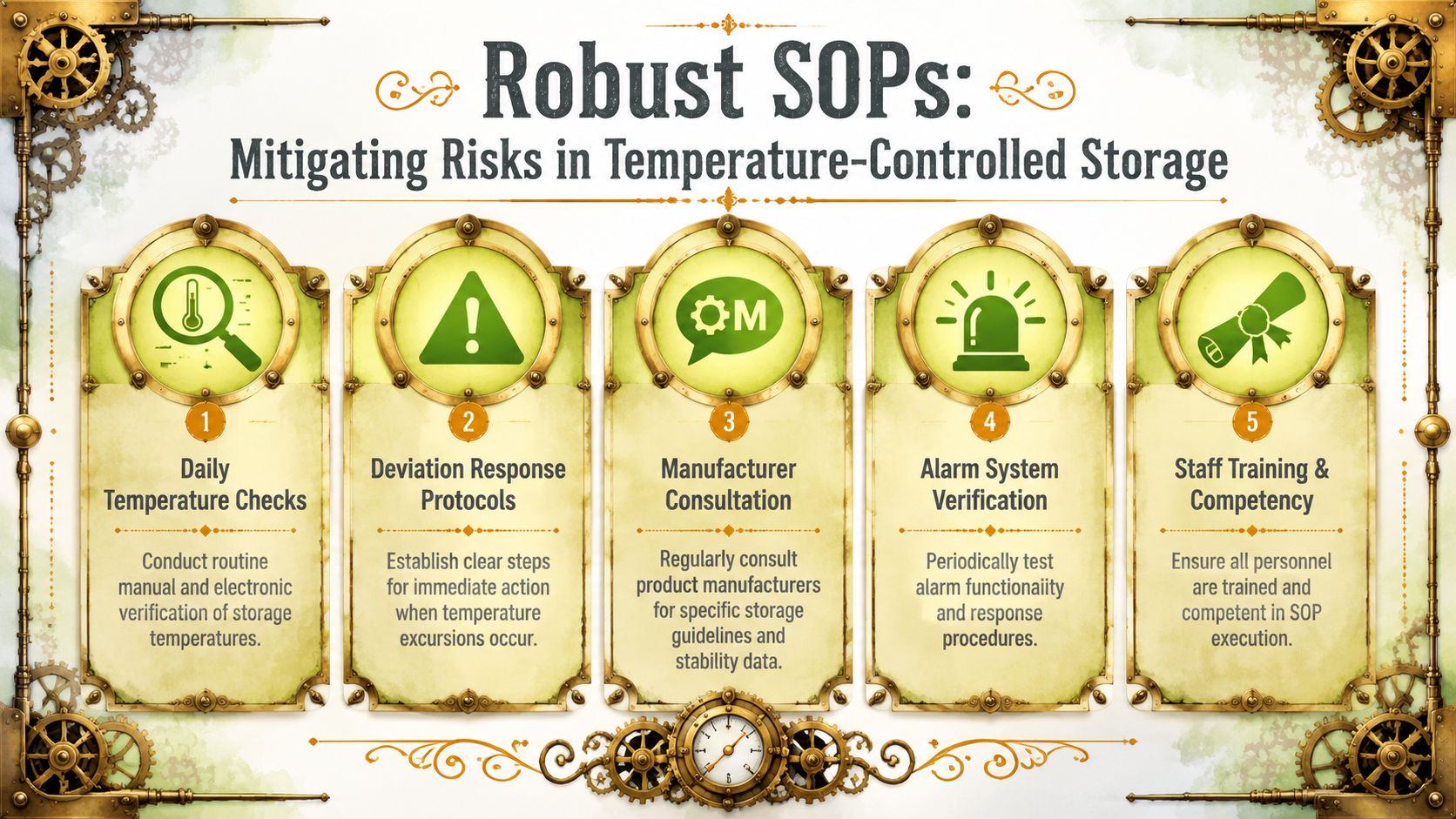
Use this checklist as a starting point:
Check and record daily
Record room or fridge temperatures at the same time each day. In care and clinical settings, morning checks are often preferred [7].Quarantine first
If a reading is out of range, separate the affected stock before anyone uses it [1].Assess the excursion
Look at the highest or lowest reading, how long the issue may have lasted, and whether the product risks heat or freezing damage.Ask for product-specific advice
Contact the manufacturer or specialist pharmacy team if the product stability isn't clear.Write down the action taken
Keep a short note of the event, the advice received, and whether stock was released or destroyed.
Common pitfalls to avoid
Some mistakes happen again and again:
- Door-shelf storage: That area warms up fastest.
- Overfilling the fridge: Air can't move properly.
- Resetting alarms without action: The record matters as much as the beep.
- No named owner: If everyone is responsible, nobody is.
A care home manager, for example, might notice the medicines room sits above 25°C on repeated warm days. Guidance says cooling measures such as air conditioning should be considered if that keeps happening [7]. That's a reminder that storage safety is not only about the fridge.
Keep the process simple enough that the busiest person on the busiest day can still follow it.
FAQs for patients and prescribers
How do I check my medicine fridge at home?
Use a reliable thermometer or logger and read it regularly. Keep medicines in the main body of the fridge, not the door.
What should I do if a chilled delivery feels warm?
Don't use the medicine until you've spoken to the supplying pharmacy. The outer packaging can be misleading.
Can I store medicines in a domestic cool box for travel?
Not if you need a proper audit trail. NHS specialist guidance says domestic cool boxes should not be used where calibrated temperature logging is required [6].
Can I freeze medicines to keep them extra safe?
No. Some medicines are damaged by freezing, even if they later thaw and look normal.
What counts as room temperature for medicines?
For many NHS medicine storage areas, it means 15°C to 25°C [1]. Always follow the label on your own medicine.
When should stock be quarantined?
If a refrigerated medicine goes above its allowed range by a significant amount, or if you can't confirm the temperature history, hold it aside and get advice [1].
Do I need to worry about short courier delays?
Sometimes yes. The last part of delivery is often the least visible, so timing, packaging, and evidence of temperature control all matter.
Should I call a pharmacist if my medicine looks normal?
Yes, if you suspect overheating or freezing. Temperature damage is often invisible.
If you need a UK-regulated online pharmacy that combines prescribing, personalised support, and careful handling of medicines, Courier Pharmacy is worth exploring. It offers treatment for a wide range of conditions, including bespoke and specialist options, with a patient-centred approach that can be especially helpful when storage, delivery timing, or formulation needs matter.
Summary
Temperature controlled storage means keeping medicines in the right range, with proof.
For many refrigerated medicines, that means 2°C to 8°C [1].
Good practice depends on stable equipment, calibrated monitoring, and clear records.
The last mile of delivery is a common weak point, especially in warm weather or missed handovers.
If a medicine may have overheated or frozen, stop and ask before using it.
When in doubt, a cautious pause is safer than a risky dose.
Meta description: Temperature controlled storage explained for UK patients. Learn medicine temperature ranges, delivery risks, monitoring tips, and what to do if storage goes wrong.
Internal links to consider
- About Courier Pharmacy
- What is compounding pharmacy
- Online pharmacy UK
- Medical supplies
- How ordering treatment works
Byline: Medical Mojo Editorial Team
Credentials: Health writers and pharmacy content specialists
Clinical review: Reviewed by a UK-registered pharmacist
Credentials: MPharm, GPhC-registered pharmacist
How this content was created
This article was written using UK legislation and NHS guidance listed below, then reviewed for clinical accuracy and patient-friendly wording. The focus was practical safety, especially around refrigerated medicines and home delivery.
References
[1] Specialist Pharmacy Service. Storing medicines at ambient temperatures. Available at: https://sps.nhs.uk/articles/storing-medicines-at-ambient-temperatures/
[2] EngeTech. Cold room regulations UK. Available at: https://www.engetech.co.uk/latest/cold-room-regulations-uk
[3] NHS England. Health Building Note 14-02 Medicines storage in clinical areas. Available at: https://www.england.nhs.uk/wp-content/uploads/2021/05/HBN-14-02-Medicines-storage-in-clinical-areas.pdf
[4] UK Parliament deposited paper. Guidance on temperature mapping and pharmacy refrigerator monitoring. Available at: https://data.parliament.uk/DepositedPapers/Files/DEP2009-1264/DEP2009-1264.pdf
[5] UK Legislation. Food Safety (Temperature Control) Regulations 1995. Available at: https://www.legislation.gov.uk/uksi/1995/2200/made
[6] Specialist Pharmacy Service. Temperature control whilst transporting medicines. Available at: https://www.sps.nhs.uk/articles/temperature-control-whilst-transporting-medicines/
[7] Doncaster and South Humber Formulary. Storage and temperature monitoring best practice guide. Available at: https://www.dgsdvhformulary.nhs.uk/media/1103/3-storage-and-temperature-monitoring-kmccg-best-practice-guide-v11.pdf
Disclaimer: This information is for general education only and isn't a substitute for personal medical advice. Always follow the storage instructions on your medicine and ask a pharmacist, prescriber, or NHS service if you're unsure.


