Topical Antifungal Drugs: A Practical UK Guide
Topical antifungal drugs explained for the UK: ingredients, uses, safety and when to see a GP. Clear, pharmacist-friendly advice that actually helps.
SEO brief
- Primary keyword: topical antifungal drugs
- Secondary keywords: antifungal cream, athlete's foot treatment, ringworm cream, fungal nail treatment, clotrimazole cream, terbinafine cream
- Search intent: informational with practical self-care guidance and referral advice
- Target reader: UK adults with a possible fungal skin, nail, or intimate-area infection
- Product/service mention: UK online pharmacy options, including pharmacist-supplied topical treatments where appropriate
- Internal links available: Assumed from the brief and used where most relevant
You've kicked off your shoes, spotted peeling skin between your toes, and now you're standing in the pharmacy aisle wondering if any antifungal cream will do. Topical antifungal drugs can treat many common fungal infections, but the right choice depends on where the infection is, what it looks like, and how long it's been there.
In the UK, these medicines often work well for straightforward skin infections. They're less useful for deeper nail disease, and sometimes “ringworm that won't shift” needs a GP, testing, or a different treatment plan. Below, you'll learn what these medicines are, which ingredients do what, how to use them properly, and when a cream isn't enough.
Five key takeaways
- Skin and nail fungal infections aren't the same. Skin often responds to short courses. Nails usually need much longer treatment.
- Terbinafine and clotrimazole aren't interchangeable in practice. Terbinafine usually works over a shorter course for dermatophyte skin infection.[1]
- Miconazole needs extra care with warfarin. Pharmacists screen for this because the interaction can be serious.[2]
- Improvement doesn't mean you should stop early. Fungal infections often look better before they're fully cleared.[3]
- If ringworm isn't improving, don't just keep switching creams. Resistance, a wrong diagnosis, or a need for oral treatment may be the real issue.[4]
What Topical Antifungal Drugs Are and Where They Fit in UK Self-Care
Topical antifungal drugs are medicines you put directly onto the affected area. That might be skin, a nail, or an intimate area, depending on the product. They either kill fungi or stop fungi multiplying, which gives healthy skin a chance to recover.
A common example is the itchy, flaky skin that turns up after sweaty trainers, communal changing rooms, or long shifts in work boots. That sort of problem often suits self-care first, especially if it's localised and you're otherwise well.
In UK practice, topical treatment has a long-established place in everyday care. An NHS Somerset antimicrobial guidance document published in 2026 says topical treatment for most fungal skin and nail infections is “low priority and suitable for self-care” and notes that terbinafine is preferred because it is fungicidal and has a shorter treatment time than fungistatic azoles or undecenoates.[5] That fits with older UK evidence showing these infections are common. A systematic review published in 1999 estimated that about 15% of the UK population had fungal infections of the skin or nails of the foot.[5]
What counts as a topical antifungal
These products come in different forms, including:
- Creams and gels for skin rashes such as athlete's foot or ringworm
- Sprays for areas that are awkward to reach or stay sweaty
- Nail lacquers for selected nail infections
- Pessaries and creams for vaginal thrush
- Oral gels for some yeast infections in the mouth
Practical rule: Treat these as proper medicines, not just “a cream from the shelf”.
Why pharmacists ask so many questions
A pharmacist isn't being nosey when they ask where the rash is, how long it's been there, or what else you take. They're checking whether it really looks fungal, whether self-care is suitable, and whether a product could cause a problem.
Real-life example: A gym-goer with itchy toes and peeling skin between two toes may do well with a short course of topical treatment and better foot drying habits.
Real-life example: A busy parent with a thick, yellow, crumbly toenail may need a different conversation. Nail infections are slower, harder to treat, and often don't behave like a simple skin rash.
Common Active Ingredients and How They Work
The names on the box matter. Some ingredients are better for dermatophyte skin infections such as athlete's foot and ringworm. Others are more often used for yeast infections or nails.
The big split is fungicidal versus fungistatic
Terbinafine is an allylamine. UK guidance commonly recommends it once or twice daily for only 1 to 2 weeks for dermatophyte skin infection.[1] That shorter course is one reason pharmacists often favour it for athlete's foot or ringworm on the body.
Clotrimazole and miconazole are azoles. They're usually used more often each day and for longer. The NHS says clotrimazole is usually applied 2 or 3 times a day for at least 2 weeks, infections often start to improve after around 7 days, and you shouldn't use it for more than 4 weeks unless a doctor tells you to.[6]
A UK NHS guideline also notes that one week of topical terbinafine can be as effective as four weeks of topical azole treatment for dermatophyte infections.[1]
Topical antifungal ingredients at a glance
| Ingredient | Drug class | Action | Typical course | Preferred use |
|---|---|---|---|---|
| Terbinafine | Allylamine | Fungicidal | Often 1 to 2 weeks for skin infection in UK guidance[1] | Dermatophyte skin infection such as athlete's foot or ringworm |
| Clotrimazole | Azole | Fungistatic | Usually 2 or 3 times daily for at least 2 weeks[6] | Yeast infections and many mild fungal skin infections |
| Miconazole | Azole | Fungistatic | Varies by product and site | Fungal skin infection and some candidal presentations |
| Amorolfine | Nail antifungal lacquer | Used on nails | 6 months for fingernails and 9 to 12 months for toenails if used[7] | Selected nail infections |
| Nystatin | Antifungal for Candida | Used for yeast | Varies by product and site | Candidal infections rather than ringworm-type rashes |
If you're comparing common skin options, Clotrimazole 1% cream is one example of an azole product used for fungal skin infections.
Topical allylamines were found to be slightly more effective than azoles or undecenoic acid in older UK evidence, but they cost more, with marginal cost per cure more than five times that of azoles.[5]
A note on combination creams
Some products combine an antifungal with hydrocortisone. They can calm an angry, inflamed rash, but they aren't a free pass to use steroid cream for longer than advised. If a steroid is needed, keep the course short and get advice if the rash isn't settling.
Where You Can Use Them on Skin, Nails and Intimate Areas
Where the infection sits often matters more than the brand name.
Skin infections
Creams, gels, and sprays are the usual choice for:
- Athlete's foot
- Ringworm on the body
- Jock itch
- Fungal rashes in sweaty skin folds
For athlete's foot, the NHS says pharmacy antifungal medicines usually take a few weeks to work.[3] That's why people often get caught out. The itching eases, but the infection hasn't fully gone.
Real-life example: A shift worker wearing steel-toe boots all day may notice the skin between the toes looks better after several days. They still need to carry on for the full course and keep the feet dry.
Nail infections
Nails are a different story. Topical treatment is much slower because the medicine has to work through hard nail tissue. South West London NHS guidance says topical nail treatment should not be routine, and if amorolfine 5% nail lacquer is used, it may need 6 months for fingernails and 9 to 12 months for toenails.[7]
That long timeline is why thick, deep, or widespread nail infection often needs GP assessment.
Intimate and mucosal areas
Some antifungals are made for vaginal thrush or candidal irritation. Others are not. Product choice depends on the exact site and symptoms.
If you're looking at thrush treatment options, vaginal thrush information and treatment options can help you see the usual product types used in UK practice.
Featured snippet answer
Can I use the same antifungal everywhere?
No. A cream for athlete's foot may not be right for nails, vaginal thrush, or the mouth. The site of infection changes the best product and the length of treatment.
Quick matching guide
- Between toes or in the groin: skin cream, gel, or spray is often suitable
- Single early nail problem: lacquer may be considered in limited cases
- Vaginal thrush symptoms: use a product designed for intimate use
- Scalp infection: don't self-treat with a cream. Get medical advice
Over-the-Counter Versus Prescription Options in the UK
For many individuals, the first encounter with topical antifungal drugs occurs as an over-the-counter purchase. That makes sense for simple, localised skin infection.
What you can usually buy from a pharmacy
Common pharmacy options include clotrimazole, miconazole, and terbinafine for straightforward skin infections. Some sit on the shelf. Others are pharmacy medicines, which means the pharmacist needs to check they're suitable first.
NHS and formulary guidance generally favour short-course topical therapy first for suitable skin infections.[5][1]
OTC vs Prescription Topical Antifungals in the UK
| Active ingredient | Availability | Typical use |
|---|---|---|
| Clotrimazole | Commonly available from pharmacies | Mild fungal skin infection, candidal skin infection, some thrush products |
| Miconazole | Commonly available from pharmacies | Skin fungal infection and candidal presentations |
| Terbinafine | Commonly pharmacy supplied for skin infection | Athlete's foot, ringworm, jock itch |
| Amorolfine nail lacquer | May be used in selected nail cases | Limited nail infection, long treatment course |
| Prescription oral antifungals | GP or prescriber only | Deeper, widespread, scalp, or nail infection when topical treatment isn't enough |
If you're checking a common skin option, terbinafine 1% cream online is one example of a pharmacist-reviewed supply route.
When a pharmacist should refer you
A cream isn't the right answer if the infection is:
- On the scalp or face
- Involving thick or multiple nails
- Spreading quickly or looking infected
- Not improving despite correct use
- In someone with diabetes and a foot problem
- In pregnancy, breastfeeding, or a child where advice is needed
- Uncertain in diagnosis
A fungal rash that doesn't behave like a fungal rash needs another look.
How to Apply Topical Antifungal Drugs the Right Way
Most treatment failures happen because the medicine was stopped too soon, used too sparingly, or put on damp skin.
Start with the basics
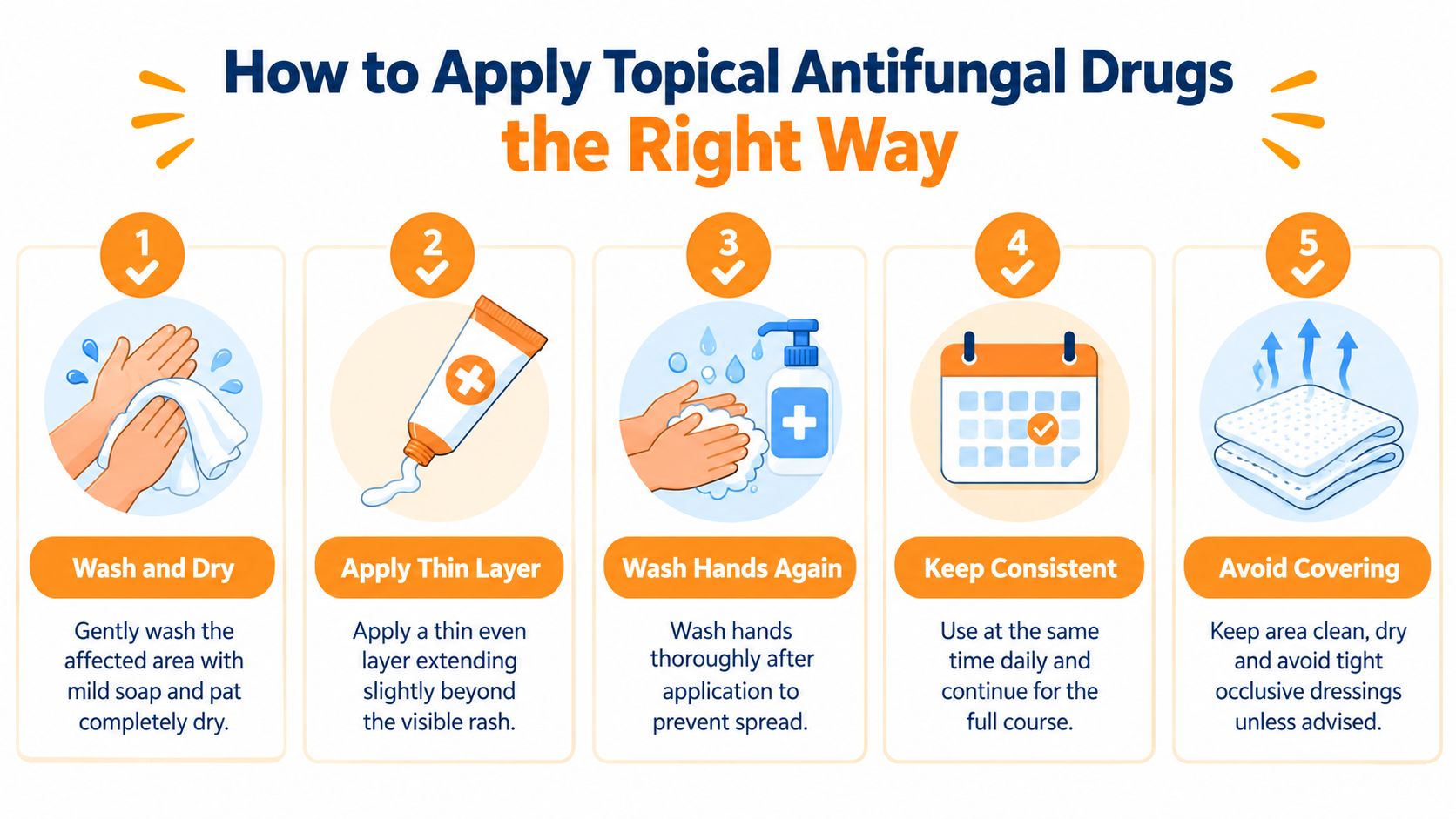
Wash the area gently, then dry it well. Take your time with skin folds and between the toes. Fungi like warmth and moisture, so a damp foot in a trainer is almost an invitation.
Then apply a thin layer to the rash and a little beyond the visible edge. Don't just dab the flaky centre.
A simple routine that works
- Clean first. Mild soap and water are fine.
- Dry properly. Pat, don't scrub.
- Apply enough. Cover the whole affected patch and nearby skin.
- Wash your hands after. That helps stop spread to other areas.
- Stick to the schedule. Same time each day helps.
Pharmacist's tip: Put your cream next to your toothbrush or phone charger. Linking it to a daily habit makes missed doses less likely.
The video below gives a quick visual guide to good application habits.
Duration matters more than most people think
For skin infection, course length depends on the ingredient and the diagnosis. In UK guidance, topical terbinafine 1% cream is typically recommended twice daily for 7 days for skin fungal infection, while clotrimazole 1% cream is a common alternative used for 1 to 2 weeks after healing. Miconazole 2% cream also appears in UK primary-care pathways.[8]
The NHS says clotrimazole infections often start improving after around 7 days, but treatment still needs to continue as directed.[6]
For nails, it's much longer. Think months, not days.
Pharmacist's tip: If the rash looks gone but the course isn't finished, keep going. Fungal infections often calm down before they clear.
Pharmacist's tip: Change socks daily, dry feet after showering, and don't share towels. Cream helps, but habits stop the infection coming back.
If you're looking at a miconazole skin option, Daktarin Cream is one example commonly used for fungal skin infection.
Safety, Side Effects and Important Interactions
Most topical antifungal drugs are well tolerated. That's the good news. The useful caution is knowing which small details matter.
Expected side effects
A bit of stinging, itching, redness, or peeling can happen where you apply the product. That's usually mild and settles. If the area becomes very sore, blistered, or suddenly much worse, stop and get advice.
Don't put these products in the eyes unless the product is designed for that use. Be cautious on broken skin too, because irritation is more likely.
The miconazole and warfarin issue
This is the interaction pharmacists are especially alert to. NHS formulary guidance flags topical miconazole, including oral gel, with an MHRA Drug Safety Update warning about a potentially serious interaction with warfarin.[2]
That means product choice isn't only about which cream works on paper. If you take warfarin, a pharmacist may prefer clotrimazole or terbinafine when clinically appropriate.
Tell the pharmacist about blood thinners before you buy an antifungal. It can change the safest option.
Pregnancy, children, and steroid combinations
If you're pregnant, breastfeeding, treating a child, or using a product on an intimate area, ask before you start. Some options are suitable in practice, but product choice should be specific.
Steroid-antifungal combinations can reduce redness and itching fast, but long use can mask infection and make the skin worse.
If you're unsure whether the rash might be bacterial, this guide to Fucidin cream and skin infections can help you understand why not every red rash needs an antifungal.
Featured snippet answer
Can antifungal cream interact with other medicines?
Usually interactions are rare with topical products, but miconazole can interact seriously with warfarin. Always mention regular medicines before buying treatment.[2]
When Ringworm Will Not Respond and Treatment Needs to Change
People often ask, “Which cream is strongest?” The better question is, when is a cream no longer enough?
Poor response doesn't always mean you chose the wrong product
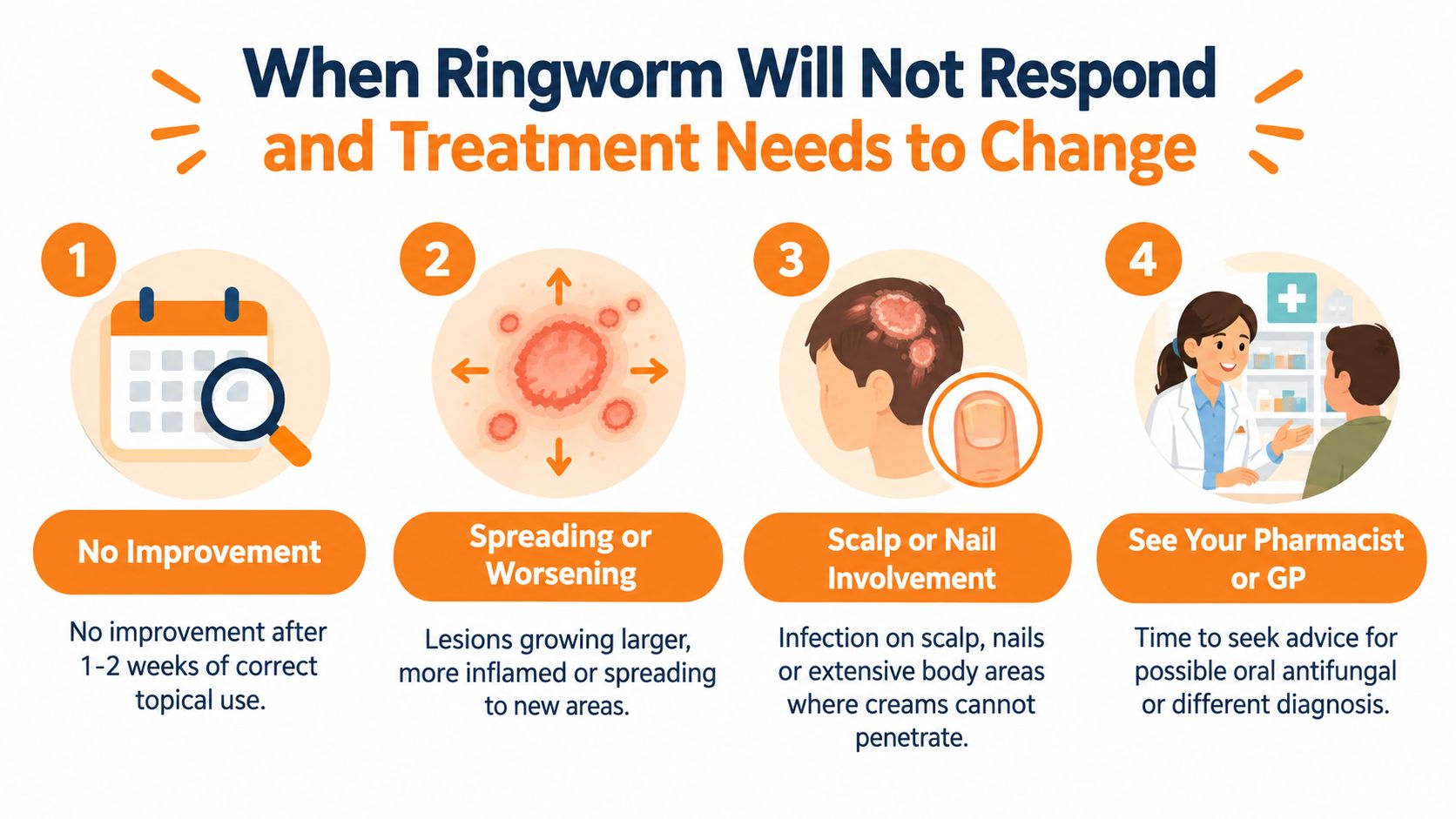
Sometimes the issue is simple. The cream wasn't used for long enough, the area stayed damp, or the diagnosis was off from the start. Eczema, psoriasis, bacterial infection, and inflamed skin folds can all mimic ringworm.
However, there's another reason this matters now. A PubMed report found Trichophyton indotineae accounted for 38% of dermatophyte isolates referred to the UK National Mycology Reference Laboratory, and NHS guidance now warns clinicians to suspect resistant dermatophytes in poor responders and request repeat culture and susceptibility testing rather than simply switching creams.[4]
Clues that should push you towards review
Ask for GP or pharmacist review if:
- The rash is spreading despite correct treatment
- The diagnosis is uncertain
- The scalp or nails are involved
- The area is very inflamed, oozing, or painful
- It keeps coming back quickly
- You're immunocompromised or have diabetes
Real-life example: A gym-goer treats a round itchy patch on the arm with an antifungal for a while, but it grows and new patches appear. That needs review for resistance, a different diagnosis, or oral treatment.
Real-life example: A parent keeps buying cream for a “ring” on a child's scalp. Scalp fungal infection needs medical assessment because creams don't penetrate well enough.
What might happen next
A GP or specialist may:
- confirm the diagnosis
- take a skin scraping or sample
- advise a different topical plan
- move to oral treatment
- look for an underlying reason the rash isn't settling
Featured snippet answer
What if ringworm isn't improving?
If you've used treatment correctly and it still isn't improving, don't keep swapping creams. You may need a different diagnosis, a culture test, or oral treatment.[4]
Your Quick Reference and Common Questions
The questions below are the ones people ask at the counter most often.
Quick reference
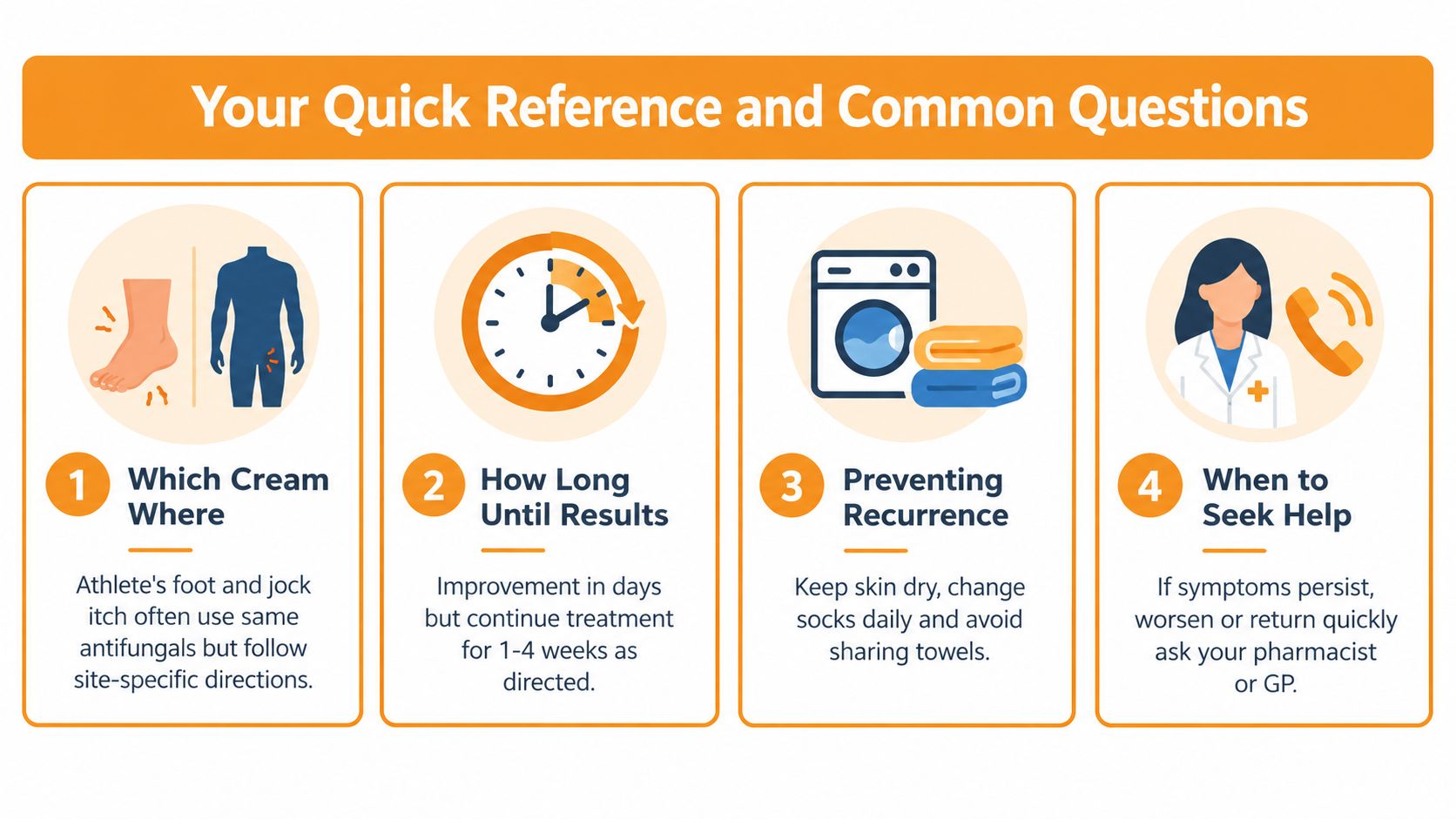
- Athlete's foot or jock itch: terbinafine or an azole may be used, depending on the pattern and product suitability
- Nail infection: expect much longer treatment and don't assume a skin cream will do the job
- Symptoms easing after a few days: that's common, but don't stop early
- Symptoms worsening, spreading, or returning fast: ask for review instead of buying another tube
Summary
Topical antifungal drugs work best when the diagnosis is right and the product matches the site of infection. Skin infections often respond to short, steady treatment, especially with terbinafine for dermatophyte rashes. Nail infections are slower and often need a different plan. Miconazole needs extra caution with warfarin. If ringworm isn't improving, don't just keep changing creams. That can be a sign you need a pharmacist, GP, or testing.
FAQs
What are topical antifungal drugs?
They're medicines applied directly to the skin, nails, or certain mucosal areas to treat fungal infection. Some kill fungi, while others stop them multiplying.
Which cream is usually better for athlete's foot?
For many dermatophyte skin infections, terbinafine is often preferred because UK guidance uses a shorter course for it.[1] However, the best choice still depends on the exact rash and your medicines.
How long does clotrimazole take to work?
The NHS says fungal infections often start to improve after around 7 days.[6] Even so, you should keep using it as directed and not go past 4 weeks unless a doctor tells you to.[6]
How long do athlete's foot treatments take?
The NHS says pharmacy antifungal medicines for athlete's foot usually take a few weeks to work.[3] Symptoms may improve before the infection fully clears.
Can I use antifungal cream on a nail infection?
Usually not in the same way you'd treat a skin rash. Nail infection often needs lacquer-based treatment for a long period, and topical therapy isn't routine for many nail cases.[7]
Is miconazole safe if I take warfarin?
You need pharmacist or prescriber advice first. NHS formulary guidance warns of a potentially serious interaction between miconazole and warfarin.[2]
When should I see a GP instead of buying a cream?
Get review if the rash is on the scalp or face, spreads quickly, looks infected, involves nails, or isn't improving with correct use. Also ask for help if you have diabetes with a foot problem or the diagnosis is unclear.
Can I stop once the rash looks better?
No, not usually. Fungal infections often look better before they're fully gone, so stopping early raises the chance of it coming back.[3]
Meta description
Topical antifungal drugs explained for UK patients. Learn which creams suit skin, nails, and thrush, how to use them safely, and when to get help.
Suggested internal links for medicalmojo.co.uk
- Athlete's foot treatment guide
- Ringworm symptoms and treatment
- Vaginal thrush treatment in the UK
- Fungal nail infection guide
- When to speak to a pharmacist about a rash
Byline
By: Medical Mojo Editorial Team
Credentials: Health writer, UK patient education content
Clinical review: Reviewed by a UK-registered pharmacist
Credentials: GPhC-registered pharmacist
How this content was created
This article was written using UK-focused NHS and peer-reviewed sources, then checked for clinical accuracy and patient-friendly wording. A pharmacist reviewer checked the safety points, treatment timelines, and referral advice.
References
[1] NHS Forth Valley (n.d.) Fungal skin infection. Available at: https://www.rightdecisions.scot.nhs.uk/antimicrobial-prescribing-nhs-forth-valley/primary-care-guidance/skin-infections/fungal-skin-infection/
[2] Greater Manchester Medicines Management Group (2025) Chapter 13 formulary guidance. Available at: https://gmmmg.nhs.uk/wp-content/uploads/2025/02/Chapter-13-v7.6-February-2025.pdf
[3] NHS (n.d.) Athlete's foot. Available at: https://www.nhs.uk/conditions/athletes-foot/
[4] PubMed (2024) Report on resistant dermatophytes and Trichophyton indotineae in the UK. Available at: https://pubmed.ncbi.nlm.nih.gov/39714510/
[5] NHS Somerset (2026) Managing common infections. Guidance for primary care. Available at: https://nhssomerset.nhs.uk/wp-content/uploads/sites/2/Managing-common-infections-Guidance-for-Primary-Care-March-2026-v2.0.pdf
[6] NHS (n.d.) About clotrimazole cream, spray and solution. Available at: https://www.nhs.uk/medicines/clotrimazole/about-clotrimazole-cream-spray-and-solution/
[7] PubMed (2022) Onychomycosis in UK primary care. Available at: https://pubmed.ncbi.nlm.nih.gov/35665209/
[8] Oxford University Hospitals (n.d.) Dermatophyte infection guidance. Available at: https://ouh.quris.com/hospital-guidelines/adult-antimicrobial-guide/empiric-treatment/fungal-infections-mycology/dermatophyte-infection/
If you want a pharmacist-reviewed route to common antifungal treatments, Courier Pharmacy offers online access to a range of OTC and prescription options where appropriate. You can check treatment pages, complete a secure questionnaire, and get advice on whether a cream is suitable or whether your symptoms need a different plan.


