UTI Infection Antibiotics: UK Treatment Guide 2026
Discover which UTI infection antibiotics work best in the UK. Learn about first-line treatments, dosing, resistance risks, and when to seek urgent help.

SEO brief
- Primary keyword: uti infection antibiotics
- Secondary keywords: UTI antibiotics UK, nitrofurantoin, trimethoprim, fosfomycin, pivmecillinam, urinary tract infection treatment
- Search intent: Find safe, practical UK guidance on when antibiotics help, which antibiotics are used first, and when to seek urgent care
- Target reader: UK adults with UTI symptoms, carers, and people considering online pharmacy treatment
- Product/service mention: Courier Pharmacy online UTI assessment and treatment
- Internal links available: Courier Pharmacy cystitis page, nitrofurantoin product page, trimethoprim product page, recurrent cystitis page, online pharmacy page
A UTI can start with nothing more than a burning pee and a nagging feeling that something's off. Then the big question lands fast, do you need antibiotics, and if so, which one? For many people, the answer depends on whether this is a simple bladder infection, a possible kidney infection, or a repeat problem with resistance in the background. UTI infection antibiotics are common in UK primary care, but the right choice isn't the same for everyone. [1]
Five key takeaways
- Not every urinary symptom needs antibiotics, but fever, back pain, pregnancy, or worsening symptoms need prompt review.
- Nitrofurantoin is usually first-line for uncomplicated lower UTI in eligible non-pregnant women with adequate kidney function. [3]
- Short courses matter, because uncomplicated UTI is usually treated for days, not weeks. [6]
- Resistance changes the game, especially if UTIs keep coming back. [2] [4]
- Online pharmacy care can be safe, if a human prescriber checks the questionnaire and your red flags first.
Understanding UTI Symptoms and When Antibiotics Help
Sarah, a busy parent, notices a burning sting every time she pees. She's also running to the loo more often, and the urine smells stronger than usual. That's the sort of moment where people reach for the internet and ask a very fair question, do I need UTI infection antibiotics right now?
Common symptoms to look out for
The usual lower UTI symptoms are pretty familiar, burning when you pass urine, needing to pee often, passing only small amounts, cloudy urine, and pelvic discomfort. Some people also notice blood in the urine. Those symptoms fit bladder irritation, but they don't automatically tell you how severe the infection is.
Practical rule: urinary symptoms plus fever, back pain, or vomiting are no longer “just a bladder issue”, they need quicker medical review.
A simple bladder infection can sometimes settle with fluids, pain relief, and watchful waiting if symptoms are mild and improving. But symptoms that are getting worse, or that come with feeling unwell, are different. If you're unsure, a pharmacist or GP can help sort out whether this looks like a lower UTI, a kidney infection, or something else entirely.
What to do in the first day
If you've got mild symptoms and no red flags, drink water, avoid alcohol and caffeine, and use standard pain relief if you normally take it safely. If symptoms aren't settling, or they keep recurring, don't keep guessing. The treatment path for a one-off mild bladder infection is very different from the approach to recurrent infection, which has its own patient advice on recurrent cystitis.
Pharmacist's tip: if you're struggling to tell whether it's a UTI, say the symptoms out loud in plain terms, burning, frequency, blood, fever, back pain. That usually helps the next clinician triage you quickly.
For many people, the key is not panic, but pattern recognition. A stingy pee, by itself, is common. A stingy pee plus fever and flank pain is not something to sit on.
Lower vs Upper UTI Why the Difference Matters
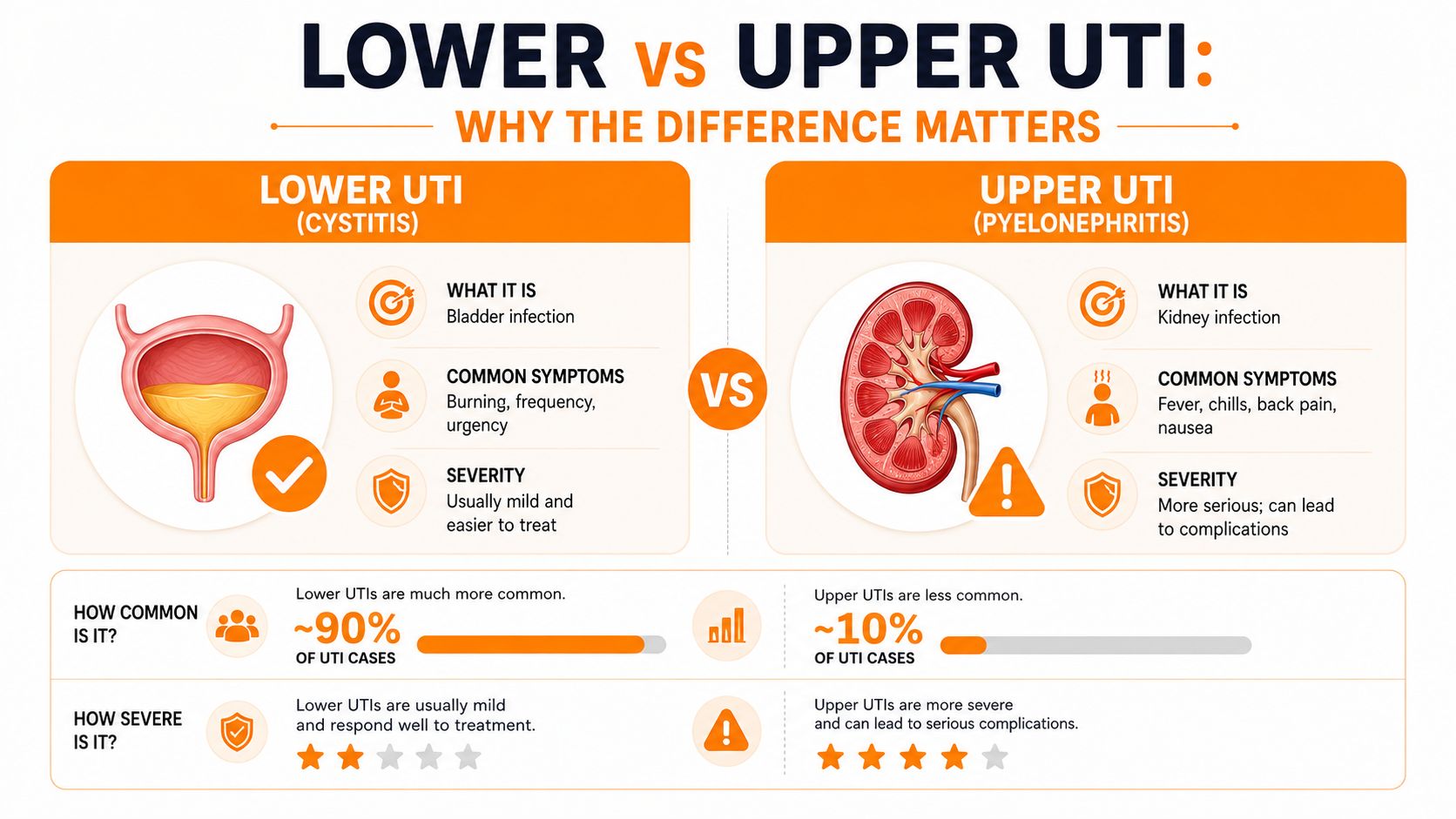
An infection in the bladder needs a different level of response from one that's reached the kidneys. That's why the lower versus upper UTI split matters so much in real life. It changes the urgency, the expected course, and sometimes the antibiotic choice.
What lower UTI usually feels like
Lower UTI, often called cystitis, usually stays around the bladder. People tend to describe burning on passing urine, needing to urinate often, pressure low in the pelvis, and sometimes blood in the urine. It can feel miserable, but it usually doesn't make you systemically unwell.
What upper UTI can look like
Upper UTI is more worrying because the infection has moved higher up. Fever, back or flank pain, chills, nausea, or vomiting are the clues that matter most. If someone has these symptoms, they need prompt assessment, because kidney infection can become serious quickly.
If symptoms include fever and back pain, don't treat it like routine cystitis.
The distinction matters because lower UTI is often managed with a short oral course, while upper UTI may need closer monitoring, culture testing, or hospital treatment if the person is very unwell. In practice, clinicians ask about fever, pain location, and how sick you feel because those details help decide whether home treatment is reasonable.
If you're speaking to a pharmacist or doctor, give a clean symptom summary. Say whether the pain is in the bladder area or the back, whether you've had fever, and whether you've been sick. That information often matters more than the exact word “UTI”.
Quick comparison table
| Feature | Lower UTI | Upper UTI |
|---|---|---|
| Main area | Bladder | Kidneys |
| Common symptoms | Burning, frequency, pelvic pressure | Fever, back pain, nausea, chills |
| Usual severity | Often less severe | More serious |
| Usual response | Short oral treatment if needed | Needs prompt clinical assessment |
First-Line UTI Antibiotics in the UK
For uncomplicated lower UTI, UK practice usually starts narrow and stays narrow when it can. That helps match the medicine to the infection without using a broader drug than needed. The main point is simple, the first antibiotic is chosen for the person and the likely bug, not just for convenience. [3] [7]
The main options used first
For most eligible non-pregnant women with adequate kidney function, nitrofurantoin is the usual first choice in UK primary care. It works well for bladder infection because it concentrates in urine, which is exactly where the infection sits. In practice, it's often given as a short course, and UK guidance also supports short community courses for suitable patients. [3] [6]
The other first-line names you'll hear are trimethoprim, fosfomycin, and pivmecillinam. Fosfomycin is useful because it can be given as a single dose in some regimens, while pivmecillinam becomes useful when resistance to the more common options is a problem. [5] [6] [7]
Pharmacist's tip: if you're handed an antibiotic you've never heard of, ask whether it's first-line for your exact situation, or a fallback because of kidney function, allergy, pregnancy, or resistance.
UK First-Line UTI Antibiotics Comparison
| Antibiotic | Typical duration | When preferred | Key considerations |
|---|---|---|---|
| Nitrofurantoin | 5 days in common uncomplicated regimens [6] | First-line for many non-pregnant women with adequate kidney function [3] | Best for bladder infection, not kidney infection |
| Trimethoprim | 3 days in some uncomplicated regimens [6] | When local resistance and patient factors make it suitable | Not ideal everywhere because resistance can be an issue [4] |
| Fosfomycin | Single dose in some regimens [6] | When a short regimen is needed or other options don't fit | Useful alternative in selected cases |
| Pivmecillinam | Short course, often around 3 days or more depending on regimen [5] [7] | When usual first-choice drugs aren't suitable | Often comes up when resistance is higher |
A useful contrast is what not to reach for first. Fluoroquinolones have been heavily used in UTI care, but that doesn't make them the best everyday choice for simple cystitis. UK stewardship reviews show how strongly UTI treatment has leaned on antibiotics overall, which is exactly why narrow, sensible prescribing matters. [1]
If you're looking for a specific medicine page, nitrofurantoin MR 100 mg capsules are commonly discussed in UK UTI treatment pathways.
Antibiotic Resistance and Why Culture Testing Matters
Repeated UTIs can train bacteria to dodge the same drugs again and again. That's the practical reason people with recurring infections often need a urine culture rather than another blind guess. In a large study of 148,994 people with culture-confirmed uncomplicated UTI, 19% had another culture-confirmed infection later, and resistance increased over time, with resistance to three or more classes rising from 13% to 20% by the sixth UTI. [2]
Why the lab result changes treatment
A urine culture tells the prescriber what grew and what it reacts to. That matters because not every antibiotic covers every strain. UK resistance data show high resistance in E. coli to amoxicillin-clavulanate (33.1%), trimethoprim-sulfamethoxazole (32.41%), and levofloxacin (32.06%), while fosfomycin (96.55%) and nitrofurantoin remain much stronger options in many cases. [4]
That pattern explains why a repeat antibiotic isn't always the right answer. If symptoms don't fit the usual story, or if you've had UTIs before, your clinician may want a sample before changing treatment. Culture-guided care reduces the chance of giving the same drug that bacteria have already learned to beat.
What patients should do
- Finish the prescribed course: stopping early can leave the strongest bacteria behind.
- Send the sample when asked: even if you're starting treatment, the culture can still guide changes.
- Mention recent antibiotics: this helps the prescriber avoid repeating a drug that may already have failed.
- Expect changes if needed: switching treatment isn't a mistake, it's often the right response to the lab result.
Practical rule: improvement in how you feel doesn't always mean the antibiotic is the right one, it may just mean the infection is temporarily quieter.
If your UTI keeps coming back, that's the moment culture testing becomes much more valuable. It turns treatment from guessing into targeted care.

Safety Considerations Pregnancy, Allergies, and Kidney Function
A good prescriber will ask questions that feel a bit nosy at first, then suddenly make perfect sense. That's because antibiotic choice for UTI depends on more than symptoms. Kidney function, pregnancy, and allergies can all change what's safe and what isn't.
Kidney function comes first
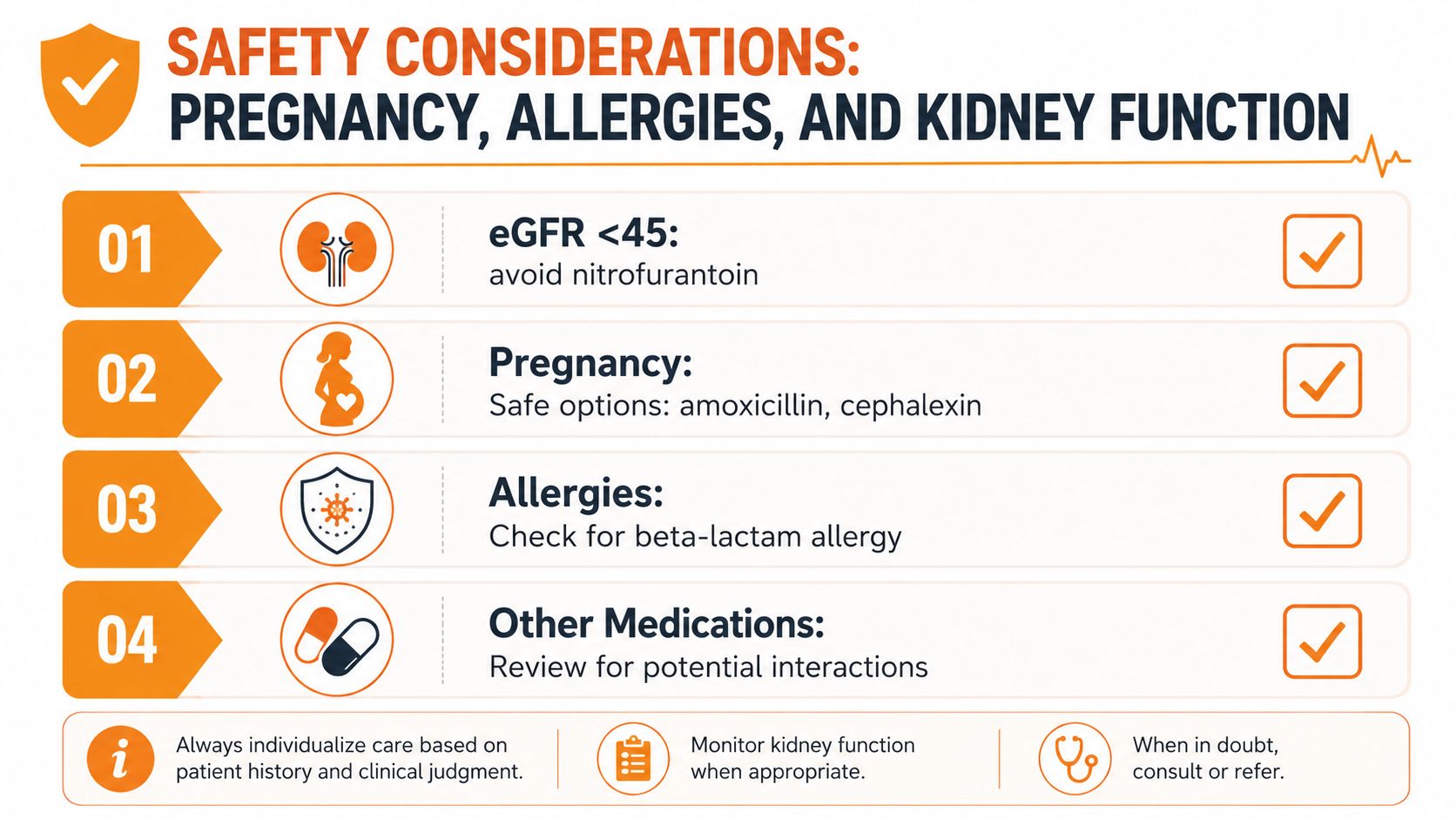
UK guidance recommends nitrofurantoin only if eGFR is at least 45 ml/min, with pivmecillinam or fosfomycin as alternatives when nitrofurantoin isn't a fit. [5] If you have reduced kidney function, the medicine may not reach the right level in urine, so the clinician has to choose differently. That's not over-cautious, it's proper prescribing.
Pregnancy and allergy shape the choice
Pregnancy changes the balance again. Some antibiotics are fine in pregnancy, but the prescriber still needs to match the drug to the trimester and the situation. Allergy history matters too, especially with beta-lactam medicines, because a rash years ago and a true immediate allergy are not the same thing.
If you've got multiple medication allergies, don't guess, list them clearly. A brief, accurate history often prevents the wrong antibiotic being chosen. Drug interactions can matter too, especially if you take regular long-term medicines, so the pharmacy or GP should always check your current list.
Pharmacist's tip: bring a full medicine list, including supplements and over-the-counter tablets. The safest UTI prescription often depends on one small detail you nearly forgot to mention.
A couple of real-world examples
A shift worker with kidney disease may be offered a different UTI antibiotic from a healthy 28-year-old, even if their symptoms sound the same. A pregnant woman with cystitis will also be treated more cautiously than someone who isn't pregnant. That's the logic behind the questions, not a lack of urgency.
For a trimethoprim example page, see trimethoprim 200 mg tablets.
When Antibiotics Are Needed vs When to Wait
A gym-goer starts to notice burning and frequency on a Friday evening. No fever, no back pain, and they're still drinking normally. In that kind of case, a short period of self-care while watching symptoms closely can be reasonable if the person is otherwise well.
When waiting can be reasonable
If symptoms are mild, confined to the bladder, and seem to be settling, immediate antibiotics are not always essential. Drinking water, resting, and using normal pain relief can help while you see whether things improve. That approach only works when the person is not pregnant, not unwell, and not showing red flags.
When antibiotics should move to the front of the queue
Fever, back pain, vomiting, blood in urine, or worsening symptoms change the picture. So do pregnancy, diabetes, and symptoms that have gone on or worsened after about 48 hours. At that point, the balance shifts towards prompt assessment and treatment rather than more waiting.
The same applies if you've had recurrent infections or a previous antibiotic didn't help. That's a clue to ask for review rather than repeat the same plan. If you want a practical patient page on repeat infection, the cystitis information for recurrent symptoms is a useful starting point.
Self-care that actually helps
- Drink water: it can ease irritation and help keep urine flowing.
- Use simple pain relief: paracetamol or ibuprofen can help if you normally take them safely.
- Avoid bladder irritants: caffeine and alcohol can make symptoms feel worse.
- Don't ignore fever or flank pain: those aren't watch-and-wait symptoms.
A UTI that is improving should feel less urgent to pee, less stingy, and less heavy in the bladder. If it's doing the opposite, it needs review.
The key is not to over-treat mild symptoms, but not to under-react to serious ones. That's the line that keeps treatment sensible and safe.
How Online Pharmacy Services Support Safe UTI Treatment
A regulated online pharmacy can be a practical route for straightforward UTI care if it is run properly. The safe version is not a button that spits out antibiotics. It starts with a clinical check, a human review, and a prescription only when the symptoms fit.
A secure online service should begin with a proper assessment. You complete a questionnaire, then a prescriber reviews your symptoms, allergies, regular medicines, pregnancy status, and other risk factors. If the pattern sounds like uncomplicated cystitis and there are no red flags, treatment can be prescribed without a face-to-face visit. That suits people who cannot easily get to a GP during work hours, and people who want a discreet route to care. Visit our online pharmacy service to start a secure assessment.
Courier Pharmacy uses this model for online pharmacy treatment, with human prescriber review and the usual safeguards you would expect from a regulated service. It is one option among several, and it does not replace urgent in-person care when you are unwell.
What good safety checks should include
A proper service should screen for fever, flank pain, pregnancy, and recurrent infection. It should also ask about kidney function and drug allergies before deciding on a medicine. If the answers suggest a more serious infection, the right move is referral, not quick dispensing.
Practical rule: if an online form does not ask about red flags, it is not doing enough.
Follow-up also matters. Courier Pharmacy says it offers free follow-up calls after antibiotic treatment, which can help if symptoms are not settling as expected. That kind of check is useful when someone is unsure whether recovery is normal or whether they need a second look.
Your Next Steps Getting the Right Treatment
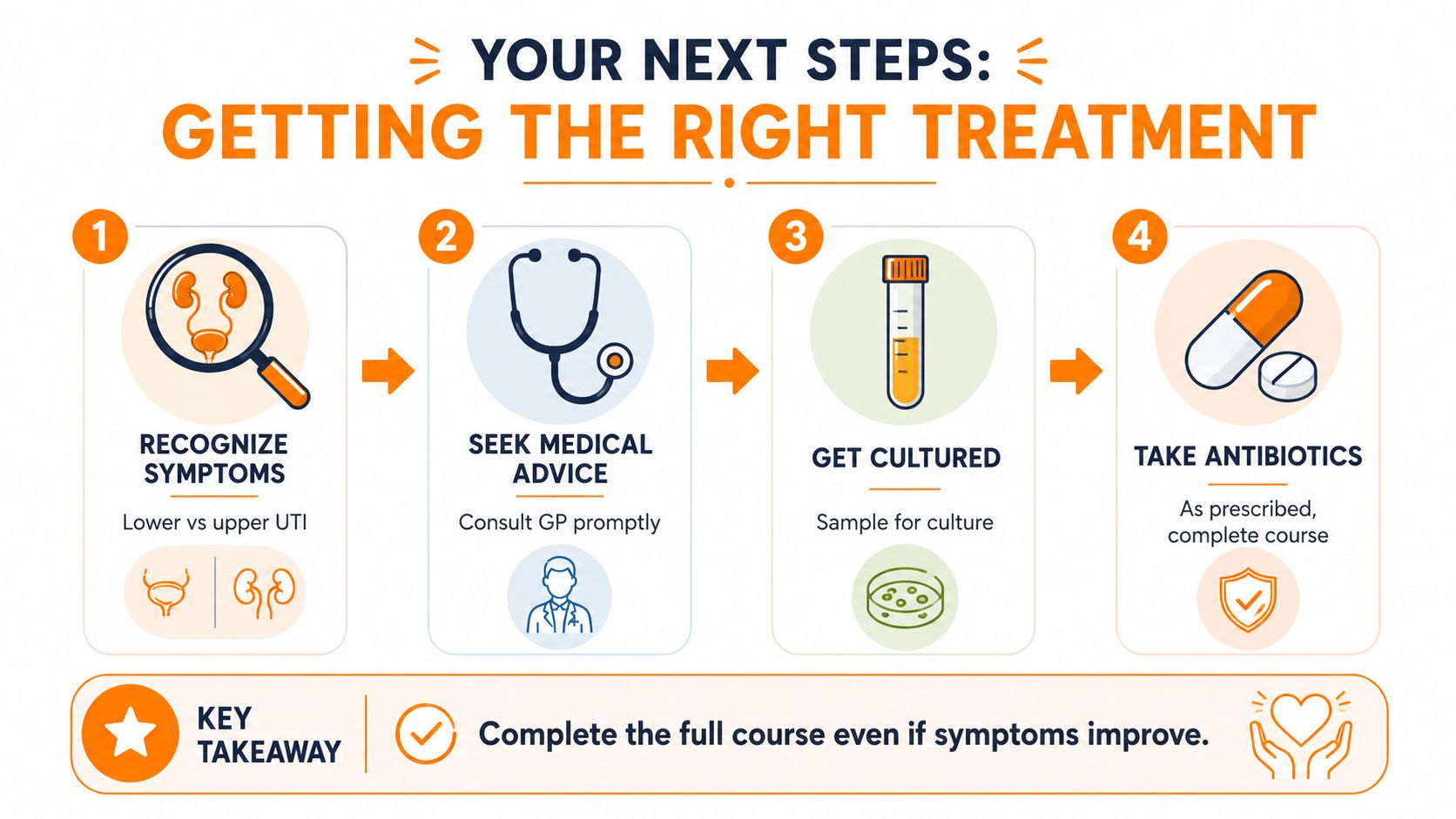
If you think you've got a UTI, start by matching the symptoms to the pattern. Burning, frequency, and pelvic pressure usually point to a lower UTI. Fever, back pain, nausea, or feeling properly unwell push it into urgent territory.
A simple way to move forward
First, decide whether this looks like a bladder infection or something higher up. Next, check whether antibiotics are needed now or whether short self-care makes sense. Then make sure the chosen antibiotic fits your kidney function, pregnancy status, and allergy history.
Keep the treatment tight and sensible
Short courses are standard for uncomplicated UTI, and the right one depends on the person, not just the label on the box. If a clinician asks for a urine sample, give it. If they change the antibiotic after the culture result, that's usually because the lab has given them a better answer than symptoms alone.
Prevention habits that help
- Drink enough fluids through the day.
- Pee after sex if that's a trigger for you.
- Wipe front to back to reduce bacterial spread.
- Avoid irritating products that can upset the area.
Most uncomplicated UTIs improve with the right short course and a bit of common-sense care. The main mistake is either ignoring warning signs or treating every urinary symptom like an emergency.
If you want a discreet, UK-regulated route to assessment and treatment, Courier Pharmacy can review your symptoms online and advise on suitable options where appropriate. Visit Courier Pharmacy to explore the service, compare treatment routes, and get support that fits the way you live.
Summary
UTIs are common, but the right treatment depends on the type of infection. Lower UTI often stays in the bladder, while upper UTI can affect the kidneys and needs faster action. Nitrofurantoin is usually the first choice for eligible patients with uncomplicated lower UTI in the UK. Resistance is a real issue, especially with repeated infections, so urine cultures matter more when symptoms keep coming back. Safety checks around pregnancy, allergies, and kidney function change the antibiotic choice. If you're unsure, get assessed rather than guessing.
FAQs
Do I always need antibiotics for a UTI?
No, not always. Mild bladder symptoms can sometimes improve with fluids and pain relief, but worsening symptoms, pregnancy, fever, or back pain need medical review. Antibiotics are more likely to help when the infection is clearly bacterial and not settling.
What is the usual first antibiotic for UTI in the UK?
For many non-pregnant women with adequate kidney function, nitrofurantoin is the usual first choice. Trimethoprim, fosfomycin, and pivmecillinam can also be used in the right situation. The prescriber chooses based on symptoms, safety, and local resistance.
How long do UTI antibiotics usually take?
Uncomplicated UTI is usually treated with a short course, not a long one. Common regimens include 3-day, 5-day, or single-dose options depending on the antibiotic. Men may need a longer course than women in some guidance. [6]
Why would my doctor ask for a urine culture?
A urine culture helps identify the bacteria and which antibiotic it should respond to. It matters more if you've had recurrent UTIs, treatment failure, or symptoms that don't fit simple cystitis. The result can stop you being given the wrong drug twice.
Can I use nitrofurantoin if I have kidney problems?
Not always. UK guidance recommends nitrofurantoin only when eGFR is at least 45 ml/min. If kidney function is lower, the prescriber may choose another antibiotic such as fosfomycin or pivmecillinam. [5]
Is an online pharmacy safe for UTI treatment?
Yes, if it uses a proper clinical questionnaire and a human prescriber review. It should also screen for red flags like fever, back pain, pregnancy, and recurrent infections. If those are present, you need in-person assessment rather than routine online treatment.
When should I get urgent help?
Get urgent help if you have fever, back or flank pain, vomiting, pregnancy with UTI symptoms, or you feel seriously unwell. Those signs can point to a kidney infection or a more complicated problem. Don't wait for it to “just pass”.
What should I do if my symptoms improve before I finish the antibiotics?
Keep taking them as prescribed. Stopping early can let the infection return and may favour resistant bacteria. If you're unsure about side effects or lack of improvement, contact the prescriber.
What helps prevent repeat UTIs?
Drink enough fluids, urinate after sex, wipe front to back, and avoid irritating products that upset the area. If UTIs keep coming back, ask for a proper review rather than repeating the same approach. Recurrent infections often need a more targeted plan.
Can a UTI get better without treatment?
Sometimes mild lower UTI symptoms improve on their own, but that's not the case for everyone. If symptoms worsen, last more than 48 hours, or you develop fever or back pain, you shouldn't keep waiting. Getting checked is safer than hoping.
How this content was created
This article was written using UK clinical guidance, peer-reviewed stewardship data, and the product and service information supplied for Courier Pharmacy. It was then reviewed for practical safety points, especially around symptom red flags, first-line antibiotic choices, resistance, and kidney function.
References
- Paper on UTI antibiotic use and stewardship in UK primary care. Available at: https://pmc.ncbi.nlm.nih.gov/articles/PMC8404614/
- J Infect Dis study on recurrent uncomplicated UTI and rising resistance. Available at: https://academic.oup.com/jid/article/230/6/e1344/7672932
- European Association of Urology, Guidelines on Urological Infections 2024. Available at: https://d56bochluxqnz.cloudfront.net/documents/full-guideline/EAU-Guidelines-on-Urological-Infections-2024.pdf
- Review of UTI antimicrobial resistance patterns. Available at: https://pmc.ncbi.nlm.nih.gov/articles/PMC10820678/
- NICE guideline NG109 recommendations. Available at: https://www.nice.org.uk/guidance/ng109/chapter/recommendations
- Rapid evidence review on UTI treatment durations. Available at: https://pubmed.ncbi.nlm.nih.gov/37922147/
- StatPearls, uncomplicated UTI antibiotic options. Available at: https://www.ncbi.nlm.nih.gov/books/NBK470195/
- Rapid evidence review on UTI regimens in men. Available at: https://pubmed.ncbi.nlm.nih.gov/38393801/
Byline: Written by a UK pharmacy content specialist
Clinical review: Reviewed by a UK-registered pharmacist
Suggested visuals
- UTI symptom checklist card, bright lime green and pale yellow-green palette, ornate brass plaque overlay. Alt text, “Checklist of common UTI symptoms and warning signs.”
- Bladder versus kidney comparison graphic, painterly steampunk style with light grey background. Alt text, “Comparison of lower and upper UTI symptoms and urgency.”
- Antibiotic choice flowchart, brass-framed with simple decision points. Alt text, “Flowchart showing how kidney function, pregnancy, and allergies affect UTI antibiotic choice.”
- Online pharmacy assessment mock-up, discreet packaging and questionnaire visual. Alt text, “Illustration of a secure online pharmacy UTI assessment process.”
Disclaimer: This article is for information only and isn't a substitute for medical advice. If you have fever, back pain, vomiting, are pregnant, or feel very unwell, get urgent clinical help.


