Weight Gain on Mini Pill: What the Evidence Says
Weight Gain on Mini Pill. Does the mini pill cause weight gain? Discover what UK clinical guidance and real patient experiences reveal, plus practical
The evidence does not support a clear causal link between the mini pill and significant weight gain. However, some users report weight changes, and most studies found average gains of less than 2 kg over 12 months.
You may be wondering about this after noticing tighter clothes, a different number on the scales, or a change in appetite. Perhaps you're a busy parent taking the mini pill between school runs, or a shift worker trying to make sense of changes during irregular hours. Timing can feel convincing, but it doesn't prove the pill caused the change.
This guide explains what UK clinical guidance says, why the mini pill differs from the contraceptive injection, how to monitor changes sensibly, and when to speak with a clinician.
- Weight gain on the mini pill isn't clearly proven to be caused by the pill.
- Most studies found average changes below 2 kg over 12 months.
- The contraceptive injection has stronger links with weight gain than oral mini pills.
- Track weight, waist, food, activity, and timing for around three to six months.
- Seek medical advice for rapid or substantial gain, swelling, fatigue, or menstrual changes.
The Mini Pill and Weight Gain Question
You start the mini pill, step on the scales a few weeks later, and the number has gone up. It is completely reasonable to wonder whether the two are linked, especially if life has felt otherwise unchanged. For many people, though, the picture is not that simple.
UK guidance gives a reassuring starting point. The progestogen-only pill, often called the mini pill, is not clearly proven to cause significant weight gain. The NHS notes that some people do report weight gain, but there is not enough evidence to show that the mini pill itself is the cause NHS guidance on mini pill side effects.

Why timing can mislead
Our brains are very good at spotting patterns. If weight changes soon after starting a tablet, it can feel like clear proof. In medicine, timing is a clue, not a conclusion.
Weight shifts for many reasons, often at the same time as contraception changes. Sleep disruption, stress, changes in appetite, less activity, the menopause transition, illness, and recovery after pregnancy can all play a part. That is one reason this topic causes so much confusion in clinic.
A useful way to look at it is this. An individual report tells you what happened to one person. A population pattern shows whether the same effect appears consistently across many people. Someone may notice weight gain after starting desogestrel or another oral progestogen-only pill, while research still fails to show a clear causal pattern for oral mini pills overall.
This distinction matters even more because the mini pill is often blurred together with the contraceptive injection, which is a separate method and should not be treated as evidence about the pill in tablet form.
If you are worried about contraception or period management, check exactly which medicine you are using. For example, norethisterone 5mg tablets for period control are different from a contraceptive mini pill, and they are not interchangeable.
Practical rule: Use timing as a prompt to monitor symptoms carefully, and seek help sooner if weight gain is rapid, marked, or comes with swelling, fatigue, or changes in bleeding.
What UK Clinical Guidance Says
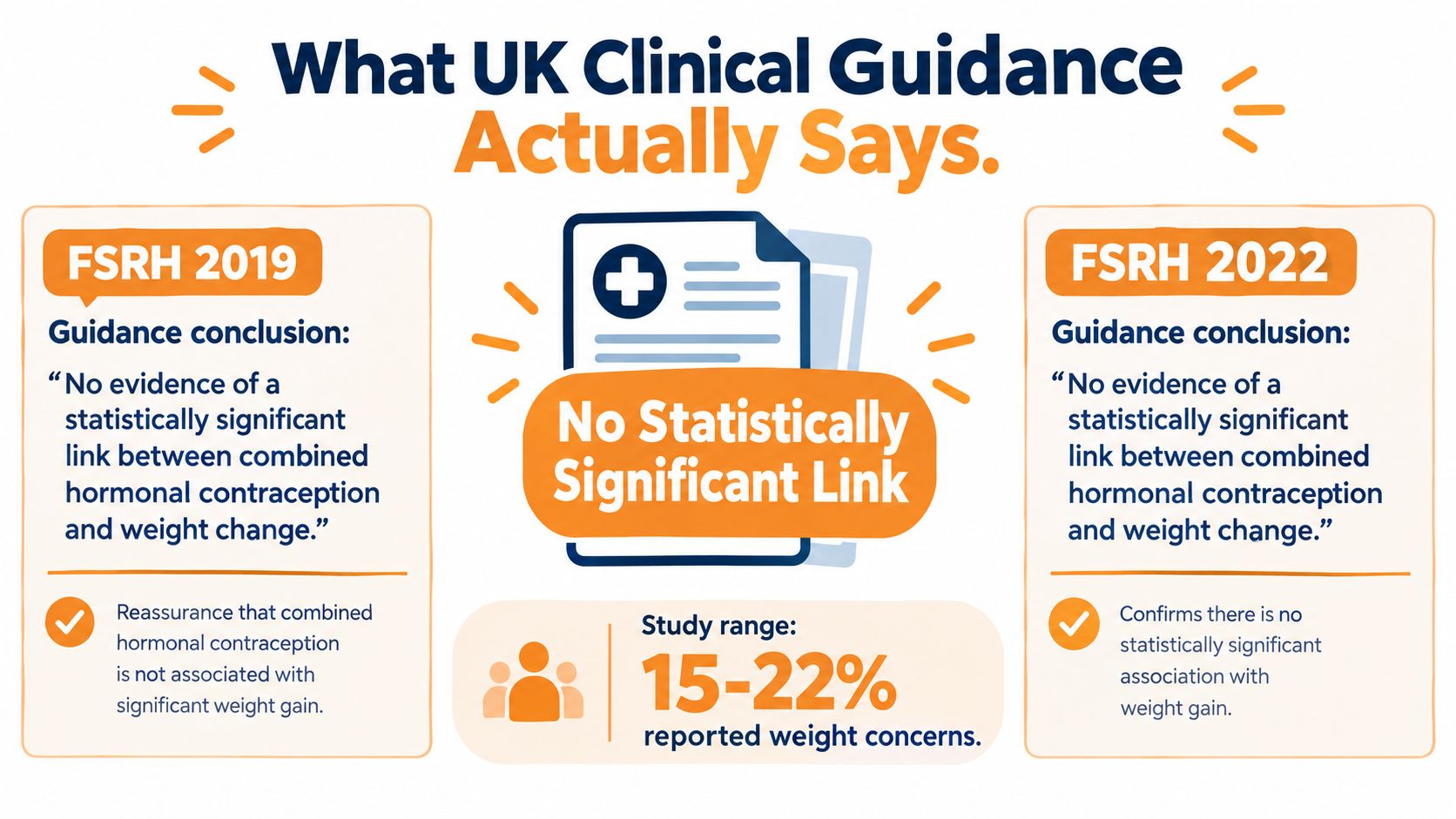
UK clinical guidance takes a careful, measured view. The Faculty of Sexual and Reproductive Healthcare, or FSRH, reviewed the evidence on progestogen-only pills in its 2019 guidance. That review drew on a Cochrane analysis of 16 randomised controlled trials and found that, in most studies of progestogen-only contraception, average weight gain stayed below 2 kg over 12 months FSRH clinical guidance.
Averages need context. They describe what happened across groups, not what one person will feel in their own body. Some people in those studies gained weight, some lost weight, and some saw little change. The overall conclusion was that the evidence did not support a clear causal association between the mini pill and weight change.
What newer guidance adds
The updated FSRH guidance discusses a small prospective study of 42 perimenopausal users of a desogestrel mini pill and 26 perimenopausal women not using hormonal contraception. After 12 months, average body weight had increased by 0.3 kg in the mini pill group and fallen by 0.2 kg in the comparison group. The difference was not statistically significant updated FSRH guidance.
The same study reported a statistically significant 2.8% increase in fat mass in the mini pill group, compared with a 0.5% decrease in the comparison group. That may sound worrying at first glance, but the study was small, observational, and limited to perimenopausal women. It cannot be treated as a rule for everyone who takes the mini pill in the UK.
Medical wording can trip people up here. Statistical significance means a result is unlikely to be due to chance within that study. It does not automatically mean the change was large, harmful, or definitely caused by the pill in every individual.
The NHS uses cautious language for the same reason. Weight gain is something people may report on the mini pill, but the evidence is still too limited to say with confidence that the pill itself is the cause.
Why the uncertainty? Studies often group together different progestogen-only methods, different pills, and different groups of women. Age, reproductive stage, health, activity, and everyday life can all affect weight over the same months that someone starts contraception.
So the most sensible reading is a calm one. Your own experience matters, but it should be reviewed in context, and it should not be assumed to mean the tablet works like the contraceptive injection. If your weight is changing, a simple record of timing, symptoms, and bleeding pattern often gives a much clearer picture than one measurement alone.
Mini Pill Versus Contraceptive Injection
A lot of confusion starts here. People hear “progestogen-only” and assume the mini pill and the injection behave much the same way in the body. They do not.
The contraceptive injection uses depot medroxyprogesterone acetate, or DMPA. It releases medicine over time after an injection, which is very different from taking a daily mini pill. In a systematic review of progestogen-only contraception, DMPA was the progestogen-only method most consistently linked with weight gain. Other progestogen-only methods did not show the same consistent pattern in the reviewed studies.
That distinction helps in real life. If someone put on weight while using the injection, it does not automatically follow that they will gain weight on desogestrel or norethisterone tablets. The route of delivery, the specific progestogen, your age, your starting weight, everyday habits, and how long you have used the method can all affect what happens.
| Contraceptive method | Average weight change | Evidence strength |
|---|---|---|
| Oral mini pill | Most studies report an average increase below 2 kg over 6–12 months | No clear causal link |
| Contraceptive injection | Weight effects appear more pronounced than with oral methods | Stronger association |
| Norethisterone mini pill | No statistically significant difference compared with levonorgestrel in a small comparison | Limited evidence |
| Desogestrel mini pill | Individual changes can occur, but population evidence doesn't show significant gain | Limited and mixed evidence |
One small comparison often gets overlooked. The evidence on norethisterone versus levonorgestrel weight change found no statistically significant difference after six months between norethisterone 350 micrograms and levonorgestrel 30 micrograms. That does not prove nobody gains weight on either pill. It means the study did not show a clear difference between them.
So, changing from one oral mini pill to another just to avoid weight gain is not strongly supported by evidence alone. A GP or contraceptive clinician would usually look at the bigger picture, including bleeding pattern, side effects, missed-pill risk, and whether the timing of the weight change suggests another cause.
If you are comparing products, medroxyprogesterone tablets are also a different medicine from the contraceptive injection and from the oral mini pill.
Practical Weight Monitoring and Management
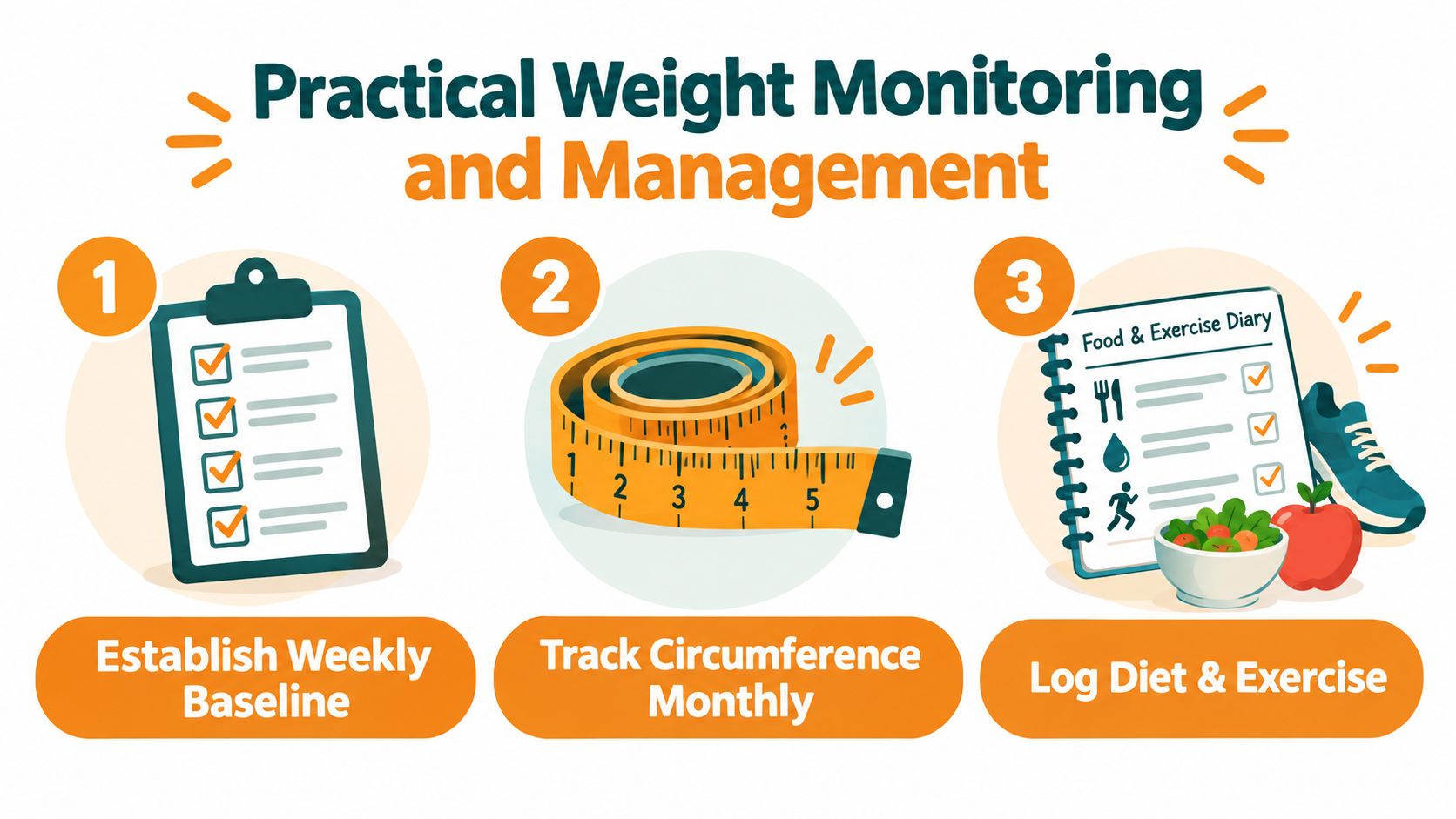
A single weigh-in can be misleading. Weight can shift from one day to the next because of fluid balance, meals, bowel movements, clothing, or where you are in your cycle. If you started the mini pill and then noticed a change, the helpful question is not “what happened today?” but “what has been happening over time?”
Build a simple baseline
A baseline gives context. It helps you and your clinician separate a temporary fluctuation from a sustained pattern, and it matters even more because the mini pill is often confused with the contraceptive injection, which has a different evidence profile for weight change.
Before deciding the pill is the cause, record:
- Weight: Use the same scales, at a similar time of day, in similar clothing.
- Waist circumference: Measure at the same point each time.
- Food and drink: Note clear changes in appetite, snacking, or meal routine.
- Activity: Include work activity, walking, gym sessions, and usual movement.
- Timing: Write down when you started the pill and when the change began.
A structured review over three to six months is usually more useful than reacting to one increase. You do not need a spreadsheet. A note on your phone is enough if you keep it consistent. If you work shifts, it can help to log sleep and meal timing beside each weigh-in. If you have started exercising more, note that too, because body composition can change even when the number on the scale moves very little.
Pharmacist's tip: Weigh under similar conditions, such as in the morning before breakfast. Look for a trend, not a single reading.
Make manageable changes
Harsh diets and punishing exercise plans rarely last. Small changes are easier to keep up with and easier to judge fairly while you are also working out whether the mini pill is playing any part.
Try practical steps that fit ordinary life:
- Plan filling meals before a long shift.
- Keep convenient foods with protein and fibre at home or work.
- Add regular walking to school runs or commuting.
- Protect sleep where your routine allows.
- Notice whether stress is changing how or when you eat.
If weight changes are bothering you, support with weight management can be useful, but it should sit alongside a proper review of symptoms and your contraception choices.
Pharmacist's tip: Do not stop the mini pill without arranging another contraceptive method if avoiding pregnancy matters to you.
Pharmacist's tip: Ask for a review if appetite changes persist, bleeding changes sharply, or your weight is rising steadily without a clear explanation.
Real Patient Experiences in the UK
A clinic conversation often starts like this: one person says their weight barely changed on the mini pill, while another feels different within months. Both accounts can be genuine. Real life brings in sleep, stress, eating patterns, other medicines, and the timing of pregnancy or perimenopause, so the picture is rarely simple.
The examples below are realistic scenarios rather than proof of cause and effect. They help show why the mini pill should be judged on its own pattern, not confused with the contraceptive injection, which is often discussed as if it were the same thing.
Sarah is a busy parent in her thirties. She started the mini pill after having a baby and noticed her weight moving up and down in the first few months. Her meals became irregular, sleep was broken, and planned exercise was harder to fit in.
Instead of stopping straight away, she kept a simple record of her weight, waist measurement, meals, and activity. That works a bit like checking your bank balance over time rather than reacting to one receipt. Her clinician found no rapid change and no warning symptoms. Sarah decided to continue the mini pill, rebuild a manageable routine, and review the trend later.

A different experience
Amira works rotating shifts and is in her forties. She noticed a steadier weight change after starting a desogestrel mini pill. Her sleep became less predictable, night shifts changed how she ate, and her periods changed as well.
Her clinician reviewed symptoms, medicines, activity, and contraceptive needs before discussing alternatives. Amira chose a different method because the overall balance no longer suited her.
Neither story cancels out the other. For further UK patient perspectives, the Courier Pharmacy health podcast discusses real treatment experiences, though it cannot replace an individual assessment.
When to Consider Alternatives and Seek Help
A mini pill should fit into your life without leaving you worried week after week. If your weight seems to be changing and it is upsetting you, ask for a review rather than stopping suddenly and hoping for the best. A planned change helps you stay protected from pregnancy while you work out what is really going on.
This matters even more because the mini pill and the contraceptive injection are often blurred together. They are not the same. If weight change has happened after an oral mini pill, your clinician should not assume it carries the same pattern seen more often with the injection. The safest approach is to look at your timing, symptoms, medical history, and what else has changed around the same period.
Arrange an appointment if your weight change feels out of proportion, keeps climbing, or comes with other symptoms. In practice, these are the main red flags:
- Rapid or substantial change, especially if it does not settle.
- Swelling, particularly new swelling in the legs, face, or hands.
- Fatigue that is persistent or unexplained.
- Bleeding changes that are marked, prolonged, or troubling for you.
- A pattern that is hard to explain from routine changes in eating, sleep, stress, or activity.
Seek urgent help if swelling comes with breathlessness, chest pain, fainting, or if you feel severely unwell. Contact NHS 111, your GP, or emergency services depending on how severe the symptoms are.
Before your review, keep a short record for a few weeks. Write down when you started the pill, when the weight change began, whether you have missed any pills, any bleeding changes, shifts in appetite, and any other medicines or supplements. This works like checking the full picture rather than judging one reading in isolation.
Your clinician may suggest staying with the current pill and monitoring, trying another oral progestogen-only pill, switching to a combined method if suitable, choosing an implant or coil, or moving to a non-hormonal option. The right choice depends on your migraines, blood pressure, smoking status, breastfeeding, pregnancy plans, bleeding preferences, and how easy it is for you to take a pill consistently.
Sometimes the answer is not to change contraception at all. A clinician may look for other causes first, including pregnancy, thyroid problems, fluid retention, low mood, poor sleep, or medicines that can affect weight. If you are also thinking about weight-loss treatment, check how it fits with contraception before starting. For background reading, see an evidence review of GLP-1 receptor agonists and mast cell activation disorders, but use it as general information rather than personal prescribing advice.
Informational disclaimer: This article is for general information only. It is not a substitute for medical advice, diagnosis, or an individual contraceptive review.
References
Faculty of Sexual and Reproductive Healthcare. (2019) Progestogen-only pills guideline. Available at: FSRH clinical guidance
Faculty of Sexual and Reproductive Healthcare. (2022, amended 2023) Progestogen-only pills guideline. Available at: Updated FSRH guidance
NHS. (n.d.) Side effects and risks of the progestogen-only pill. Available at: NHS contraception guidance
Black, A. et al. (2024) Common myths and misconceptions about contraception. Available at: London School of Hygiene & Tropical Medicine research
London School of Hygiene & Tropical Medicine. (n.d.) Association between progestin-only contraceptive use and cardiometabolic outcomes. Available at: Systematic review


