What Is Dioralyte: UK Pharmacist Guide
What is Dioralyte? Our UK pharmacist guide explains ingredients, dosage for adults & children, and when to use this rehydration solution.

Dioralyte is a brand of oral rehydration solution (ORS) available in the UK, designed to quickly replace water and salts lost during illness like diarrhoea and vomiting. Each standard sachet contains 3.56g glucose, 0.47g sodium chloride, 0.30g potassium chloride, and 0.53g disodium hydrogen citrate, and you dissolve it in exactly 200ml of water to help your body absorb fluid properly.
If you’re reading this because you or someone at home feels washed out after a sickness bug, a hot day, or heavy sweating, you’re not alone. Dioralyte can look a bit mysterious if you’ve only seen the sachets on a pharmacy shelf. This guide explains what Dioralyte is, how it works, when it may help, how to choose the right version, and when it’s better to get medical advice instead. I’ll keep it simple, practical, and safety-first.
| SEO brief |
|---|
| Primary keyword: what is dioralyte |
| Secondary keywords: Dioralyte sachets, oral rehydration solution, Dioralyte Relief, dehydration treatment, how to take Dioralyte |
| Search intent: Informational. The reader wants a clear UK guide to what Dioralyte is, what it’s used for, and how to use it safely. |
| Target reader: UK adults, carers, and health-curious readers |
| Product/service mention: None in main body. Neutral educational article. |
| Internal links available: Assumed from brief and included where required |
Five key takeaways
- Dioralyte is not just a drink. It’s a carefully balanced oral rehydration solution.
- The exact mix matters. You must dissolve each sachet in 200ml of water for it to work as intended [1].
- It can help in more than diarrhoea. It’s used for the oral correction of fluid and electrolyte loss, including after general illness, flu, and sport-related fluid loss [4].
- Dioralyte Relief is different. It uses 6g of pre-cooked rice powder rather than simple glucose and may help with loose stools [2].
- Some people need extra caution. If you have kidney problems or take medicines such as ACE inhibitors or potassium-sparing diuretics, speak to a prescriber first [5].
A simple definition
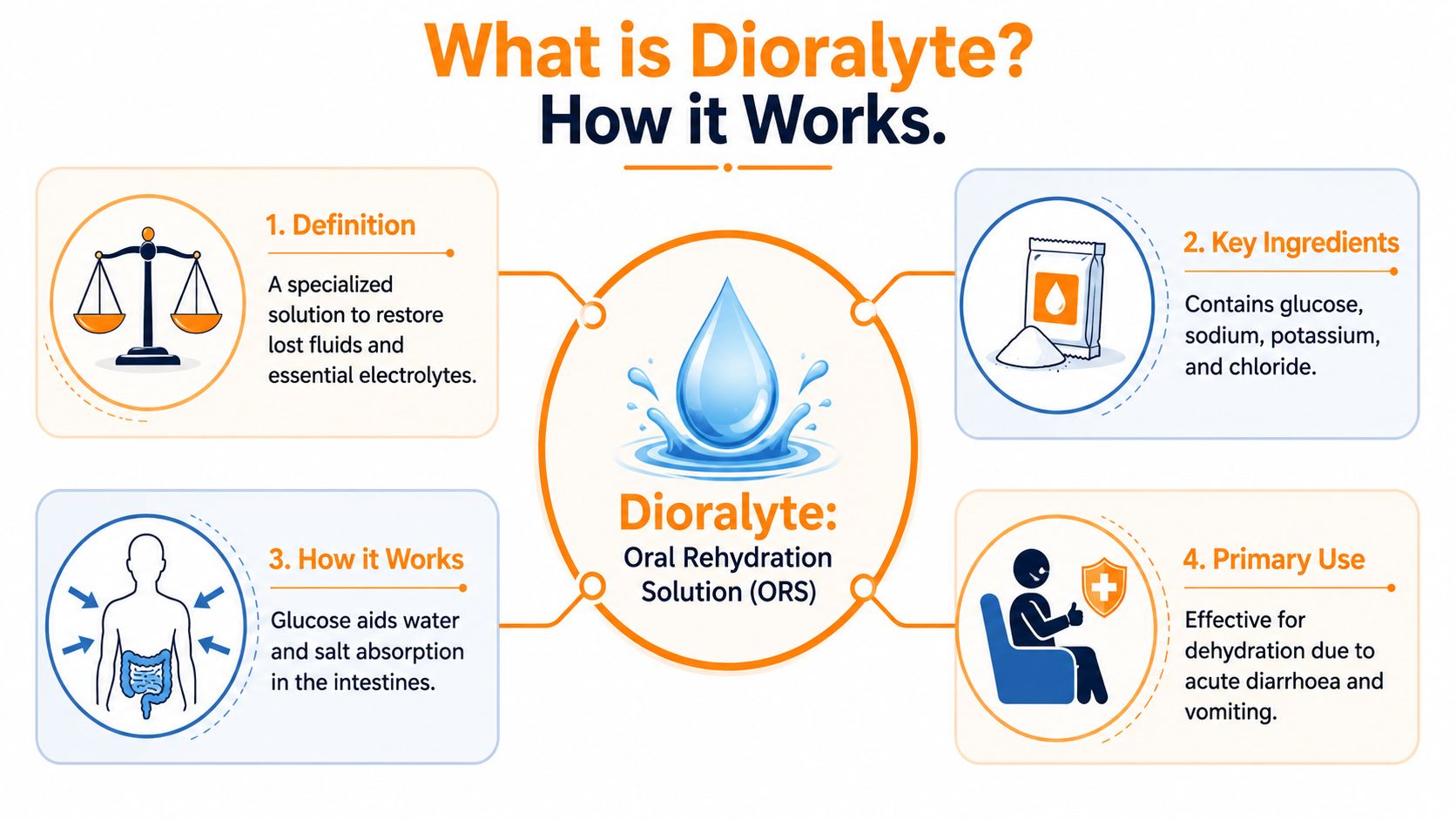
Dioralyte is an oral rehydration solution. That means it’s a powder you mix with water to replace both fluid and electrolytes, which are salts your body needs to work properly [1].
That’s the main point many people miss. It isn’t just flavoured water, and it isn’t the same as a fizzy drink, fruit juice, or a sports drink. It’s made to help the gut absorb water efficiently.
How the ingredients help
Here’s the standard sachet in plain English [1]:
- Glucose 3.56g. Helps your gut pull sodium across the bowel wall.
- Sodium chloride 0.47g. Replaces salt lost through diarrhoea or vomiting.
- Potassium chloride 0.30g. Helps restore potassium, which matters for muscles and nerves.
- Disodium hydrogen citrate 0.53g. Helps correct the acid-base upset that can happen with diarrhoea.
The science sounds fiddly, but the idea is simple. Sodium and glucose move together across the intestinal wall through something called SGLT1. As they move, they create an osmotic gradient that draws water from the gut into the bloodstream [3].
A good way to picture it is a biological battery charger. When illness drains your body, Dioralyte gives it the right mix of parts to recharge fluid balance. Water alone can help thirst, but it doesn’t replace lost salts in the same way.
Pharmacist's tip
If plain water seems to “go straight through you” when you’ve got diarrhoea, an oral rehydration solution often works better because it’s designed for absorption, not just drinking.
Why oral rehydration matters
Oral rehydration therapy, the wider treatment idea behind products like Dioralyte, has had a huge impact on public health. It’s estimated to have saved 70 million lives since its introduction in the late 1970s [6].
In one early cholera emergency in Bangladesh during the 1971 Indo-Pakistani War, use of salt and sugar solutions reduced the case-fatality ratio from 30% to below 4% within months [6]. In controlled cholera trials, an oral glucose-electrolyte solution achieved an 80% reduction in the need for intravenous fluid therapy [6].
Those figures don’t mean every mild tummy bug is dangerous. They do show why pharmacists take rehydration seriously. A small sachet can represent a very well-tested treatment approach.
When you should consider using Dioralyte
Common times it may help
Dioralyte is often associated with diarrhoea. That’s a good starting point, but it’s broader than that. Its indication is for the oral correction of fluid and electrolyte loss [4].
That means it may be useful after:
- A sickness bug with diarrhoea or vomiting
- Flu or a febrile illness when you’ve not eaten or drunk much
- Heavy sweating after exercise or a physically demanding shift
- Travel-related stomach upset
- Periods of poor intake when you feel weak, washed out, or light-headed

If nausea is part of the problem, it also helps to look at practical support for nausea and vomiting treatment options.
Real-life examples
A busy parent might reach for Dioralyte after a child has repeated loose stools and isn’t drinking much. In that case, the goal isn’t to “stop” the diarrhoea instantly. It’s to replace what the body is losing.
A shift worker in a hot kitchen or warehouse may feel drained, headachy, and crampy after sweating for hours. If they’ve lost salts as well as water, an oral rehydration solution can be more useful than plain water alone.
A gym-goer who’s had an intense session and then felt wiped out after a stomach bug might use Dioralyte during recovery. It doesn’t replace rest, but it can support rehydration in a more targeted way.
A wider role in recovery
Many guides stop too early. Dioralyte is mainly known for diarrhoea, but the broader indication matters [4]. Some people with long recovery periods after illness struggle with poor intake, sweating, dizziness, or feeling “depleted” after exertion.
That doesn’t mean everyone with Long COVID or chronic fatigue syndrome should use Dioralyte routinely. It does mean fluid and electrolyte balance can be part of the conversation, especially when symptoms flare after illness, travel, or activity.
A short explainer may help here:
Some patients don’t need “more water”. They need better replacement of water plus salts, especially after illness or heavy fluid loss.
Choosing the right Dioralyte product
Standard Dioralyte or Dioralyte Relief
There are a few versions of Dioralyte in the UK, including different flavours. The practical choice usually comes down to standard Dioralyte versus Dioralyte Relief [1][2].
The key difference is the carbohydrate source. Standard Dioralyte uses glucose. Dioralyte Relief uses 6g of pre-cooked rice powder instead of simple glucose [2].
That matters because rice starch digests more slowly and reduces the osmotic load in the gut. In plain English, it may help reduce the volume of diarrhoea and shorten how long it lasts compared with standard glucose-based solutions [2].
| Feature | Dioralyte (Standard) | Dioralyte Relief |
|---|---|---|
| Main role | Replaces lost fluids and electrolytes | Replaces lost fluids and electrolytes, with added focus on loose stools |
| Carbohydrate source | Glucose | 6g pre-cooked rice powder [2] |
| Why that matters | Supports sodium and water absorption | Slower digestion may reduce osmotic load in the gut [2] |
| Best fit | General rehydration after fluid loss | Loose or frequent watery stools |
| Flavour options mentioned in UK information | Includes blackcurrant, citrus, raspberry, and natural [1] | Available in flavour variants such as blackcurrant in UK product information [2] |
If your main problem is dehydration, standard Dioralyte may be enough. If your main problem is ongoing watery diarrhoea, Dioralyte Relief may be the better fit.
If stools are loose but you’re also trying to add bulk, products such as Fybogel lemon sachets may come up in conversation with a pharmacist, though they serve a different purpose and aren’t a substitute for oral rehydration.
Practical rule: Choose the product based on your main problem. If it’s fluid loss, think rehydration first. If it’s frequent loose stools, Relief may make more sense.
How to prepare and take Dioralyte correctly
How to make it up
This part matters more than people think. Each sachet is designed to be dissolved in exactly 200ml of water [1].
Follow these steps:
- Wash your hands first.
- Measure 200ml of fresh drinking water.
- Empty the whole sachet into the water.
- Stir until dissolved.
- Use it fresh for that dose [1].
Don’t guess the amount of water. If you make it too strong, the salt balance can be wrong. If you make it too weak, it may not work as intended [3].
Also, don’t mix it with juice, squash, fizzy drinks, or extra sugar. That changes the balance.
Pharmacist's tip
If the taste puts you off, chill the water before mixing. Most people find that easier to sip.
Recommended Dioralyte dosage by age
For standard Dioralyte, official UK guidance says [1]:
| Age Group | Recommended Dosage |
|---|---|
| Children aged 2 to 12 years | One sachet after each loose motion [1] |
| Adults and children over 12 years | One or two sachets after each loose motion [1] |
For Dioralyte Relief, UK product information states that children from age 2 take one sachet after every loose motion, and adults take one to two sachets after each loose motion, with a maximum of 5 sachets per day over 3 to 4 days [2].
Small, frequent sips often work better than big gulps, especially if you feel sick. If vomiting is an issue, pause briefly and restart slowly.
If sickness is severe and a prescriber has already advised an anti-sickness medicine, they may also discuss products such as ondansetron 8mg tablets. That won’t replace oral rehydration, but it may make it easier to keep fluids down when clinically appropriate.
Common mistakes to avoid
People often get tripped up by the same few things:
- Using the wrong volume of water. Dioralyte isn’t “close enough” medicine.
- Taking it as a concentrated shot. It must be diluted properly.
- Adding sweeteners or juice. This can change how it works.
- Forgetting fresh preparation. Make it up fresh for each dose [1].
Pharmacist's tip
If you feel nauseous, use a teaspoon or small sips every few minutes rather than trying to drink the full glass quickly.
A simple mini answer:
Can I mix Dioralyte with less water to make it stronger?
No. Each sachet should be mixed with exactly 200ml of water [1].
Safety, side effects, and when to be cautious
Who should check with a prescriber first
Dioralyte is useful, but it isn’t right for everyone. The biggest group to pause and ask first are people at risk of high potassium levels, also called hyperkalaemia.
That includes some people with renal impairment and some people taking medicines such as ACE inhibitors or potassium-sparing diuretics [5]. In those cases, standard oral rehydration solutions may not be the safest option without professional advice.

Other people who should be more careful include:
- People with kidney problems
- People on a potassium or sodium restricted plan
- People with diabetes, because the sachet contains glucose
- People with complex medical conditions where fluid balance needs closer supervision
- Anyone buying for a very young child, especially under age 2, unless they’ve had clinical advice
If vomiting is stopping you from keeping fluids down, don’t just keep trying indefinitely. That’s when pharmacy or medical advice matters. In some cases, a clinician may consider symptom support such as cyclizine 50mg tablets, depending on the person and the cause.
When to seek urgent help
Dioralyte helps with mild to moderate fluid loss. It does not replace proper assessment when someone looks seriously unwell.
Get urgent medical help if you notice:
- Signs of severe dehydration, such as marked drowsiness, confusion, or collapse
- Blood in the stool
- Severe or worsening abdominal pain
- Persistent vomiting so fluids won’t stay down
- A child who seems floppy, unusually sleepy, or hard to wake
- Symptoms that keep worsening instead of settling
Mini answer:
Can Dioralyte cause side effects?
Some people may dislike the taste or feel bloated or sick if they drink it too quickly. The bigger issue is using it in the wrong person or mixing it incorrectly.
How to get Dioralyte in the UK
Where you can buy it
In the UK, Dioralyte is regulated as a pharmacy (P) medicine [1]. That means you can buy it without a prescription, but a pharmacist may ask a few questions to make sure it’s suitable.
You’ll usually find it in:
- High-street pharmacies
- Supermarket pharmacies
- Registered online pharmacies
If you buy from an online pharmacy, use a UK-regulated service. A proper pharmacy checks that the medicine is appropriate and gives you safety advice, rather than treating it like an ordinary retail item.
For readers who prefer remote access, a UK online pharmacy service can make that process easier when you’re unwell and don’t want to leave home.
When a pharmacist or doctor may step in
A pharmacist may recommend Dioralyte when symptoms sound straightforward and short-lived. They may advise seeing a GP or urgent care instead if the story suggests something more serious, such as severe dehydration, prolonged symptoms, or a high-risk medical history.
Some parents ask if a GP can prescribe it. That can happen in certain clinical settings, especially when younger children or more complex cases are involved. However, many adults buy it directly from a pharmacy.
The bigger message is reassuring. Oral rehydration therapy is one of the most important public health advances of modern medicine, and its widespread use has saved millions of lives, particularly in children with dehydration from diarrhoeal disease [6]. In day-to-day UK practice, that same principle still matters. Replace the fluid. Replace the salts. Get help early if the situation doesn’t look right.
Summary
Dioralyte is a UK oral rehydration solution used to replace water and salts lost during illness.
It works because the mix of glucose and electrolytes helps your gut absorb fluid efficiently.
Standard Dioralyte focuses on rehydration, while Dioralyte Relief may help more when stools are very loose.
You must mix each sachet with exactly 200ml of water and follow age-appropriate dosing [1].
It can also have a role after flu, heavy sweating, or poor intake, not just diarrhoea [4].
If you have kidney problems or take medicines that affect potassium, get advice before using it [5].
If someone looks very unwell, don’t rely on sachets alone. Seek medical help.
FAQs
What is Dioralyte used for?
Dioralyte is used for the oral correction of fluid and electrolyte loss [4]. People often use it for diarrhoea, vomiting, or fluid loss after illness. It may also help after sweating heavily or when recovery from illness has left you depleted.
Is Dioralyte better than water?
For simple thirst, water is fine. When you’ve lost both fluid and salts, Dioralyte can be more suitable because it contains a specific balance of glucose and electrolytes [1][3].
Can I use Dioralyte for vomiting?
It may help replace fluid lost through vomiting if you can keep small amounts down. Sip it slowly rather than drinking it quickly. If vomiting keeps happening and you can’t hold fluids, seek medical advice.
What’s the difference between Dioralyte and Dioralyte Relief?
Standard Dioralyte contains glucose. Dioralyte Relief contains 6g of pre-cooked rice powder, which is digested more slowly and may help reduce the volume and duration of diarrhoea [2].
How much water do I mix with a Dioralyte sachet?
Use exactly 200ml of water for each sachet [1]. Don’t make it stronger or weaker. The right dilution is part of how the product works safely.
Can children take Dioralyte?
Yes, according to UK product guidance, children aged 2 to 12 years take one sachet after each loose motion [1]. For younger children, especially under age 2, it’s best to get medical advice first.
Is Dioralyte safe if I have kidney problems?
You should check with a prescriber first. People with renal impairment or those taking ACE inhibitors or potassium-sparing diuretics may be at higher risk of hyperkalaemia with standard oral rehydration solutions [5].
Can I drink Dioralyte after exercise?
It can be useful when exercise has caused notable fluid and electrolyte loss, especially if you also feel unwell or depleted [4]. It isn’t necessary after every routine workout, but it may be helpful in some situations.
Do I need a prescription for Dioralyte in the UK?
Usually not. Dioralyte is a pharmacy medicine in the UK, so you can buy it from a pharmacy without a prescription [1]. A pharmacist may still ask questions to check it’s right for you.
Can I make Dioralyte taste better?
You can chill the water before mixing or sip it slowly. Don’t add juice, sugar, or squash, because that changes the intended balance of the solution.
Meta description
What is Dioralyte? A UK pharmacist explains what Dioralyte is, how it works, when to use it, how to take it safely, and when to seek medical help.
Internal link suggestions
- Nausea and vomiting treatments
- UK online pharmacy service
- Ondansetron 8mg tablets
- Cyclizine 50mg tablets
- Fybogel lemon sachets
Byline and clinical review
Written by: Medical Mojo Editorial Team, UK health writers
Clinically reviewed by: UK Registered Pharmacist
How this content was created
This article was written using UK medicines information and public health sources, then reviewed for clarity, safety, and UK relevance. We used the official product information for Dioralyte and Dioralyte Relief, plus evidence on oral rehydration therapy and pharmacist guidance on safe use in higher-risk patients.
Disclaimer: This article is for information only and isn’t a substitute for personal medical advice. If you’re worried about dehydration, persistent symptoms, or a child who seems unwell, speak to a pharmacist, GP, NHS 111, or urgent care.
If you need help choosing a suitable rehydration product, checking whether Dioralyte is safe with your medicines, or arranging discreet online access to pharmacy care, Courier Pharmacy offers UK-regulated support with pharmacist oversight.
References
[1] electronic Medicines Compendium (emc) (n.d.) Dioralyte Sachets Summary of Product Characteristics. Available at: https://www.medicines.org.uk/emc/product/2773/smpc
[2] electronic Medicines Compendium (emc) (n.d.) Dioralyte Relief Summary of Product Characteristics. Available at: https://www.medicines.org.uk/emc/product/2858/smpc
[3] Biomedicus (n.d.) Dioralyte Relief Blackcurrant Sachets side effects. Available at: https://biomedicus.gr/dioralyte-relief-blackcurrant-sachets-side-effects-2/
[4] Dioralyte (n.d.) Dioralyte family. Available at: https://dioralyte.co.uk/dioralyte-family/
[5] Pharmacy Magazine (n.d.) Oral rehydration. Dioralyte product range. Available at: https://www.pharmacymagazine.co.uk/sponsored-education/oral-rehydration-dioralyte/product-range-806903
[6] Our World in Data (n.d.) Oral rehydration therapy. Available at: https://ourworldindata.org/oral-rehydration-therapy


