What Is Patient Centred Care Explained
Discover what is patient centred care, its principles, benefits and how to find providers who truly put you at the centre of your treatment.
SEO brief
- Primary keyword: what is patient centred care
- Secondary keywords: patient-centred care, person-centred care, shared decision-making, personalised healthcare, NHS patient access
- Search intent: Informational. The reader wants a clear, practical explanation of patient centred care in the UK.
- Target reader: UK adults, carers, and patients managing everyday or long-term health needs
- Product/service mention: Courier Pharmacy, mentioned only in the final CTA
- Internal links available: Assumed from the URLs provided
What is patient centred care
You might be reading this after a rushed GP call, a hospital letter full of jargon, or yet another appointment where you left thinking, “That didn't feel like it was about me at all.” That feeling is common. Many people want good care, but they also want care that fits their life, values, worries, and practical limits.
Patient centred care means healthcare built around you, not just your diagnosis. It treats you as a partner in decisions, not a bystander. In this guide, you'll learn what the term means, how it works in real life, how it differs from older care models, and how to spot whether a provider is doing it well.
Five key takeaways
- It's a partnership: You and your clinician make decisions together.
- Your values matter: Treatment should fit your goals, beliefs, and daily life.
- Good communication changes care: Clear conversations can improve safety and follow-through [3].
- Digital access helps: Record access can support shared decisions and better understanding [2].
- Not every service gets this right: Many patients with complex needs still feel care isn't individualized [4].
Understanding the Key Concepts
A simple way to think about it
Think of healthcare like planning a journey. In an older model, the clinician picks the route, speed, and destination, then tells you to get in the car. In patient centred care, you still get expert guidance, but the route also reflects where you need to go, what obstacles you have, and what matters most to you.
The Institute of Medicine defines patient-centred care as care that is respectful of and responsive to individual patient preferences, needs, and values, ensuring patient values guide all clinical decisions, with principles such as coordination, physical comfort, and access to care [5].
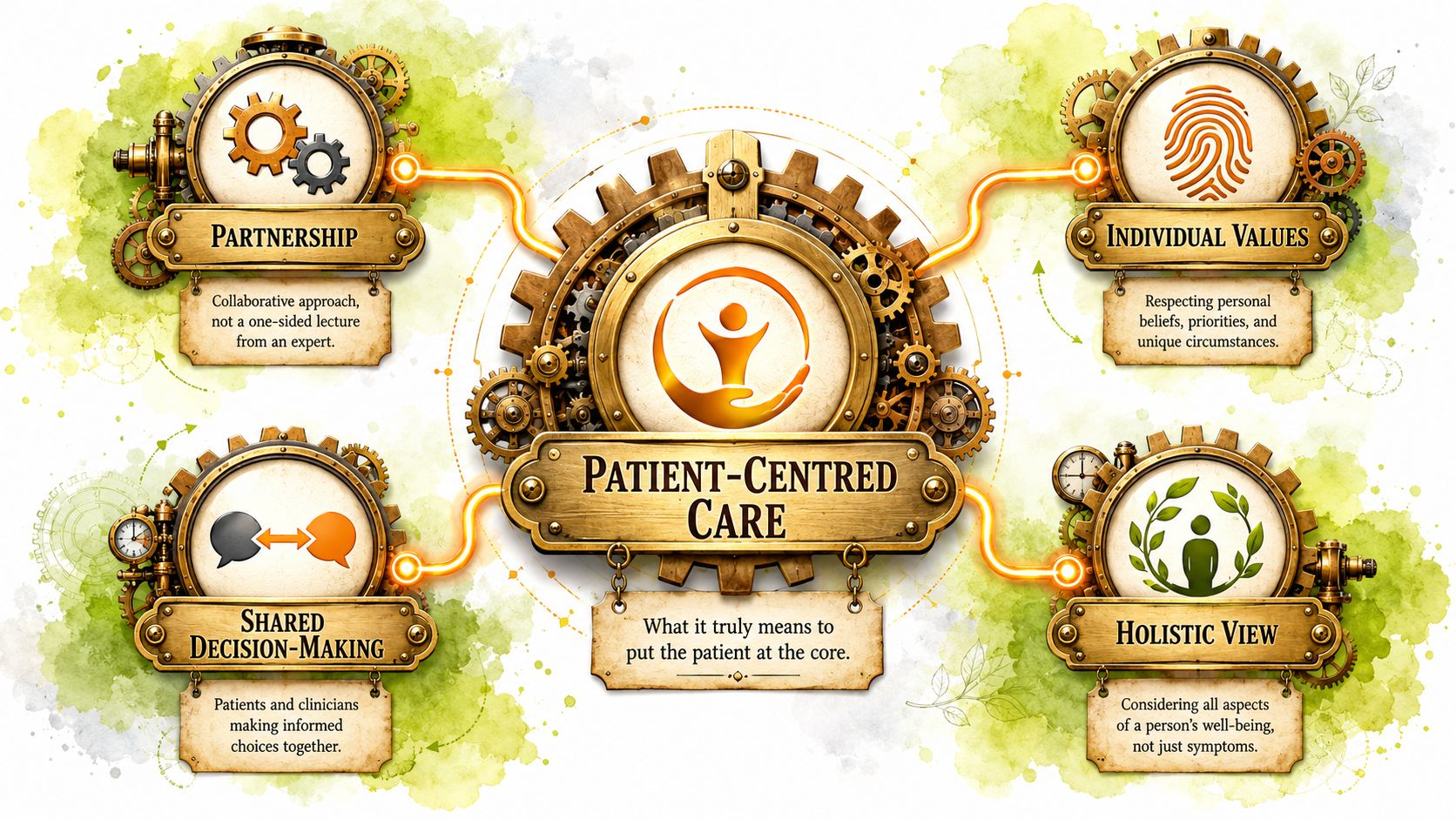
That sounds formal, so let's make it simpler. It means your care shouldn't focus only on test results, symptoms, or a guideline on a screen. It should also take account of your priorities, your comfort, your family life, and what you can realistically manage.
For a background on personalised pharmacy care in the UK, you can see Courier Pharmacy's about page.
The three ideas at the heart of it
Patient centred care is often understood faster when it's broken into three parts:
- Respect: Your worries, beliefs, and preferences count.
- Partnership: You're involved in decisions instead of being talked at.
- Personalized support: The plan fits your life, not an imaginary “average patient”.
Practical rule: If a treatment plan looks good on paper but doesn't fit your real life, it isn't fully patient centred.
A common point of confusion is the phrase “the patient is at the centre.” It doesn't mean you must become your own doctor. It means the clinician brings medical expertise, and you bring lived experience. Both matter.
Another confusion is whether this only applies to serious illness. It doesn't. It matters in everyday care too. Booking appointments, understanding side effects, choosing between options, and getting information in plain English are all part of it.
Core Principles and Benefits
What the core principles look like in practice
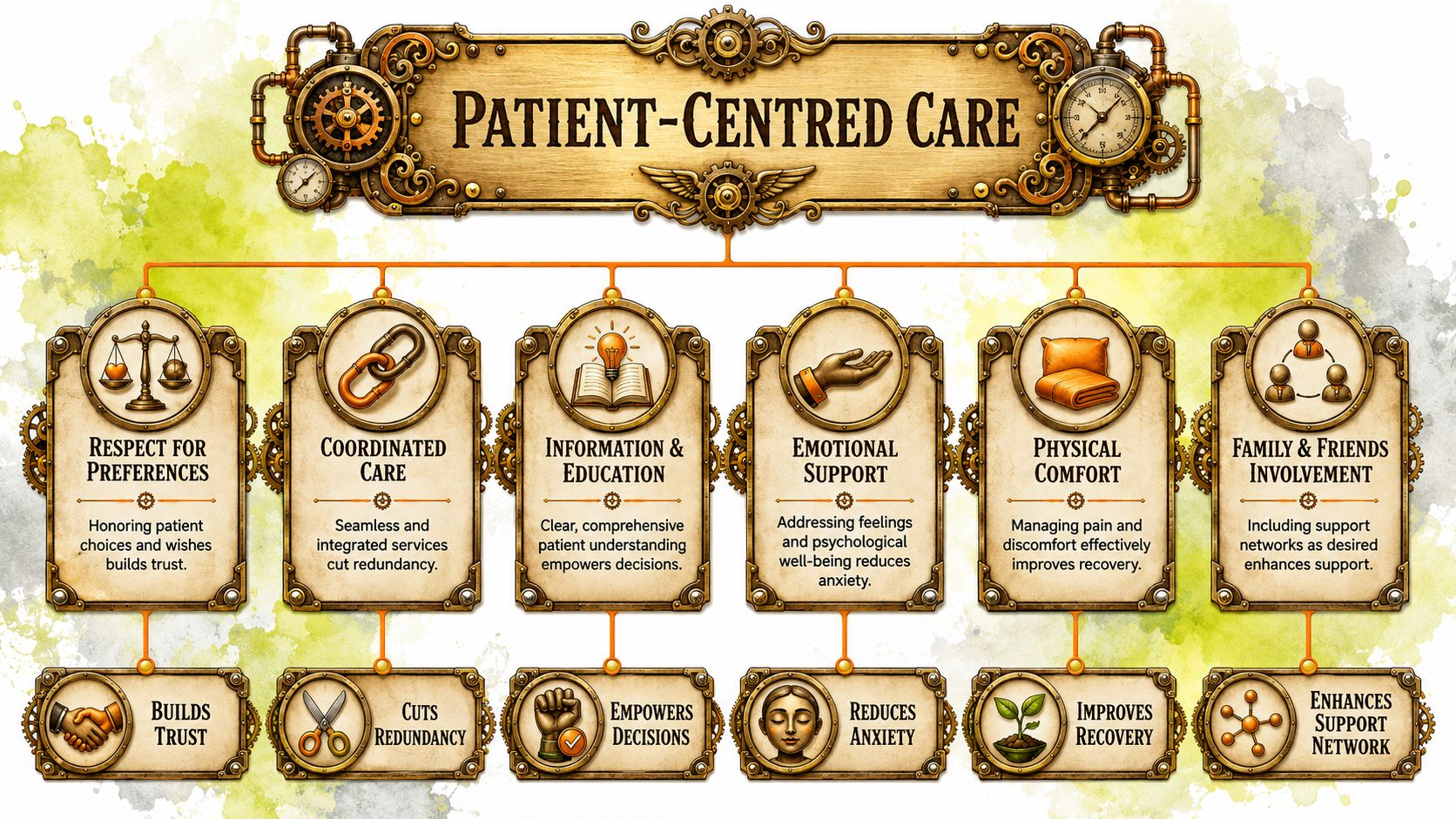
Patient centred care sounds warm and sensible. But it also has concrete parts. In practice, it often includes respect for preferences, clear information, coordinated care, physical comfort, emotional support, and involving family or friends if the patient wants that [5].
Here's what that can look like in ordinary UK care:
- Respect for preferences: A clinician asks what outcome matters most to you.
- Clear information: You get plain-language advice, not unexplained jargon.
- Coordinated care: Different parts of the system share the right information.
- Physical comfort: Pain, sleep, mobility, or side effects aren't brushed aside.
- Emotional support: Fear, embarrassment, and stress are treated as real factors.
- Family involvement: A carer or partner is included if you want support.
By May 2015, 97% of GP surgeries in England offered online access to patients' summary medical records, up from 32% in April 2014, helping more patients take an active role in decisions and understand their care better [2].
For a closer look at how patient data supports care decisions, see patient consultation data information.
Why these benefits matter day to day
When these principles work well, people often feel less lost. They know what the plan is, why it was chosen, and what to do next.
That matters even more for long-term conditions. A British Heart Foundation initiative funded five sites across England and Scotland, leading to over 13,000 people receiving person-centred care over three years, with participants reporting greater confidence in managing long-term conditions [1].
Good care doesn't just tell people what to do. It helps them feel able to do it.
Here, the benefits become practical. A treatment plan you understand is easier to follow. A plan that fits your life is easier to keep up with. A plan shaped with you is more likely to reflect your actual goals.
Pharmacist's tip: If you don't understand why a medicine was chosen, ask, “What's the benefit for me, and what are my options?” That question often opens a much better conversation.
Pharmacist's tip: Ask for key instructions in writing if your appointment felt rushed. That can help if you're tired, stressed, or managing several medicines.
Pharmacist's tip: If side effects would affect work, driving, sleep, or caring duties, say so early. That information can change the best option for you.
Comparing Care Models
How the models differ
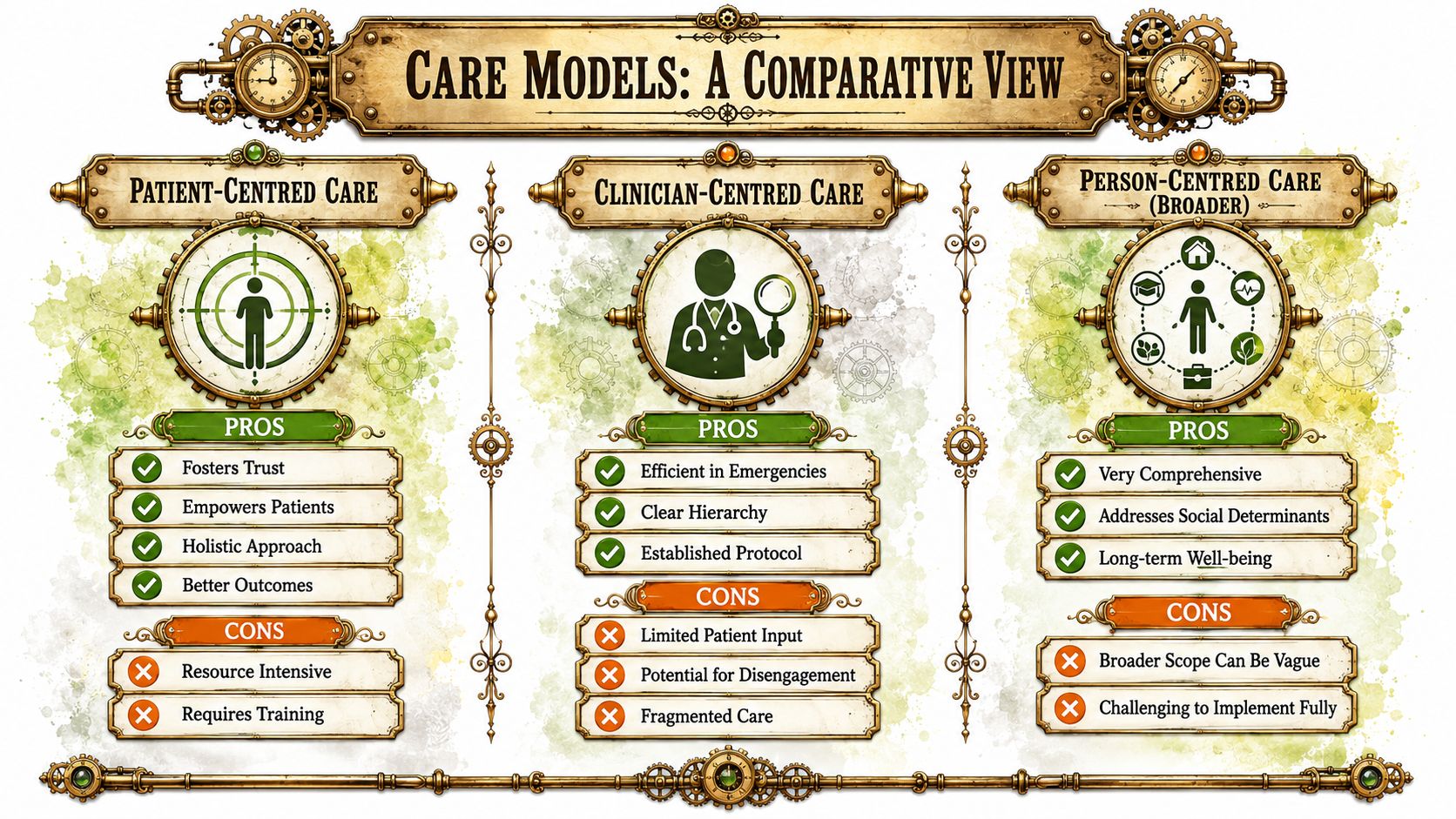
A simple way to separate these models is to ask one question first. What is the consultation built around?
| Model | Main focus | Who drives decisions | Typical experience |
|---|---|---|---|
| Clinician-centred care | Diagnosis and protocol | Mostly the clinician | Efficient, but can feel one-way |
| Patient-centred care | The patient's values, needs, and choices in clinical care | Shared | Collaborative and specific to the patient |
| Person-centred care | The whole person, including social and wider life factors | Shared across broader support | Broader, sometimes less specific in clinical encounters |
Clinician-centred care works a bit like following a fixed route on a sat nav. It can be the right approach when time is short and the medical risk is high. In an emergency, people usually want a confident professional to take the lead quickly.
Outside urgent situations, the picture changes. Many UK patients are not choosing between clearly identical options. They are weighing up side effects, work patterns, caring duties, allergies, swallowing difficulties, previous bad experiences, and whether a standard medicine format is even suitable.
That is where patient-centred care becomes more than a polite conversation. It means the clinician still brings expertise, but the plan is built with the patient, not handed over to them.
Person-centred care goes one step wider. It looks beyond the appointment itself and includes housing, family support, mental wellbeing, daily routine, and other factors that shape health. That broader view matters, but it does not always solve a practical prescribing problem inside a consultation.
The gap often shows up most clearly with bespoke medication needs. A service may say it is personalised, yet still offer only standard strengths, standard formats, and standard pathways. For patients who need unusual doses, allergy-aware ingredients, or a medicine made in a different form, how compounding pharmacy supports bespoke prescriptions helps explain why individual care sometimes needs specialist dispensing as well as a good consultation.
Why the distinction matters
The difference is not academic. It affects what happens when your needs do not fit the default option.
In a clinician-centred appointment, the conversation may stay close to guideline first, patient second. In a patient-centred appointment, the clinician still uses the guideline, but also asks how the treatment will work in your actual life. That can change the final choice, the dose form, the timing, and the support offered after prescribing.
A helpful way to picture it is this. Clinician-centred care asks, “What is usually prescribed for this condition?” Patient-centred care asks, “What is appropriate for this condition and workable for this person?”
That distinction matters a great deal in digital care too. An online service is not patient-centred solely because it is convenient. It becomes patient-centred when digital prescribing is paired with proper clinical review, clear questions, and options that reflect the patient's circumstances, including cases where standard medicines are not the best fit. That is one reason Courier Pharmacy's model stands out. It combines digital prescribing with specialist compounding, so personalisation can continue beyond the consultation and into the medicine itself.
A short explainer can help make the difference clearer:
If your dose, formulation, or ingredient requirements fall outside the usual options, truly patient-centred care should change the prescription process, not just the wording around it.
Practical Examples and Patient Journeys
A busy parent with asthma
A busy parent in Derby manages asthma while juggling school runs, work, and a child who also seems to catch every bug going. Their biggest problem isn't only symptoms. It's time. They miss routine reviews because appointments clash with pickup times, and they sometimes delay asking for help until symptoms flare.
A patient-centred approach would start by asking what gets in the way. Maybe the issue is timing, confidence with inhaler use, or confusion over preventer versus reliever medicines. Once that's clear, the plan can fit real life better.
That same kind of thinking also shapes digital care pathways. A secure online questionnaire, review by a human prescriber, and clear follow-up can suit someone who can't easily take daytime calls. For an example of how this process can work, see how ordering treatment works and why you might not get a call.
A shift worker with migraine
Now take a shift worker with migraine. Night shifts, rotating meals, poor sleep, and bright warehouse lighting all affect symptoms. A standard conversation might focus only on which medicine to take. A patient-centred conversation asks when attacks happen, what side effects would make shifts unsafe, and whether the person can follow the plan at work.
That can change everything. A medicine that causes drowsiness may be a poor fit for driving home. A treatment that works well but needs rigid timing may be hard to use on changing shifts. The “best” option on paper may not be the best option for that person.
This matters even more for people who need bespoke medication, special formulations, or alternative testing methods because of allergies, intolerances, or needle phobia. Patient centred care isn't just about being listened to. It's about building a plan you can live with.
Featured snippet answer
What does patient centred care look like in daily life?
It looks like care that fits your work, family life, symptoms, values, and practical limits. You're involved in decisions and you understand the plan.
Evaluating Patient Centred Providers
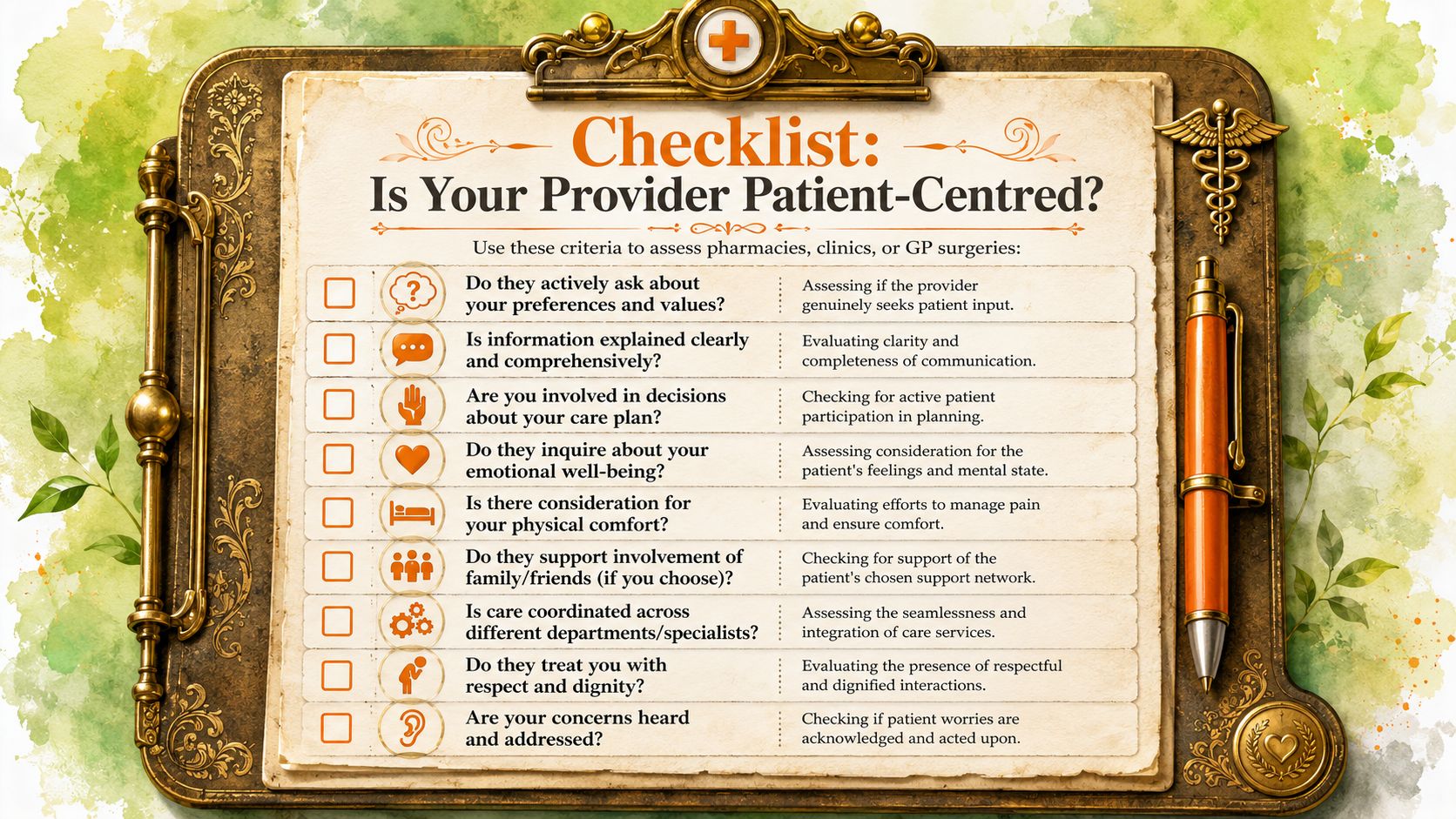
A provider can be friendly, fast, and easy to access, yet still miss what matters to you. Patient centred care goes further. It checks whether the plan works in real life, not just in theory.
That difference often shows up when care is less straightforward. A standard service may cope well with common requests, but struggle if you need a different strength, an ingredient-free formulation, extra prescriber review, or a medicine made to suit allergies, intolerances, or swallowing difficulties. This is one of the clearest gaps in patient centred care. Saying care is personal is one thing. Building a treatment plan around the actual medicine you can use is another.
For many UK patients, this now includes digital care. A good UK online pharmacy service should do more than process an order. It should gather the right information, involve a qualified prescriber where needed, explain options clearly, and make room for more specialist needs such as bespoke medication and compounding.
Questions worth asking
Use these questions like a checklist before you choose a clinic, GP service, or pharmacy:
- Do they ask about your daily reality? This includes work, caring responsibilities, routines, and what you can realistically manage.
- Do they explain choices in plain English? You should come away knowing what each option is for, what may go wrong, and what happens next.
- Can they handle more complex medication needs? Ask how they deal with allergies, ingredient restrictions, unusual doses, or formulations that need to be specially prepared.
- Is there a clear prescribing process? You should know who reviews your information and when a clinician steps in.
- Do they offer follow-up or a route for questions? Good care should not stop the moment payment is taken or treatment is issued.
- Do they keep information joined up? Clear records and sensible communication reduce errors and repetition.
A simple way to judge this is to listen for the kind of questions they ask. A provider focused only on speed may ask, “What do you want?” A patient centred provider is more likely to ask, “What are you trying to manage, what has or has not worked before, and what might make this hard for you to use?”
Evaluation criteria for patient centred providers
| Criteria | What to Look For |
|---|---|
| Listening | They ask about your concerns, goals, and preferences |
| Clarity | Advice is easy to understand, with no unexplained jargon |
| Choice | You're offered options where appropriate |
| Fit | Plans reflect allergies, routines, beliefs, and practical barriers |
| Follow-up | There's a clear route for questions or review |
| Comfort and dignity | You feel respected, not rushed or dismissed |
| Coordination | Records, results, and plans are shared sensibly |
| Support network | Family or carers can be included if you want |
One useful analogy is a pair of shoes. Two pairs may be the same size on the label, but only one fits properly once you walk in it. Healthcare works in much the same way. A treatment can look right on paper and still be wrong for your body, schedule, or medication needs.
That matters even more for patients who fall outside the “standard pack” approach. Courier Pharmacy's mix of digital prescribing and specialist compounding is a good example of what better implementation can look like. The prescriber review happens online, but the care does not stop at a standard product list. If a patient needs a medicine prepared in a more suitable form, the service can address that gap rather than forcing the patient into an option that is unsuitable from the start.
Ask yourself: did this provider understand what would make treatment usable for me, including the medicine itself, or did they expect me to fit around their system?
Pharmacist's tip: Before an appointment or online consultation, write down four things. Your main goal. Your top worry. Your current medicines. Any ingredient, dose, or formulation problems you have had before. That gives the clinician a clearer starting point.
Featured snippet answer
How can I tell if a provider is patient centred?
They listen, explain choices clearly, involve you in decisions, and check whether the medicine and plan suit your health needs, routine, and practical limits. If they ignore those details, care is less likely to work well for you.
Conclusion and Next Steps
Patient centred care is simple in theory but powerful in practice. It means care should respect your values, fit your life, and involve you in decisions. It doesn't replace professional expertise. It adds your expertise about your own body, priorities, and day-to-day reality.
If you want more of this kind of care, start small. Take your questions to your next appointment. Ask what your options are. Tell the clinician what matters most to you, whether that's fewer side effects, easier routines, less pain, or a formulation you can use.
Three practical next steps can help:
- Ask for joined-up information: Check whether you can access your records and results.
- State your preferences clearly: Say what you can and can't manage.
- Choose providers carefully: Look for flexibility, follow-up, and respect for complex needs.
This article is for information only and isn't a substitute for personal medical advice. If your symptoms worsen suddenly, you feel seriously unwell, or you think you're having a medical emergency, seek urgent help through NHS services straight away.
FAQs
What is patient centred care in one sentence?
It's healthcare that respects your preferences, needs, and values, and uses them to guide decisions about your care [5].
Is patient centred care the same as person-centred care?
Not quite. They overlap, but person-centred care is often broader and may include social and life factors beyond the immediate clinical setting. Patient-centred care usually focuses more closely on the healthcare relationship and decisions.
Does patient centred care still work in emergencies?
Yes, but it looks different. In a true emergency, clinicians may need to act fast. Even then, good teams still explain what they can, involve families where possible, and respect the patient's values when known.
Can I ask for more involvement in decisions at my GP surgery?
Yes. You can ask about options, benefits, side effects, and what happens if you wait or choose differently. You can also ask for written information or a follow-up discussion if you need time to think.
What should I do if I feel unheard?
Start by stating your main concern clearly and briefly. If that doesn't help, ask for another appointment, a second opinion, or support from a carer or advocate. Keeping notes can help you explain patterns and concerns.
Why does record access matter?
When you can see your results, medicines, and care plan, it's easier to spot errors, ask better questions, and understand what's happening [2]. That supports safer, more shared care.
Does patient centred care matter for medicines?
Very much. The right medicine on paper may still be wrong for your routine, allergies, side effects, or ability to take it. Good prescribing takes those factors seriously.
What if I need a bespoke or compounded medicine? That's one of the clearest tests of whether care is really customized. If standard options don't meet your needs, a patient-centred provider should at least discuss suitable alternatives and safe next steps.
Can family or carers be involved?
Yes, if you want them involved. Many people find it helpful to have someone else listen, ask questions, or help with practical follow-through.
When should I seek urgent help instead of waiting for routine care?
Seek urgent help if you have severe breathing problems, chest pain, signs of stroke, severe allergic reactions, sudden confusion, or any rapidly worsening symptom that feels dangerous. Use NHS urgent or emergency services as appropriate.
Summary
Patient centred care means your healthcare should fit you, not just your diagnosis.
It relies on respect, partnership, and plans that make sense in real life.
In the UK, policy supports this approach, but many patients still don't feel fully heard [2][4].
Good patient centred care improves communication, supports better decisions, and can improve safety [3].
You can spot it by how well a provider listens, explains, tailors, and follows up.
If you need bespoke medicines or non-standard support, this approach matters even more.
You deserve care that treats you like a person, not a problem to process.
Meta description
What is patient centred care? Learn what it means, how it works in the UK, and how to spot care that fits your needs and values.
Internal links to suggest
- About Courier Pharmacy
- Patient consultation data
- What is compounding pharmacy
- How ordering treatment works
- Online pharmacy UK
Visual guidance
Concept map of patient centred care Alt text: Steampunk-style concept map showing patient-centred care at the centre with partnership, individual values, shared decision-making, and whole-person perspective branching out.
Benefits infographic
Alt text: Brass-plaque infographic showing core parts of patient-centred care and matching benefits such as trust, reduced anxiety, and better support.Care model comparison chart
Alt text: Comparison chart of patient-centred, clinician-centred, and person-centred care with key pros and cons in a lime green and brass design.Provider checklist graphic
Alt text: Ornate clipboard checklist helping patients assess whether a clinic, GP surgery, or pharmacy is patient-centred.
Byline
Written by Medical Mojo Editorial Team
Clinical review
Clinically reviewed by a UK-registered pharmacist
How this content was created
This article was written using the verified source material listed below, with a focus on UK-relevant patient education, plain-English explanations, and editorial review for clarity, balance, and safety.
References
[1] British Heart Foundation. (n.d.) Person-centred care. Available at: https://www.bhf.org.uk/informationsupport/support/person-centred-care
[2] de Lusignan, S. et al. (2019) How can we make person-centred care a reality?. Available at: https://pmc.ncbi.nlm.nih.gov/articles/PMC6465833/
[3] UK Government. (n.d.) Data strategy to support delivery of patient-centred care. Available at: https://www.gov.uk/government/news/data-strategy-to-support-delivery-of-patient-centred-care
[4] Picker. (n.d.) New report reveals state of person-centred care in NHS England. Available at: https://www.picker.org/research-library/new-report-reveals-state-person-centred-care-nhs-england
[5] Oneview Healthcare. (n.d.) Eight principles of patient-centered care. Available at: https://www.oneviewhealthcare.com/blog/eight-principles-patient-centered-care/
If you need treatment that fits around real life, Courier Pharmacy offers a UK-regulated online route to prescription medicines, testing, and specialist compounding, with human prescriber review and support for people whose needs don't fit standard boxes.


